 Book Call with Haroon
A business’s success depends a lot on Customer Acquisition Cost (CAC). This means how much money a company spends to get one customer. When CAC is low and the Customer Lifetime Value (CLV) is high, the business is in a strong position. Experts say the best balance is when CLV is three times higher than CAC.
Today, many markets are crowded, so reducing costs is more important than ever. For example, Bumble tested different video ideas and increased how long people watched their TikTok ads by 30%.
One smart way to lower costs is retargeting. This means advertising to people who already know the brand. These users are more likely to buy and usually cost less to reach. Testing different marketing ideas is not just about ads; it helps businesses make more money.
In this article, you’ll find eight simple experiments that businesses can try. You’ll learn how to reduce CAC, set them up, and grow the ones that work best. These ideas can help any business, whether it’s a new tech startup or a company that has been around for many years, use its money wisely and stay ahead of competitors.
What is Customer Acquisition Cost (CAC)?
CAC shows how much money a business spends to turn a potential buyer into a paying customer. The calculation takes all marketing, advertising, and sales investments and divides them by the number of customers gained in a specific time period.
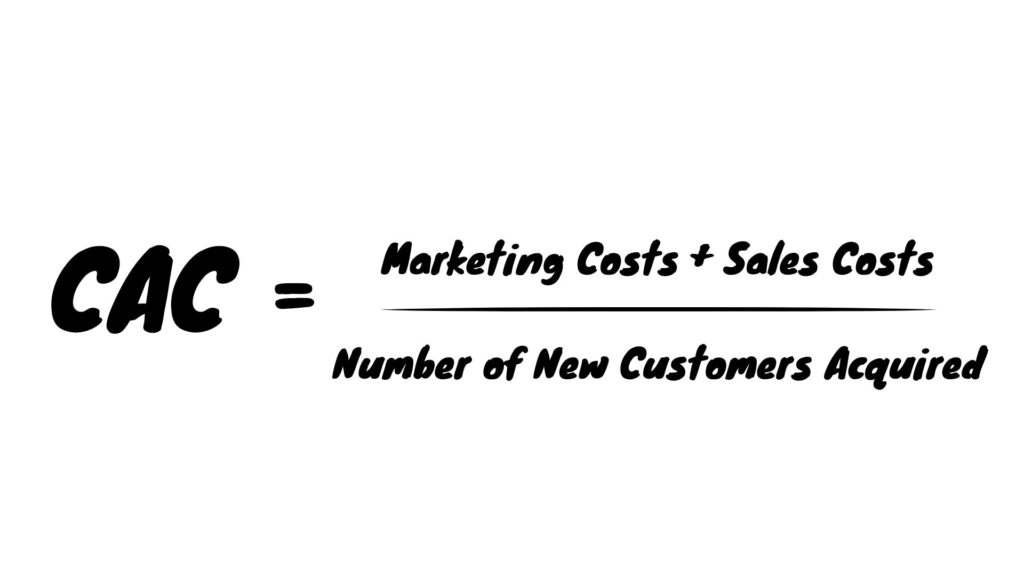
Companies often miss the true cost of acquiring customers because they don’t count indirect expenses. The total costs should include:
- Sales and marketing team salaries
- Marketing software subscriptions
- Professional services (designers, consultants)
- Content production costs
- Administrative overhead tied to acquisition
Why performance experiments matter for CAC optimization?
The riskiest move in today’s competitive digital world is waiting for the perfect marketing plan. Performance experiments help you learn what appeals to your audience while keeping financial risks low.
Small tweaks can lead to amazing results. To cite an instance, Bing’s engineering team tested a small change in ad headline displays that boosted revenue by 12% – this later generated over $100 million yearly revenue.
Evidence replaces guesswork through controlled experiments. Your team can:
- Test ideas with minimal spending
- Start small and grow with live data
- Find hidden opportunities
- Expand successful strategies and drop failing ones
Common CAC challenges in SaaS and B2B startups
The median CAC payback period for B2B SaaS companies jumped from 14 months in 2023 to 18 months in 2024, a dramatic 29% increase. This shows growing problems in go-to-market strategies.
SaaS startups face these key challenges:
- Rising acquisition costs: Customer acquisition costs have risen 40-60% since 2023. B2B Google Ads campaigns now cost $802 per customer acquired.
- Channel saturation: Traditional digital channels are packed with competition, making it tough to get noticed. Companies need fresh approaches to find customers.
- Extended sales cycles: B2B sales need multiple stakeholders and longer decision times, which drives costs up. Enterprise B2B SaaS CAC ranges from $300 to over $14,000 based on industry.
B2B SaaS companies need sales teams and product demonstrations that raise CAC substantially, unlike B2C companies that can use self-serve channels.
How to Reduce CAC while Setting Up Performance Experiments
You need careful preparation to make your CAC reduction experiments work and get good results. Here’s how to reduce CAC and build a well-laid-out testing approach that will give you reliable answers.
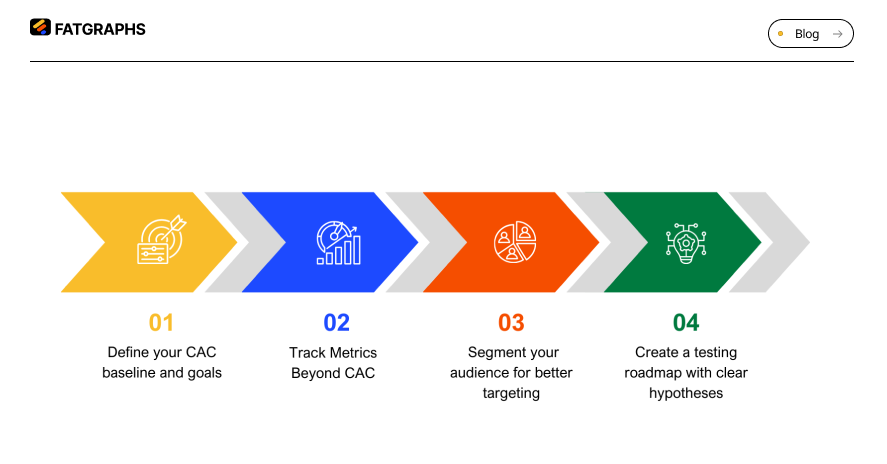
1- Define your CAC baseline and goals
Your first step is to build an accurate CAC calculation system that has all acquisition-related expenses, not just direct advertising costs. Your CAC baseline should count:
- Marketing and advertising spend
- Sales team’s salaries and commissions
- Technology costs (CRM, marketing automation)
- Content creation expenses
- Administrative overhead tied to acquisition
Your CAC targets should match industry standards and your business model. SaaS businesses should target a CAC payback period of 12 months or less and keep an LTV: CAC ratio of 3:1.
2- Choose the right metrics to track
Look beyond simple CAC numbers to learn more about:
- CAC by channel (organic search vs. paid social)
- CAC: LTV ratio to check profitability
- Conversion rates at key funnel stages
- CAC payback period
Regular tracking of these metrics helps you spot worrying patterns early and see how well your improvements are working. On top of that, it helps to analyze your funnel to find conversion drop-offs where changes could cut acquisition costs by a lot.
3- Segment your audience for better targeting
Your sales and marketing data will show you high-value customer segments that give better returns on acquisition spend. Put your focus on customers who bring higher lifetime value compared to their acquisition cost. Sometimes, spending more to acquire a customer makes sense if they bring greater LTV.
4- Create a testing roadmap with clear hypotheses
Build a well-laid-out testing roadmap that puts experiments in order based on their possible impact. Your roadmap should list:
- Test hypotheses in order of priority
- Timeline that prevents test overlaps
- Who owns each experiment
- How it connects to business goals
Each test needs specific hypotheses written like this: “Based on [insight], we believe [change] will result in [outcome] for [user segment]”. This way, every experiment ties directly to your CAC reduction goals.
How to Reduce CAC? 8 Performance Experiments
You don’t need a complete overhaul to boost your customer acquisition. The key lies in testing elements that affect conversion. These eight experiments will help you optimize your acquisition strategy and lower your costs.
1. A/B test landing page headlines and CTAs
Landing page optimization can boost conversion rates without increasing ad spend. You should test different headline approaches, benefit-focused versus feature-focused, questions versus statements, or customized versus general messaging. Your CTAs need testing with button placement (above or below the fold), color contrast, and action-oriented language like “Get Started” instead of “Buy Now”.
2. Experiment with ad creatives and formats
Many overlook creative testing, yet it can reduce costs by 20-40%. Instead of crafting one perfect ad, create various formats such as:
- Static ads: testimonials, before/after comparisons, statistics grids
- Video formats: tutorials, founder stories, myth-busting content
Facebook ads with user-generated content achieve a 300% higher click-through rate and 50% lower cost per acquisition.
3. Test different audience targeting strategies
Good targeting comes from understanding why people choose your product. Look beyond simple demographics and segment your audience based on specific use cases and pain points. Loop earplugs showed this by creating targeted campaigns for different groups: parents who want quiet, office workers avoiding distractions, and festival-goers protecting their hearing.
4. Try new acquisition channels (e.g., Reddit, Quora)
Some channels generate interest but never turn into revenue. You should try alternative platforms where competitors might be less active. Research shows that testing emerging channels helps you avoid the rising costs of saturated platforms while finding more affordable acquisition opportunities.
5. Personalize content by funnel stage
Your content should match where prospects are in their experience. Educational content and clear messaging through A/B testing work best for the awareness stage. Detailed case studies, comparison guides, or interactive demos support research processes during consideration. This approach delivers the right message at the right time and increases relevance.
6. Use retargeting with UGC or testimonials
Combining retargeting campaigns with user-generated content works great for re-engaging visitors. Adding authentic reviews or product demonstrations helps address doubts for abandoned carts. Research shows people respond better to ads with real-life experiences than polished brand-created content, making this an effective way to lower acquisition costs.
7. Test pricing page layouts and offers
Your pricing page plays a crucial role in conversion decisions. Data shows simple options often work better than complex ones, even if tiers don’t fit every customer perfectly. Try emphasizing different plans: the middle option, the most expensive one (creating a price anchoring effect), or the plan with the least friction.
8. Run email drip experiments for lead nurturing
Set up automated email sequences that trigger specific actions like downloading resources or signing up for webinars. Try different content types, timing intervals, and personalization strategies. Well-laid-out drip campaigns move “warmed up” leads further into the sales cycle without constant oversight from salespeople, which reduces conversion costs.
9- Analyzing Results and Scaling What Works
The right analysis of your CAC reduction experiment results is a vital step toward success. You need accurate interpretation, proper tools, and smart decision-making to optimize your results.
How to interpret CAC changes from experiments
You should track multiple metrics at once to understand CAC changes. Here’s how to break down your analysis:
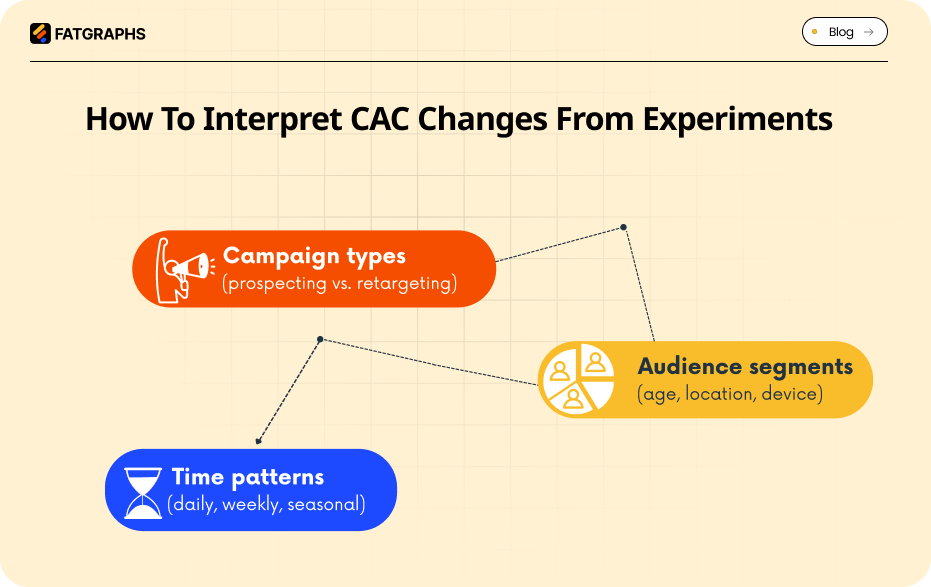
- Campaign types (prospecting vs. retargeting)
- Audience segments (age, location, device)
- Time patterns (daily, weekly, seasonal)
- Placement performance (Facebook Feed achieves USD 20.35 average CAC compared to USD 150.90 for Messenger Inbox)
A 25% CAC spike usually has a reason behind it. Look for signs of ad fatigue, mismatched creatives, or saturated audiences.
Tools to track and visualize CAC performance
Meta Ads Manager works as your main dashboard to track CAC and related metrics. You can create custom reports that break down performance by campaign, ad set, and creative elements. The data accuracy improves with server-side tracking through Meta’s Conversions API, which helps especially after iOS privacy updates.
You should combine Google Analytics or e-commerce dashboards to confirm platform data. A detailed monitoring system needs your CRM, billing platform, and marketing analytics tools to work together.
When to scale and when to pivot
The best way to scale success is through two-week sprints that limit experiment size. Top teams can deliver 10-30 experiments in each sprint.
You should consider a pivot if your data shows:
- Creative fatigue hurts performance
- Current strategies yield fewer returns
- Unexpected patterns need new approaches
Avoiding false positives and experiment fatigue
Your experiment’s integrity depends on solid hypothesis testing. You need clear questions about:
- Problem definition
- Core beliefs
- Supporting evidence
- Success metrics with current baselines
A post-mortem review two weeks after experiments helps assess your baseline estimates’ accuracy and document key learnings. This careful approach stops wrong data interpretation from causing unnecessary changes.
Conclusion
Systematic performance experiments on how to reduce CAC costs are now essential for business success. This piece shows how well-executed experiments can positively affect your bottom line and create lasting growth opportunities for your business.
Your path to effective CAC reduction begins with accurate baselines. You can then use the eight experimental approaches we discussed, from landing page optimization to email drip campaigns, to find what works best for your unique business model.
These experiments each play a specific role. A/B testing headlines helps improve conversion rates, while refined audience targeting ensures your marketing budget reaches ideal customers. It also helps to diversify channels, which lets you avoid saturated platforms where costs keep rising.
The rewards substantially outweigh the effort needed for these experiments. Research shows companies that regularly test and optimize achieve 20-40% lower acquisition costs compared to those who rely on gut feelings alone.
CAC reduction works best as an ongoing process, not a one-time project. Markets change, customer priorities shift, and competition grows fiercer. Regular testing helps you be proactive and improve your acquisition efficiency continuously.
Pick 2-3 experiments from this piece that match your biggest CAC challenges. Begin with small tests, measure results carefully, and expand what works. This systematic approach will turn your acquisition strategy from a cost center into a reliable growth engine that beats your competition.
FAQs
Q1. How to reduce CAC with some effective ways?
How to Reduce CAC? Focus on optimizing landing pages, experimenting with ad creatives, refining audience targeting, and personalizing content for different funnel stages. Additionally, implement retargeting campaigns with user-generated content and test various pricing page layouts and offers.
Q2. How can performance experiments help in lowering CAC?
Performance experiments provide a structured approach to discovering what resonates with your audience while minimizing financial risk. They allow you to test early with minimal investment, launch small and improve based on real-time data, uncover new opportunities, and scale what works while abandoning what doesn’t.
Q3. What metrics should I track besides CAC to get a comprehensive view of acquisition performance?
In addition to CAC, monitor metrics such as CAC by channel, CAC: LTV ratio, conversion rates at key funnel stages, and CAC payback period. These metrics provide deeper insights into your acquisition strategy’s effectiveness and profitability.
Q4. How often should I run performance experiments to optimize CAC?
Approach CAC reduction as an ongoing process rather than a one-time project. Implement regular testing schedules, such as two-week sprints, to stay ahead of market shifts and continuously improve acquisition efficiency. Successful teams typically ship between 10 and 30 experiments per sprint.
Q5. What tools can I use to track and visualize CAC performance?
Use Meta Ads Manager as your primary dashboard for tracking CAC and related metrics. Integrate Google Analytics or e-commerce dashboards to validate platform data. For comprehensive monitoring, connect your CRM, billing platform, and marketing analytics tools to get a holistic view of your CAC performance.