
 Book Call with Haroon
SaaS customer acquisition costs have increased by 70% over the last five years. As markets become more saturated, experts now predict these costs could double by 2026. At the same time, top-performing SaaS companies manage to keep their SaaS acquisition costs at around 30% of customer lifetime value. Meanwhile, many other companies see their margins shrink with every new customer they acquire.
The difference comes down to having a strategic, evidence-based approach to finding, converting, and retaining the right users. SaaS marketing strategies must evolve beyond traditional methods, as competition intensifies. Understanding the SaaS acquisition engine and customer acquisition cost benchmarks will be critical for driving sustainable growth.
What is SaaS Customer Acquisition?
SaaS customer acquisition is the process of attracting, converting, and retaining users through channels like SEO, paid ads, outbound, and product-led growth. In 2026, successful SaaS companies focus on reducing CAC, improving LTV, and maintaining a 3:1 or higher LTV: CAC ratio.
What makes SaaS acquisition different?
Traditional businesses typically focus on 1-time purchases. SaaS companies rely on recurring revenue. This fundamental difference changes acquisition from a quick transaction into a long-term relationship. Because of this, SaaS companies must evaluate acquisition costs across the entire customer lifecycle, not just the first sale.
For example, entertainment SaaS companies spend about $612 per customer, while medical technology firms invest closer to $3,662. Your target audience also has a major impact on acquisition costs, so acquisition strategies must be tailored to your specific business model and target market.
What are the 3 Phases in SaaS Customer Acquisition
SaaS customer acquisition is found in 3 phases, and each phase requires different tactics and performance metrics.
1- Lead Generation
This initial phase focuses on building awareness among potential customers. Channel performance varies widely. Organic search (SEO) delivers leads at an average cost of $508 per acquisition, while account-based marketing (ABM) can cost approximately $4,084 per customer.
2- Lead Nurturing
During the nurturing phase, prospects begin engaging more deeply with your brand. This is where you guide them through your SaaS marketing funnel. Industry benchmarks show visitor-to-lead conversion rates ranging from 1.1% in Real Estate SaaS to 2.1% in Industrial and Retail SaaS.
3- Sales
In the final phase, qualified leads interact directly with your sales team and show clear purchase intent. At this stage, opportunity-to-closed-deal conversion rates typically range between 35% and 48%, depending on the industry. Each phase requires its own set of metrics. On average, lead-to-MQL conversion rates range from 37–48%, while MQL-to-SQL conversion rates usually fall between 35–43%.
Source: FirstPageSage
What is SaaS customer acquisition cost (CAC)?
Customer acquisition cost represents how much a company spends on sales and marketing to acquire a single customer. A complete CAC calculation includes salaries, software tools, outsourced services, and overhead costs. While more complex, this approach provides a more accurate view, especially when calculated quarterly or annually. The basic formula is straightforward:

Most SaaS companies report CAC figures between $500 and $1,000, though actual numbers depend on factors like business model, audience, and acquisition channels. When CAC rises due to specific activities, it’s a signal to reassess your strategy. Reduce investment in underperforming channels and double down on those that consistently deliver results.
Source: Wearefounders
How Do SaaS Companies Measure CAC and Customer Lifetime Value?
Successful SaaS companies rely on data, not assumptions. To build an effective acquisition strategy in 2026, you must understand the metrics that measure both efficiency and profitability.
1- Understanding customer lifetime value (LTV)
Customer lifetime value represents the total gross profit a customer generates over the duration of their relationship with your business.
For example, if a customer makes two $500 purchases per year and stays for three years, their lifetime value would be $3,000.
Low LTV often points to underlying issues such as ineffective pricing, poor onboarding, weak product-market fit, or inadequate customer success efforts. Improving LTV starts with acquiring the right customers and building an acquisition pipeline that aligns with their needs and expectations.
2- The LTV: CAC ratio and why it matters
The LTV: CAC ratio answers one critical question. Does the value generated by customers exceed the cost of acquiring them? Industry experts generally recommend a minimum ratio of 3:1, which means customers should generate at least 3 times more value than their acquisition cost. Benchmarks vary by industry, based on data from 46 SaaS companies between 2021 and 2025:
| SaaS Industry | LTV: CAC |
| Adtech | 7:1 |
| Entertainment | 6:1 |
| Business Services | 3:1 |
| Fintech | 5:1 |
| Cybersecurity | 5:1 |
| Industrial | 3:1 |
| Design | 6:1 |
| Medtech | 4:1 |
| Edtech | 5:1 |
| Pharmaceutical | 4:1 |
A higher ratio indicates efficient acquisition and strong retention. A lower ratio signals overspending or poor customer quality.
Source: FirstPageSage
Which Customer Acquisition Channels Work Best for SaaS?
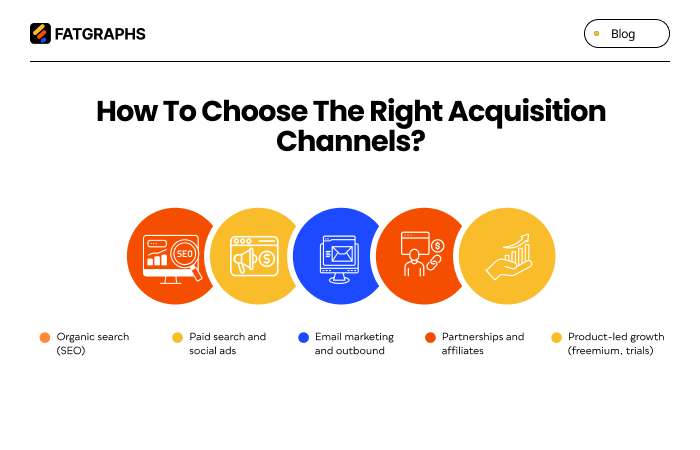
Selecting the right channels plays a major role in SaaS growth. Data from many SaaS companies highlights clear differences in cost and performance.
1- Organic search (SEO)
Organic search remains one of the most cost-effective acquisition channels, with an average CAC of $508. However, success depends on consistent, high-quality content creation.
SEO typically requires 6–12 months to show meaningful results, with the strongest returns appearing after 12–24 months. Once established, it delivers qualified leads without incremental advertising costs.
2- Paid search and social ads
Paid channels provide faster access to high-intent prospects. Paid search averages $817 CAC, while LinkedIn Ads cost approximately $708 per customer.
Although more expensive than organic channels, paid ads offer precise targeting and clear attribution, making them valuable for high-intent keywords and enterprise-focused campaigns.
3- Email marketing and outbound
Email marketing delivers the lowest average CAC at $471, particularly when used to nurture existing leads. Success depends on high-quality lists and relevant messaging.
Cold outreach can scale efficiently with automation tools, especially for early-stage SaaS companies. However, poor execution can harm deliverability and brand reputation.
4- Partnerships and affiliates
Strategic partnerships allow SaaS companies to reach pre-qualified audiences through trusted relationships. While CAC data varies, these channels often deliver higher conversion rates than cold acquisition methods.
In B2B SaaS, communities, podcasts, and industry forums, often referred to as dark social, play a critical role in purchase decisions, even though attribution is difficult.
5- Product-led growth (freemium, trials)
Free trials and freemium models are particularly effective for early-stage SaaS companies. When paired with strong content and onboarding, they can drive rapid adoption.
Companies using content-supported product-led growth strategies often see 30% higher growth rates and 5–10% improvements in retention.
SaaS Customer Acquisition Strategies by Business Type
SaaS acquisition strategies must adapt to different business models.
- B2B SaaS customer acquisition strategies
B2B SaaS companies benefit from social platforms like LinkedIn, Facebook, and Twitter, but much of the buying journey happens in less trackable channels such as private communities, podcasts, and industry groups. Although attribution tools may miss these interactions, their influence on buying decisions is significant.
- Early-stage vs. enterprise SaaS
Early-stage SaaS companies often succeed with free trials, freemium models, educational content, and cold outbound outreach. Enterprise SaaS companies, by contrast, typically rely on account-based marketing, industry events, and sales-led approaches to secure higher-value contracts.
How does customer type affect CAC?
Customer acquisition costs vary dramatically by segment:
| Customer Type | Average CAC |
| Consumer | $233 |
| Small B2B | $726 |
| Middle Market | $3,596 |
| Enterprise | $8,461 |
These differences reinforce the need to align acquisition strategies with target market economics.
Using CRM data to refine targeting
CRM data provides valuable insights into which channels drive closed deals. By analyzing engagement patterns and sales outcomes, companies can identify the most efficient paths to acquisition. Segment-level analysis allows teams to create targeted campaigns and allocate resources more effectively.
How can I optimize Customer Acquisition?
Long-term SaaS success depends on continuous optimization.
1- Reducing churn to improve LTV
Low lifetime value often results from poor retention. Improving onboarding, pricing, product-market fit, and customer success processes can significantly increase LTV. Content marketing alone can improve retention by 5–10%.
2- Experimenting with pricing models
Pricing directly influences both CAC and LTV. Different customer segments require different pricing strategies; what works for consumer SaaS won’t work for enterprise solutions.
3- Tracking and improving conversion rates
Industry benchmarks reveal variation across funnel stages:
| Industry | Visitor-to-Lead | Lead-to-MQL | MQL-to-SQL | SQL-to-Opportunity | Opportunity-to-Closed |
| Business | 1.9% | 37% | 39% | 45% | 36% |
| Healthcare | 1.8% | 48% | 43% | 41% | 35% |
| Industrial | 2.1% | 47% | 39% | 42% | 39% |
4- Using data to integrate and improve
CRM and funnel data reveal which touchpoints influence purchasing decisions most effectively. Maintaining industry-standard LTV: CAC ratios from 3:1 to 7:1, depending on the sector, ensures sustainable growth.
Conclusion
Mastering SaaS customer acquisition requires strategy, discipline, and constant refinement. Acquisition costs vary widely by industry and customer type, making efficiency critical. Your success in 2026 depends on selecting the right channels, monitoring key metrics, and aligning acquisition efforts with long-term value creation. Organic search and email marketing remain at cost-effective foundations, while paid and product-led strategies drive scale when used strategically.
The most successful SaaS companies balance growth with retention, ensuring that new customers stay long enough to generate real value. Sustainable growth starts with understanding your CAC, optimizing LTV, and continuously improving based on real data, not assumptions.
FAQs
1. How can SaaS companies reduce customer acquisition cost without slowing growth?
SaaS companies can reduce CAC by focusing on high-intent channels like SEO and email, improving conversion rates across the funnel, and eliminating underperforming campaigns. Aligning marketing with ICP targeting and using CRM data to double down on profitable segments also lowers acquisition costs without limiting growth.
2. What is a good CAC to LTV ratio for SaaS in 2026?
A healthy LTV to CAC ratio for SaaS companies is typically between 3:1 and 5:1. High-performing companies may reach 6:1 or higher, depending on retention and pricing models. A ratio below 3:1 often indicates inefficient acquisition or poor customer quality.
3. Which customer acquisition channels work best for B2B SaaS companies?
The most effective channels for B2B SaaS include organic search, LinkedIn ads, email marketing, and outbound sales. Many high-performing companies also rely on product-led growth, partnerships, and community-driven channels, even though some of these are harder to track.
4. How long does it take for SaaS acquisition strategies like SEO to show results?
SEO for SaaS typically takes 6 to 12 months to generate consistent leads, with stronger results appearing after 12 to 24 months. While slower than paid channels, it delivers compounding returns and significantly lowers CAC over time.