
 Book Call with Haroon
Most SaaS companies don’t have a pricing problem, they have a value communication problem. They price based on competitors or internal costs, and as a result, leave significant revenue on the table. Value-based pricing changes this. Instead of asking “what should we charge?” it asks a better question:
“What is this product actually worth to the customer?”
A value-based pricing model allows you to set different price points for different customer groups based on what they believe your product is worth. This approach can also uncover hidden revenue opportunities by reaching more types of customers. This article explains what value-based pricing is, its main benefits, and how to build and apply a strategy that increases your SaaS revenue.
Value-Based Pricing in SaaS: How to Set Prices Based on Customer Value
Value-based pricing is a pricing strategy where you set your prices according to the value customers believe they receive from your product, instead of basing prices on your costs or your competitors’ prices. This method focuses on what customers are willing to pay to achieve the results your software provides.
Value-based pricing is connected to the idea of Economic Value to the Customer (EVC). This concept says your price should be equal to the price of the next-best alternative plus the extra value your product creates. For example, if a competing machine costs $10,000 more but helps a factory save $50,000 in labor costs, the extra value created is $40,000.
How value-based pricing works in SaaS
The pricing formula works like this:
Price = price of the next-best alternative + (capture percentage × differentiation value).
For example, imagine the next-best alternative costs $20,000 per year, but your product helps the customer avoid $10,000 in errors. If you capture part of that extra value, your price would increase accordingly.
SaaS companies can use this method effectively because it is usually easy to calculate return on investment (ROI), and customer data is widely available. A common guideline is the 10x ROI rule, which means customers should get much more value than what they pay.
Slack is a good example of this strategy. Its Pro plan is designed for small teams and includes features like voice calls and Google Drive integration. Its Enterprise Grid plan costs much more, not because it is more expensive to build, but because large companies place a higher value on features such as HIPAA compliance and encryption key management.
Value-based pricing vs cost-based pricing
Cost-based pricing simply adds a profit margin to your production costs. Value-based pricing focuses on the results customers achieve. Cost-based pricing is easier to calculate but often results in lost revenue. For instance, if your software costs $10 to deliver and you add a margin, you might charge $15.
However, if your product helps a customer avoid $1,000 per month in downtime, they might be willing to pay far more because the price reflects the benefit they receive, not your internal cost.
Key components of a value-based pricing model
Market segmentation means grouping potential customers based on their needs, behavior, or size. Different groups see different levels of value in your product, so each group may need different pricing. B2B SaaS companies often segment by company size (SMB, mid-market, enterprise), while B2C products may segment by user behavior or industry.
Product differentiation refers to what makes your software different from competitors. This can include features, design, reliability, or ease of use. The stronger your differentiation, the more customers may be willing to pay. Understanding this requires deep market research and continuous monitoring because customer perceptions can change over time.
Benefits of Value-Based Pricing for SaaS Revenue
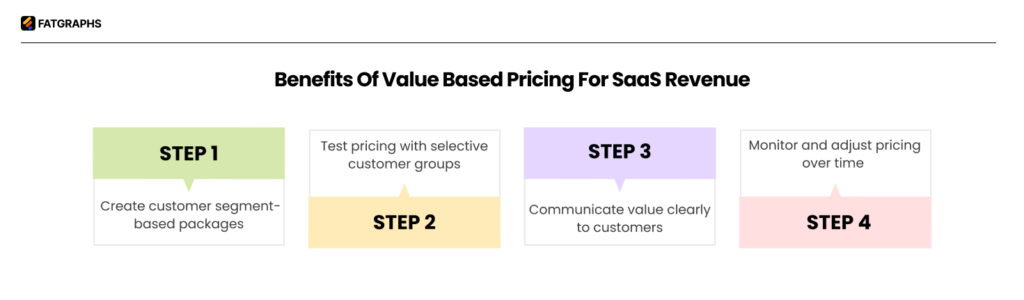
Captures maximum revenue potential
Value-based pricing allows you to earn more from customers who gain significant value from your product. Pricing is one of the most powerful growth levers in SaaS and often has a bigger impact than focusing only on customer acquisition.
This method also prevents underpricing. If your software saves a customer a large amount of money each year, you can charge a meaningful portion of that value instead of limiting yourself to cost plus a small margin. In this way, your price reflects the real economic benefit you deliver.
Lines up pricing with customer value perception
When prices match the outcomes customers receive, they are more likely to view the pricing as fair. This improves satisfaction and builds trust. Value-based pricing positions your company as a partner that focuses on customer success rather than just selling software.
When customers clearly understand why your product costs what it does, they are more willing to accept the price. This transparency strengthens relationships and encourages long-term loyalty through ongoing communication about the value delivered.
Enables better market segmentation
Different customer groups gain different levels of value from the same product. Value-based pricing allows you to capture this variation through tiered packages. For example, Zuora implemented tier-based value pricing and saw stronger enterprise deal performance after recognizing that larger customers experienced much greater value.
Price segmentation helps maximize revenue by charging premium prices to high-value customers while still offering affordable options for price-sensitive segments. This flexibility reduces the risk of losing revenue through one-size-fits-all pricing.
Supports long-term revenue growth
This pricing approach encourages continuous product improvement. As you enhance your product and deliver better results, your pricing can increase to reflect the added value. Because the focus remains on customer outcomes, companies are motivated to build more innovative and effective solutions over time.
Improves customer satisfaction and retention
Value-based pricing can improve customer loyalty because users feel they are being charged fairly. When customers consistently receive strong value, retention tends to improve. Higher retention leads to greater customer lifetime value and lower churn. Many companies that adopt this model see improved satisfaction alongside stronger profit margins.
How to Set Your Value-Based Pricing Strategy
Creating a value-based pricing strategy requires structured research and careful analysis. The first step is to collect solid evidence about what customers value most.
Conduct customer value analysis
Start with detailed market research using surveys, customer interviews, and focus groups. Your goal is to understand what customers care about and what they are willing to pay for solutions. Without enough qualified responses, pricing insights can become unreliable.
You can also use advanced pricing research methods. The Van Westendorp Price Sensitivity Meter asks key pricing questions to identify acceptable price ranges. The Gabor-Granger Method tests willingness to buy at different price points. Conjoint analysis examines how customers trade off between features and price when making decisions.
Review your target market segments
Next, divide your customer base into clear segments based on company size, industry, use case, or profitability. Build detailed buyer personas that reflect real customer groups. These profiles should include budget range, price sensitivity, ROI expectations, key pain points, and preferred communication style.
Research competitor pricing models
Study how your direct competitors price their products. This helps you understand market expectations and identify where your product stands out. Map their pricing tiers, feature bundles, and positioning. Competitor pricing should not dictate your strategy, but it provides important context for market positioning.
Calculate your perceived value
Estimate the total benefits your product delivers. Include measurable financial gains such as cost savings, operational improvements, and productivity increases. Also consider functional and emotional benefits, such as ease of use and customer confidence.
If your SaaS product saves a mid-market customer a large amount of labor cost each month, the delivered value is at least that amount. Many SaaS companies price their product as a reasonable share of the value they create.
Determine pricing tiers and packages
Once your personas are clear, design pricing tiers that reflect different value levels. Products with research-based tiering often achieve stronger revenue performance compared to products with randomly bundled features. Most SaaS companies perform well with a small set of clearly differentiated pricing tiers. Each tier should offer clear additional value that justifies the higher price.
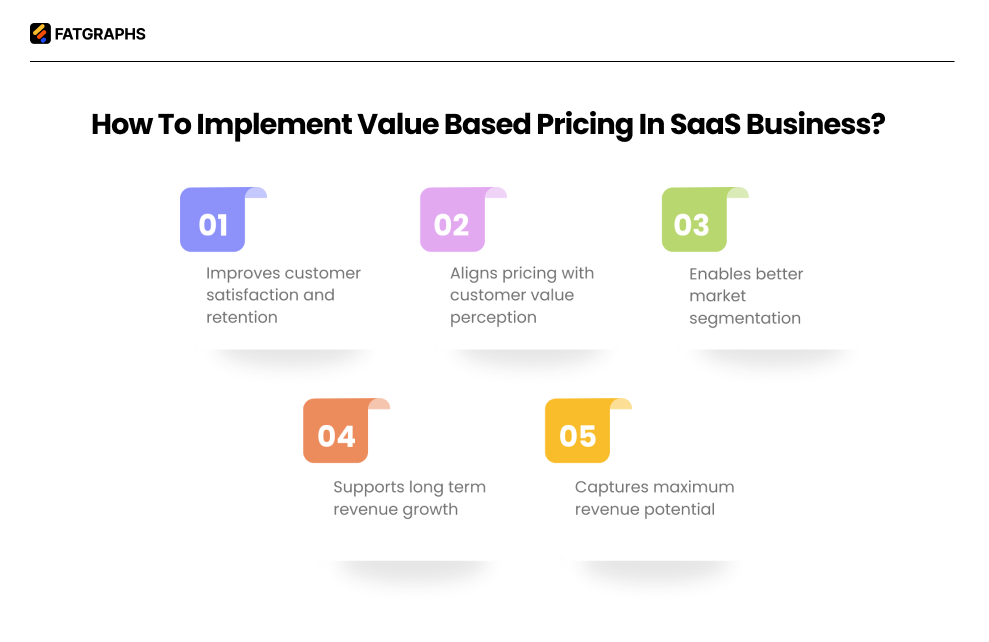
After defining your strategy, execution becomes critical. Implementation requires careful packaging, testing, communication, and continuous optimization.
Create customer segment-based packages
Segment-based packaging is one of the fastest ways to monetize different value levels without pushing away smaller customers. Align your packages with real customer groups rather than forcing everyone into a single model.
The Good-Better-Best framework works well when segments differ by company size or complexity of needs. Proper product tiering helps capture value from premium customers while keeping entry-level options attractive.
Test pricing with select customer groups
Before rolling out new pricing widely, run controlled tests. Use A/B testing on pricing pages with new prospects and measure conversion behavior. Begin with a specific segment or region. Sales teams can also test new pricing during live conversations with prospects and renewal customers. Companies that regularly test pricing typically achieve better margin control.
Communicate value to customers with clarity
Your messaging should emphasize outcomes, not just features. Whenever possible, present concrete examples that demonstrate ROI, productivity gains, or cost savings. Case studies and customer testimonials provide strong social proof and increase credibility.
Monitor and adjust pricing over time
Track key metrics such as conversion rate, monthly recurring revenue, average revenue per user, and churn rate. Review pricing performance regularly and adjust when customer needs, product capabilities, or market conditions change. Build feedback loops between customer success data and pricing decisions to keep your strategy aligned with real customer value.
Conclusion
Value-based pricing requires meaningful research, disciplined testing, and ongoing refinement. However, when executed correctly, it allows SaaS companies to capture revenue that would otherwise be lost while also strengthening customer relationships through fair and transparent pricing.
Begin with thorough customer research to understand the true value your product delivers. Then design segment-specific packages and test them carefully. When your pricing reflects genuine customer outcomes rather than internal costs, it becomes a powerful driver of sustainable SaaS revenue growth.
FAQs
Q1. What is the main difference between value-based pricing and cost-based pricing?
Value-based pricing sets prices according to the perceived value and outcomes customers receive from your product, while cost-based pricing simply adds a markup to your production costs. For example, if your software costs little to deliver but saves a customer significant downtime each month, value-based pricing allows you to charge based on the customer’s gain, whereas cost-based pricing keeps the price tied to your internal expenses.
Q2. How much value should customers receive compared to what they pay for SaaS products?
A common industry guideline is that customers should receive meaningfully more value than what they pay. Many SaaS companies price their tiers as a reasonable portion of the measurable value they deliver.
Q3. What research methods are most effective for determining value-based pricing?
The most effective methods include customer surveys, interviews, and focus groups combined with advanced techniques like the Van Westendorp Price Sensitivity Meter, the Gabor-Granger Method, and conjoint analysis. Collecting feedback from qualified decision-makers is important for reliable pricing insights.
Q4. How does value-based pricing improve customer retention?
Value-based pricing improves retention because customers feel the price is fair relative to the outcomes they receive. When buyers perceive strong value, they are more likely to continue using the product. This approach builds trust and positions your company as a long-term partner.
Q5. Should I change my pricing all at once or test it gradually?
It is best to test pricing gradually through controlled experiments before a full rollout. Start with A/B testing on pricing pages or pilot programs within a specific segment. Companies that consistently test and refine pricing typically maintain healthier margins and more stable growth.