
 Book Call with Haroon
Enterprise SaaS SEO fails surprisingly often, even inside well-funded companies with strong brands and large teams. The reason is simple; many organizations still treat SEO like a content side project instead of a revenue-driven acquisition system. At scale, traffic alone does not move the needle. What works is intent-led architecture, product-aligned content, and tight execution across marketing, product, engineering, and sales. When done right, Enterprise SaaS SEO becomes predictable, defensible, and compounding. This article breaks down how large B2B SaaS companies can design SEO as a serious growth engine, not an experiment.
What Is Enterprise SaaS SEO & How Is It Different from Traditional SEO?
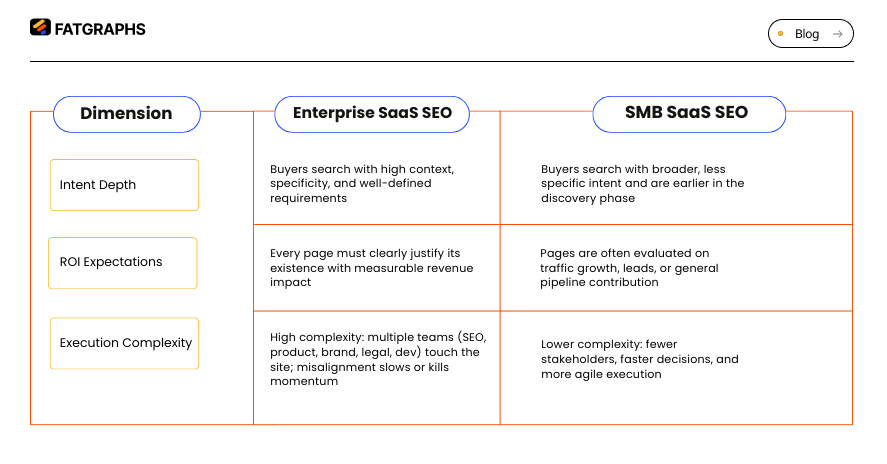
Enterprise SaaS SEO focuses on large websites, complex products, long sales cycles, and multi-stakeholder buying journeys, unlike SMB or content-only SEO. The scale alone changes everything, from keyword strategy to site architecture and measurement.
Enterprise SaaS SEO is the practice of building organic growth systems for software companies with hundreds or thousands of pages, multiple ICPs, and revenue targets tied directly to pipeline. It goes beyond publishing blog posts and ranking for top keywords. It connects search behavior to product value and business outcomes.
Content alone does not win because content without product context attracts the wrong audience. SEO fits into enterprise demand generation when it supports the full funnel, from education to evaluation to purchase, and works alongside sales, paid media, and product-led growth.
Why Does SEO Matter for Enterprise SaaS Growth in 2026?
SEO matters because it compounds customer acquisition efficiency and improves pipeline quality over time. Unlike paid channels, organic search keeps working long after the initial investment.
For enterprise SaaS companies, SEO reduces over-reliance on paid media. As CPCs rise and attribution becomes noisier, organic demand becomes a stabilizing force. High-intent search terms often capture buyers who are already solution-aware and closer to a sales conversation.
Organic search should be viewed as pipeline, not just traffic. A single comparison page can influence multi-million dollar deals months after the first visit. One SaaS leader described SEO as “the quiet channel that keeps deals warm while sales does the talking.”
In saturated markets, Enterprise SaaS SEO becomes a competitive moat. Once a company owns high-intent categories, use cases, and integrations in search, competitors must outspend or outbuild to catch up. That defensibility is hard to replicate quickly.
Building an SEO Strategy SaaS Enterprise
A scalable Enterprise SaaS SEO strategy starts with intent mapping, not keywords. You build it by aligning search intent to product value, funnel stages, and revenue metrics.
1- Map the search intent:
Start by mapping search intent to funnel stages. Top-of-funnel searches focus on problems and education. Middle-of-funnel searches explore solutions and use cases. Bottom-of-funnel searches compare vendors, pricing, and alternatives. Each stage needs different content and success metrics.
2- Keyword Strategy:
Enterprise SaaS keyword research clusters around four areas, problem keywords that describe pain points, solution keywords that frame categories, product keywords tied to features, and comparison keywords that capture buying intent. This structure keeps SEO aligned with how buyers think.
3- Topic clusters:
Topic clusters should be built around core use cases, not broad themes. For example, instead of “project management,” build a cluster around “project management for remote engineering teams,” supported by product pages, guides, and comparisons.
Prioritization is where most teams struggle. A simple framework helps, weigh traffic potential against revenue impact. A page that drives fewer visits but influences large deals often beats a high-traffic blog post with no pipeline impact.
Role of Site Architecture in Enterprise SaaS SEO
Site architecture determines whether SEO growth compounds or collapses under scale. Enterprise SaaS SEO succeeds when site structure mirrors buyer intent and product logic.
- An SEO-friendly SaaS architecture organizes pages by problems, solutions, use cases, industries, and products in a clear hierarchy. This helps both users and search engines understand relevance. Think of the site as a well-organized library, not a pile of articles.
- Product pages, use case pages, and industry pages each serve different intent. Product pages explain what the software does. Use case pages explain why it matters. Industry pages show relevance in specific contexts. All three are necessary.
- At scale, indexation and crawl budget become real constraints. URL sprawl from filters, parameters, and experiments can quietly hurt performance. Regular audits and clear indexing rules prevent this.
- Internal linking acts as a revenue lever. Strategic links from high-authority pages to bottom-of-funnel pages pass trust and guide buyers forward, often shortening sales cycles.
Content Design for Enterprise SaaS SEO
Enterprise SaaS SEO content must support buying decisions, not just rankings. The best content educates, qualifies, and accelerates pipeline.
- Product-led content explains features in real-world scenarios.
- Use case pages show how different teams solve specific problems.
- Comparison and alternatives pages address the questions buyers already ask sales.
- Integration pages capture demand from ecosystem searches.
Thought leadership builds brand authority, but search-driven content captures demand. Both matter, but they serve different goals. Search content should answer clear questions. Thought leadership should shape how the market thinks.
Content governance is critical at scale. Without ownership, pages go stale and rankings slip. High-performing SaaS teams assign clear owners, update content regularly, and retire pages that no longer support strategy. One common practice is quarterly content reviews tied to pipeline performance.
Technical SEO Challenges Unique to Enterprise SaaS
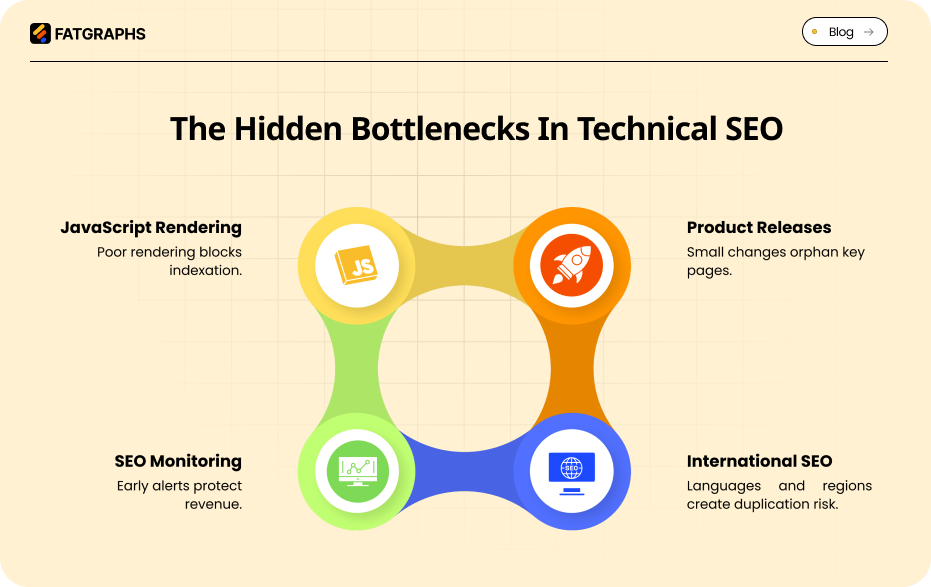
1- Technical SEO is often the hidden bottleneck in Enterprise SaaS SEO. Complex stacks, JavaScript frameworks, and constant releases introduce SEO risk.
2- Many SaaS platforms rely heavily on JavaScript. If rendering is not handled properly, search engines may struggle to index key content. Server-side rendering or hybrid approaches often solve this.
3- Product releases and site changes can break SEO quietly. A small navigation update can orphan dozens of pages. Strong SEO processes include pre-launch checks and post-release monitoring.
4- International SEO adds another layer. Global SaaS companies must manage languages, regions, and compliance while avoiding duplicate content issues.
SEO monitoring should be proactive. Alerts for traffic drops, indexation changes, and ranking volatility help teams respond before revenue is impacted.
How Do You Measure ROI in Enterprise SaaS SEO?
Traffic alone is a vanity metric for Enterprise SaaS SEO. Success is measured by pipeline influence, deal velocity, and assisted revenue. Key metrics include:
- Organic-sourced pipeline
- Organic-influenced revenue
- Conversion rates by intent stage
- Time to close for organic leads.
Connecting SEO to CRM data is essential. When search touchpoints appear in opportunity histories, SEO earns credibility with leadership. Many teams integrate SEO dashboards directly into revenue reporting. Leading indicators include rankings for high-intent terms and engagement on BOFU pages. Lagging indicators include closed-won revenue. Both matter, but leaders watch the full chain.
Common Enterprise SaaS SEO Mistakes That Limit Growth
Most Enterprise SaaS SEO failures are strategic, not tactical. Teams fail when SEO is isolated from product, sales, and analytics.
- Treating SEO as a blog-only channel attracts the wrong audience.
- Ignoring bottom-of-funnel intent leaves revenue on the table.
- Scaling content without governance creates clutter instead of leverage.
- Underinvesting in technical SEO turns growth into guesswork.
One SEO director shared that their biggest win came not from more content, but from deleting 30 percent of low-impact pages and strengthening internal links to revenue-driving ones.
Conclusion
Enterprise SaaS SEO becomes a competitive advantage when it is built as a system, not a campaign. Companies that integrate SEO with product strategy, revenue metrics, and go-to-market execution turn organic search into a durable acquisition engine. This approach takes patience and discipline, but the payoff compounds.
Over time, SEO reduces acquisition costs, improves deal quality, and strengthens market positioning. The real question is not whether SEO works for enterprise SaaS. It is whether your organization is treating Enterprise SaaS SEO as a traffic play, or as a core growth lever tied directly to revenue.
FAQs
1- How long does Enterprise SaaS SEO take to show results?
Enterprise SaaS SEO typically shows early signals within three to six months, such as improved rankings and engagement. Meaningful pipeline impact often takes six to twelve months. The timeline depends on site complexity, competition, and execution quality.
2- Is Enterprise SaaS SEO worth it compared to paid acquisition?
Yes, because SEO compounds over time while paid acquisition resets every month. SEO often delivers higher-intent leads at a lower blended CAC. Many SaaS companies use SEO to stabilize growth while paid channels drive short-term scale.
3- How many pages does an enterprise SaaS company need for SEO?
There is no ideal number. What matters is coverage of intent, not volume. A focused site with a few hundred high-quality, intent-mapped pages often outperforms a bloated site with thousands of low-impact pages.
4- Can product-led SaaS companies rely primarily on SEO?
Product-led SaaS companies benefit greatly from SEO, especially for use cases and integrations. SEO supports self-serve discovery and education. However, it works best alongside product onboarding and lifecycle marketing.
5- Should Enterprise SaaS SEO be handled in-house or by an agency?
Many companies use a hybrid model. In-house teams own strategy and alignment, while agencies support execution and expertise. The key is clear ownership and tight integration with internal teams.