
 Book Call with Haroon
Enterprise SaaS SEO is the practice of building organic search as a revenue-generating acquisition system for B2B software companies, connecting search intent to pipeline, CAC reduction, and MQL quality across the full buying journey. It goes beyond publishing blog posts and ranking for traffic. It is a growth infrastructure decision.
Enterprise SaaS SEO fails surprisingly often, even inside well-funded companies with strong brands and large teams. The reason is almost always the same: the organization is treating SEO like a content side project instead of a revenue-driven acquisition system.
At scale, traffic alone does not move the needle. What works is intent-led architecture, product-aligned content, and tight execution across marketing, product, engineering, and sales. When built correctly, Enterprise SaaS SEO becomes predictable, defensible, and compounding. This guide breaks down exactly how to build it and how to fix it when it is not working.
Quick Take: What is Enterprise SaaS SEO?
Enterprise SaaS SEO means improving the online visibility of large business software companies so they can be found on search engines. These companies usually have big websites with many pages, sell to groups of decision-makers, and take a long time (about 6 to 18 months) to close a sale.
Unlike regular SEO, the goal is not just to get more visitors. Instead, it focuses on attracting the right people at every stage of their buying journey, from when they first realize they have a problem to when they compare different companies, and helping turn that interest into actual sales opportunities.
Why Enterprise SaaS SEO Is a Different Problem Than Standard SEO
Standard SEO optimizes individual pages. Enterprise SaaS SEO builds systems. The difference in scope changes everything from how you research keywords to how you measure success.
Here is what makes the enterprise SaaS context unique:
- Long sales cycles: B2B SaaS buyers research for weeks or months before converting. A single page can influence a deal long before sales enter the conversation.
- Multi-stakeholder buying committees: Your ICP is not one person. It is a founder, a VP, a demand gen manager, and an IT lead all searching for different things about the same problem. Your SEO must cover all of them.
- Complex site architecture: Enterprise SaaS sites have hundreds or thousands of pages across product features, use cases, integrations, help docs, and regional subdomains. Without a clear structure, SEO growth collapses under its own weight.
- Pipeline accountability: Traffic is not the goal. Pipeline is. Every SEO decision must connect to a revenue outcome, or it will be deprioritized in the next budget cycle.
The core shift: stop viewing organic search as a traffic channel. Start viewing it as the top of your pipeline. SaaS demand generation works when SEO fills the top of that funnel with buyers who are already researching, not just readers who are curious.
The Enterprise SaaS SEO system
| Funnel stage | Search intent | Content type | Success metric |
|---|---|---|---|
| Top of funnel (TOFU) | Problem-aware “Why is my CAC rising?” | Educational blog posts, guides | Organic sessions, brand searches |
| Middle of funnel (MOFU) | Solution-aware “best SaaS demand gen tools.” | Use case pages, comparison guides | Demo requests, MQL volume |
| Bottom of funnel (BOFU) | Vendor-aware “Your Brand vs Competitor” | Comparison pages, pricing pages, case studies | Organic-sourced pipeline, deal influence |
Most enterprise SaaS companies over-invest in TOFU and under-invest in BOFU. The result: high traffic, low pipeline. The fix starts with intent mapping covered in the next section.
Keyword Strategy: How to Research and Prioritize for Pipeline, Not Traffic
Most keyword research frameworks optimize for traffic volume. Enterprise SaaS SEO keyword strategy optimizes for revenue impact. These are not the same thing. A page that generates 200 visits per month but influences $500,000 in pipeline is worth more than a page that generates 10,000 visits with zero deal influence.
The 4 keyword categories every Enterprise SaaS SEO program needs
Structure your keyword map around these four types, which reflect how B2B buyers actually search:
- Problem keywords buyers are describing pain without knowing the solution yet. Example: “Why is MQL quality dropping?” or “SaaS CAC too high.” These are TOFU. They build awareness and brand authority.
- Solution keywords for buyers who know a category exists and are exploring it. Example: “B2B demand generation software” or “SaaS marketing automation tools.” These are MOFU. They drive demo and trial intent.
- Product keywords buyers are searching for specific features or capabilities. Example: “SaaS pipeline forecasting tool” or “account-based marketing platform for SaaS.” These map directly to your product pages.
- Comparison of keywords buyers in the final evaluation stage. Example: “Your Brand vs Competitor” or “best category alternatives 2026.” These are BOFU and convert at the highest rate.
This structure keeps your SEO investment aligned with how your buyers think, not with what is easiest to rank for.
Topic clusters: build around use cases, not broad themes
Topic clusters organize your content around a central pillar page supported by several related posts, all internally linked. For enterprise SaaS, clusters should be built around specific use cases and buyer problems, not broad industry topics.
❌ Wrong: Build a cluster around “project management.”
✅ Right: Build a cluster around “project management for remote engineering teams” pillar page supported by guides on async planning, sprint tracking for distributed teams, and integrations with tools your ICP already uses.
This specificity signals topical authority to Google and matches the precision that enterprise buyers use when they research. Broad clusters attract broad audiences. Specific clusters attract your ICP.
Site Architecture: Why Structure Determines Whether SEO Compounds or Collapses
Site architecture is the most underinvested area in enterprise SaaS SEO. Most companies put all their resources into content and almost nothing into how that content is organized, connected, and discovered. At scale, this causes growth to stall, not because the content is bad, but because the structure is broken.
The right hierarchy for an enterprise SaaS site
An SEO-friendly SaaS site organizes pages in a clear hierarchy that mirrors buyer intent and product logic:
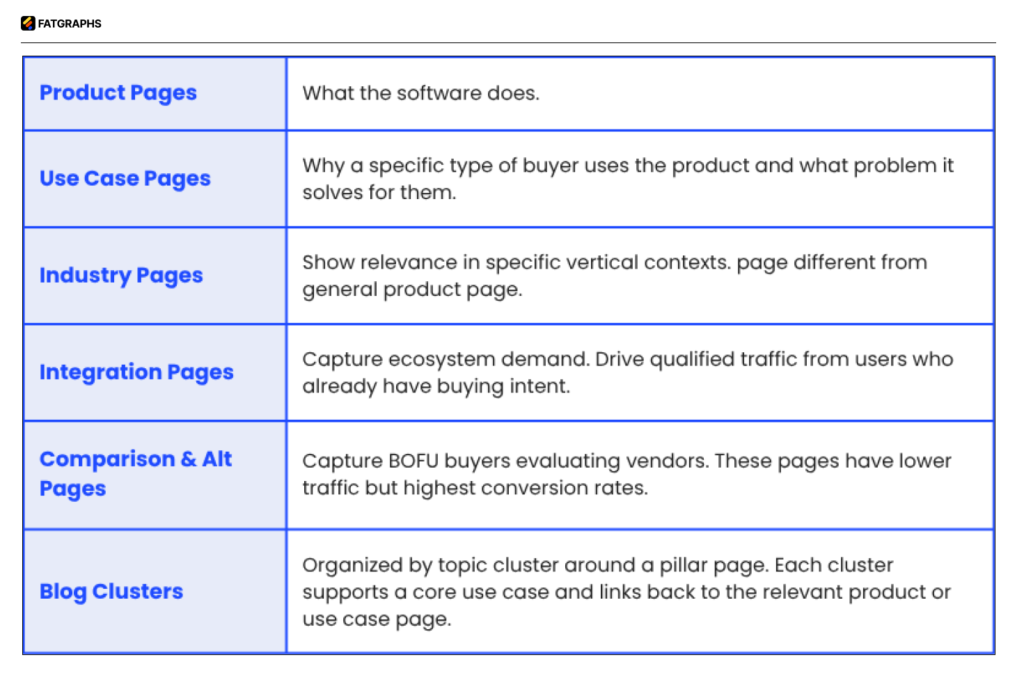
- Product pages explain what the software does. Each core feature or module gets its own page optimized for feature-specific keywords.
- Use case pages explain why a specific type of buyer uses the product and what problem it solves for them. These are your MOFU workhorses.
- Industry pages show relevance in specific vertical contexts. “SaaS marketing tools for fintech companies” is a different page from your general product page, and it ranks for a completely different audience.
- Comparison and alternatives pages capture BOFU buyers evaluating vendors. These pages often have lower traffic but the highest conversion rates on the site.
- Integration pages capture ecosystem demand. Buyers search for “[Your Tool] + [Tool They Use]” constantly. These pages are easy to build and drive qualified traffic from users who already have buying intent.
- Blog clusters are organized by topic cluster around a pillar page. Each cluster supports a core use case and links back to the relevant product or use case page.
Crawl budget and indexation: the hidden bottleneck
At scale, crawl budget becomes a real constraint. Search engines allocate a limited number of crawls per site per day. If your site has hundreds of low-value URLs from filter parameters, session IDs, or tag pages, Google spends its crawl budget on those instead of your important pages.
Fix this by:
- Using canonical tags on duplicate or near-duplicate pages
- Blocking parameter-generated URLs in your robots.txt or Google Search Console
- Running quarterly crawl audits using Screaming Frog or Sitebulb to identify orphaned pages and crawl traps
- Submitting updated XML sitemaps after major content additions or structural changes
Internal linking as a revenue lever
Internal links pass authority from high-traffic pages to high-intent pages. Most SaaS sites do this backwards; their high-authority blog posts link to other blog posts instead of linking to product pages, use case pages, and comparison pages where conversions happen.
The fix is deliberate: every TOFU blog post should include at least one contextual internal link to a MOFU or BOFU page relevant to the reader’s problem. This shortens the buyer’s path from awareness to evaluation, and it directly improves your SaaS pipeline metrics by moving organic visitors closer to a conversion event.
Content Strategy: What Enterprise SaaS Buyers Actually Need at Each Stage
Enterprise SaaS content fails when it is written for Google instead of for buyers. The goal of content is not to rank. The goal is to support a buying decision, and different buying stages need completely different content.
Content types mapped to buyer stage
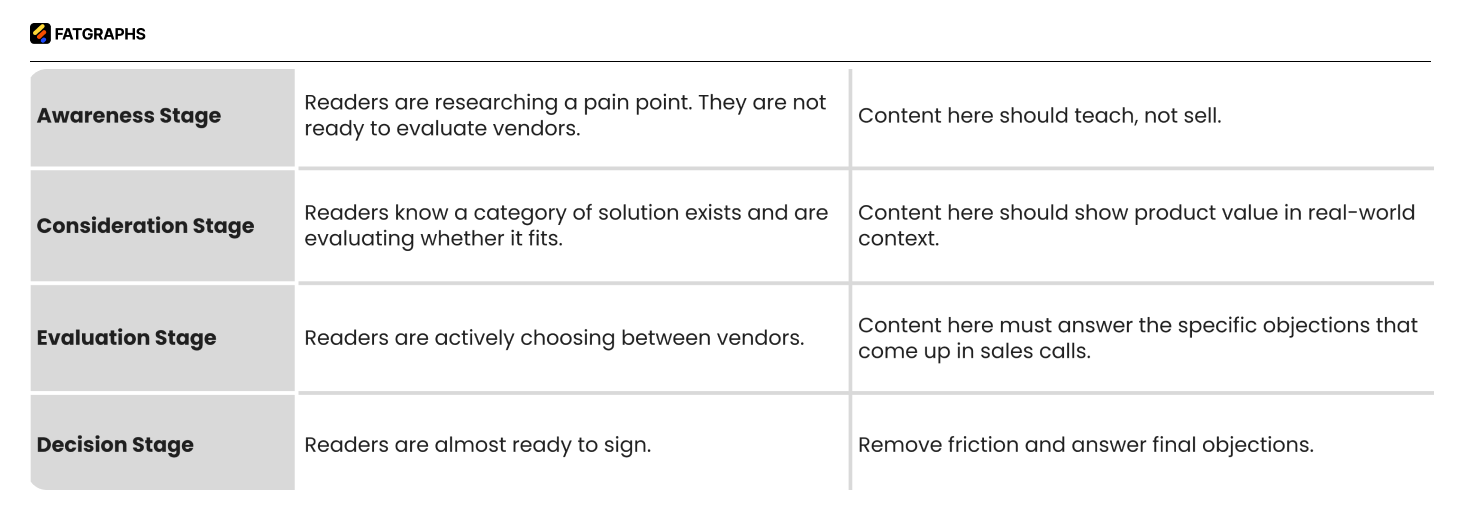
- Awareness stage: Educational blog posts, problem-focused guides, industry reports. Content here should teach, not sell. Example: “Why SaaS CAC is rising in 2026 and what to do about it.”
- Consideration stage: Use case pages, solution comparison posts, ROI calculators, webinars. Content here should show product value in a real-world context, not just features.
- Evaluation stage: Comparison pages “Your Brand vs Competitor”, alternatives pages “best category tools for B2B SaaS”, case studies with measurable results, and integration guides.
- Decision stage: Pricing pages, security and compliance pages, implementation guides, and onboarding documentation. Readers are almost ready to sign. Remove friction and answer final objections.
The content types most SaaS teams skip
Comparison and alternatives pages are the most underleveraged content type in B2B Enterprise SaaS SEO. They target buyers in their final evaluation stage, the highest-intent search queries on your entire site. Yet most SaaS companies either do not build them, or build them as one-page overview tables that do not answer the specific questions buyers are asking.
A strong comparison page addresses:
- The specific use case where your product wins
- The specific use case where the competitor wins (honest comparisons build trust)
- Real customer outcomes with measurable results
- Pricing and contract structure differences
- Migration and implementation considerations
Integration pages are the second most underleveraged type. If your product integrates with Salesforce, HubSpot, Slack, or any tool your ICP uses daily, you need a dedicated, SEO-optimized page for each integration. These pages are fast to build and convert at high rates because the searcher already uses the ecosystem you operate in.
Technical SEO: The Hidden Bottleneck Most SaaS Teams Ignore
Technical SEO is where enterprise SaaS growth quietly breaks down. Most teams invest in content and almost nothing in the infrastructure that makes that content discoverable, indexable, and rankable.
JavaScript is the most common invisible problem
Many B2B SaaS platforms are built on React, Vue, or Angular, JavaScript-heavy frameworks that render content client-side. If search engines cannot execute the JavaScript to render your pages, they index empty shells. Your product features, use case content, and conversion pages may be completely invisible to Google even if users can see them fine in a browser.
The fix: implement server-side rendering (SSR) or static site generation (SSG) for your most important SEO pages. Use Google Search Console’s URL Inspection tool to render any page and confirm what Google actually sees versus what a user sees. If the rendered version is missing content, you have a JavaScript SEO problem that no amount of content production will fix.
Site migration SEO risk
Product releases and site redesigns are the most common causes of sudden organic traffic drops in enterprise SaaS. A single navigation update can orphan dozens of high-ranking pages. A CMS migration without proper redirect mapping can erase years of organic authority overnight.
Every site change that touches URLs, navigation, or page templates needs a pre-launch SEO review that includes:
- A full crawl of the current site before migration
- A complete redirect map from old URLs to new URLs (301 redirects, not 302)
- Post-launch monitoring for ranking drops, indexation errors, and crawl anomalies in the first 30 days
Core Web Vitals is a ranking factor and a conversion factor
Google’s Core Web Vitals (Largest Contentful Paint, Interaction to Next Paint, Cumulative Layout Shift) are both a ranking signal and a direct conversion driver. Slow pages lose rankings. They also lose conversions. For enterprise SaaS, a one-second improvement in page load time has been documented to produce measurable increases in conversion rate. Use Google PageSpeed Insights to identify and prioritize performance issues on your highest-traffic pages first.
International SEO for global SaaS companies
Global B2B SaaS companies face an additional layer of technical complexity: managing languages, regional variants, and compliance requirements without creating duplicate content issues. The core requirement is correct hreflang implementation, telling Google which version of a page to serve to users in which country and language. Incorrect hreflang is one of the most common causes of international SaaS sites cannibalizing their own rankings across regions.
How to Measure Enterprise SaaS SEO ROI?
Traffic is a vanity metric for enterprise SaaS SEO. If you are reporting organic sessions to your leadership team, you are reporting the wrong number. What leadership needs to see is organic pipeline influence, assisted revenue, and CAC impact numbers that connect directly to the business model.
This is not just a reporting problem. It is a survival problem. SEO programs that cannot demonstrate pipeline impact get defunded. Programs that show up in the revenue dashboard get investment.
The right metrics split by who is reading the report
| Audience | Metric | What it shows |
|---|---|---|
| CEO / CFO / Board | Organic-sourced pipeline ($) | How many closed or open pipeline touched by an organic search visit |
| CEO / CFO / Board | Blended CAC impact from SEO | How much lower overall CAC is because of organic vs paid-only acquisition |
| VP of Marketing | Organic MQL volume and quality | How many marketing qualified leads came from organic, and their close rate vs paid MQLs |
| VP of Marketing | Organic-assisted revenue | Deals where organic search was a touchpoint, even if not the last one |
| Demand Gen Manager | Organic conversion rate by intent stage | TOFU vs MOFU vs BOFU conversion rates show where the funnel is leaking |
| Demand Gen Manager | Rankings for high-intent keywords | Leading indicator position 1–5 for BOFU keywords predicts pipeline 60–90 days out |
| SEO / Content Team | Organic sessions, CTR, impressions | Tactical health indicators are useful for diagnosing, but not for leadership reporting |
How to connect SEO data to your CRM
The technical requirement is connecting search touchpoints to deal histories in your CRM. Most B2B SaaS teams use HubSpot or Salesforce. Both support UTM parameter tracking that can capture organic search as a first-touch or multi-touch attribution source on each contact record.
The process:
- Ensure your CRM is capturing first-touch and last-touch sources on every contact and deal
- Tag organic traffic correctly in Google Analytics 4, and confirm that “Organic Search” is appearing as a distinct source in your acquisition reports
- Run a monthly report in your CRM, filtering deals by “first touch source = Organic Search.” This gives you an organic-sourced pipeline
- Run a second report filtering by “any touchpoint = Organic Search”; this gives you the organic-influenced pipeline
- Compare CAC for organic-sourced customers vs paid-sourced customers. This is the most powerful number to bring to a budget conversation
When SEO data shows up in the same dashboard as pipeline and revenue, it earns budget. When it lives in a separate traffic report, it gets cut.
For the full set of metrics that B2B SaaS teams should track across their entire marketing system, read our guide on the most important B2B SaaS metrics.
Common Enterprise SaaS SEO Mistakes That Kill Growth
Most Enterprise SaaS SEO failures are strategic, not tactical. The content may be good. The technical implementation may be solid. But the strategy is disconnected from revenue, and at some point, that disconnection becomes visible in a budget review.
- Treating SEO as a blog-only channel. Blogs build awareness. They do not close deals. If your entire SEO investment is in TOFU content with no MOFU or BOFU pages, you are generating traffic with no path to the pipeline.
- Ignoring comparison and alternatives pages. These are your highest-converting pages. Buyers who search “Your Brand vs Competitor” are days away from a decision. If you do not own that search result, your competitor does.
- Scaling content without governance. Adding 50 blog posts per quarter without a retirement and consolidation strategy creates a bloated site with fragmented authority. More pages do not mean more SEO power; focused, high-quality, well-linked pages do.
- Underinvesting in technical SEO. A JavaScript rendering problem, a crawl budget issue, or a broken redirect map can silently destroy rankings that took 12 months to build, and nobody notices until the pipeline report comes in flat.
- Measuring SEO with traffic metrics instead of pipeline metrics. This is the reason SEO budgets get cut. If you cannot show pipeline influence, leadership will fund channels that can.
- Separating SEO from product and sales. Enterprise SEO requires cross-functional accountability, product teams define features that become SEO pages, sales teams surface the objections that become comparison content, and analytics teams connect search data to deal records. SEO that lives only in the marketing team will always underperform.
In-House vs Agency: How to Structure Enterprise SaaS SEO Execution
Most enterprise SaaS companies run a hybrid model, and for good reason. In-house teams own strategy, ICP knowledge, and alignment with product and sales. Agencies bring execution capacity, technical depth, and outside perspective that internal teams rarely have time to develop.
The right structure depends on your stage:
| Situation | Recommended structure |
|---|---|
| Under $5M ARR, lean team | One in-house SEO or content lead + specialist agency for technical SEO and link building |
| $5M–$20M ARR, growing team | In-house SEO manager owning strategy and content calendar + agency for execution, scale, and technical audits |
| $20M+ ARR, full marketing org | In-house SEO director + content team + specialist agencies for international, technical, and programmatic SEO |
The most common failure in agency relationships: hiring an agency for strategy and execution without giving them access to your ICP data, sales call recordings, and pipeline attribution reports. An SEO agency that does not know what keywords your sales team hears on discovery calls cannot build BOFU content that converts.
Give your agency access to: your CRM pipeline data, your top 10 competitor comparison requests from sales, your ICP definition, and your current keyword ranking report. That context turns generic SEO execution into revenue-connected work.
Conclusion
Enterprise SaaS SEO is not a content play; it is a revenue system. When built correctly, it integrates intent mapping, technical infrastructure, bottom-of-funnel content, and CRM-connected measurement into a compounding acquisition engine. The companies that win in organic search at the enterprise level are not the ones publishing the most content. They are the ones who have built the clearest connection between search behavior and buyer intent across their entire go-to-market motion.
The payoff is measurable: lower CAC, faster deal velocity, higher lead quality, and a search presence competitors cannot quickly replicate. The question for every enterprise SaaS leader is not whether SEO works; it clearly does. The question is whether your team is building it as a serious growth system or still treating it as a side channel that publishes blog posts.
Frequently Asked Questions
1. What is enterprise SaaS SEO?
Enterprise SaaS SEO is the practice of building organic search visibility for large B2B software companies with complex websites, long sales cycles, and multi-stakeholder buying processes. It differs from traditional SEO in that success is measured by pipeline contribution and revenue influence, not traffic volume alone.
2. How is enterprise SaaS SEO different from regular SEO?
Regular SEO focuses on rankings and traffic. Enterprise SaaS SEO focuses on revenue impact across a buying committee that may include 6–10 people with different search behaviors. It requires intent mapping, technical depth, and content that spans education, evaluation, and purchase stages simultaneously.
3. How long does enterprise SaaS SEO take to show results?
Early signals like improved rankings and engagement typically appear within 3 to 6 months. Meaningful pipeline impact on organic-sourced opportunities and influenced revenue generally takes 6 to 12 months, depending on site complexity, competition, and execution quality.
4. Does enterprise SaaS SEO reduce customer acquisition cost (CAC)?
Yes. Unlike paid channels that reset with every budget cycle, organic search compounds over time. High-intent organic leads typically convert at higher rates and close faster, which lowers blended CAC significantly. Many SaaS companies report organic CAC 40–60% lower than paid acquisition at scale.
5. What content types matter most for enterprise SaaS SEO?
Bottom-of-funnel content drives the most pipeline: competitor comparison pages, use case landing pages, integration pages, security and compliance pages, and ROI calculators. Top-of-funnel educational content builds authority but should be secondary to decision-stage content.
6. Should enterprise SaaS SEO be in-house or outsourced?
Most high-growth SaaS companies use a hybrid model, where in-house teams own strategy, brand voice, and sales alignment, while specialist agencies or contractors handle technical execution and content production. The key is clear ownership and integration with your CRM and revenue reporting.
7. How do you measure ROI for enterprise SaaS SEO?
Move beyond traffic. Track organic-sourced pipeline, organic-influenced revenue, conversion rate by funnel stage, and time-to-close for organic leads. Connect your SEO data to CRM opportunities so leadership can see SEO as a revenue channel, not a marketing cost.