

 Book Call with Haroon
Product-market fit is one of the most important milestones for any startup or SaaS company. Before scaling SaaS marketing, expanding sales teams, or investing heavily in growth, companies must confirm that their product truly solves a meaningful problem for a specific market.
However, identifying this stage is not always straightforward. Many founders assume they have achieved product-market fit simply because they have some early users or initial traction. In reality, true product-market fit appears through consistent signals in customer behavior, retention, and growth patterns.
This guide explains how to measure product market fit using practical indicators such as growth curves, subscriber adoption, customer satisfaction surveys, and churn analysis. These B2B Saas metrics help determine whether your product is genuinely resonating with the market or still needs refinement.
What is Product-Market Fit?
Product-market fit occurs when a product effectively satisfies the needs of a clearly defined market segment. At this stage, customers begin to adopt the product naturally because it solves a real problem for them. Instead of relying heavily on aggressive SaaS marketing efforts, companies start seeing organic adoption. Customers continue using the product regularly, recommend it to others, and integrate it into their workflows. In simple terms, product-market fit means the market genuinely wants the product.
Why Measuring Product-Market Fit is Important?
Many startups fail because they attempt to scale operations before confirming that the product truly matches market demand. Accurate measurement helps businesses:
- Validate that the product solves a real customer problem
- Identify whether users find long-term value in the product
- Determine the right moment to invest in growth and marketing
- Reduce the risk of scaling a product that customers do not strongly need
Without clear signals of product-market fit, growth efforts often become inefficient and unsustainable.
Key Indicators That Help Measure Product-Market Fit
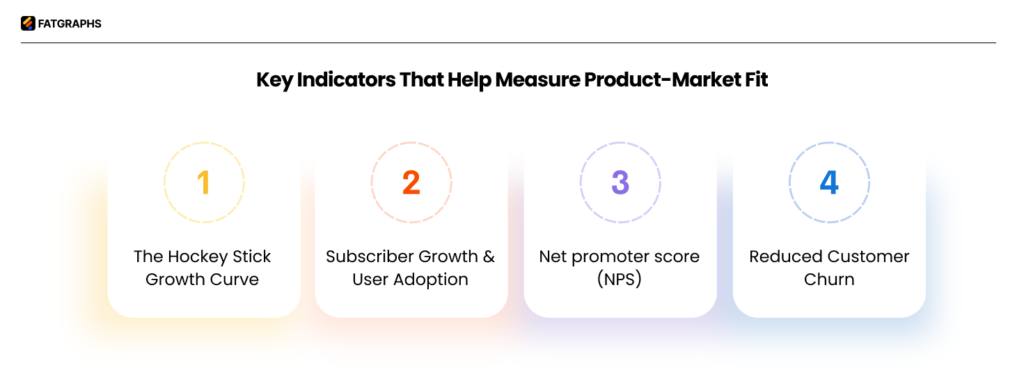
There is no single metric that confirms product-market fit. Instead, it emerges through a combination of SaaS marketing KPIs or growth patterns, customer engagement, and retention signals. The following indicators are commonly used by founders and product teams to measure product market fit effectively.
1- The Hockey Stick Growth Curve
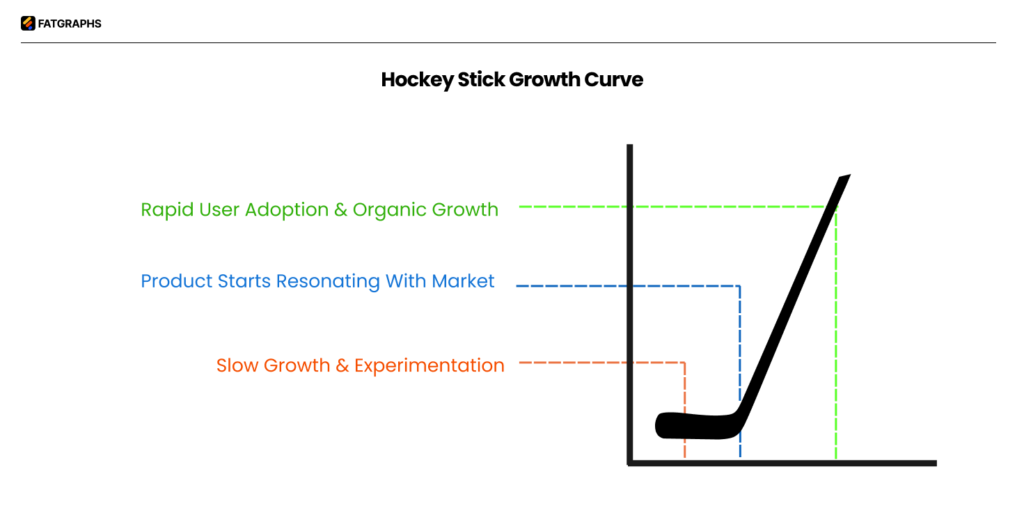
One of the most recognizable signals of product-market fit is the hockey stick growth curve.
➥ What the Hockey Stick Curve Represents
In the early stages of a product, growth is typically slow while the team experiments with positioning, features, and customer segments. Once the product begins to resonate with the market, growth suddenly accelerates. This pattern creates a curve that resembles a hockey stick: a flat line followed by a sharp upward trajectory.
➥ Why This Pattern Indicates Product-Market Fit
The upward growth phase usually appears when the product begins solving a clear problem for a defined audience. At this point:
- Customers start recommending the product to others
- Organic acquisition begins to increase
- Marketing efforts become more efficient
- User adoption grows more consistently
These signals suggest that the product is no longer struggling to find its audience.
➥ Avoid Misinterpreting Temporary Growth
Not every growth spike indicates product-market fit. Temporary marketing campaigns, promotions, or partnerships can also create short-term spikes in user numbers. To truly measure PMF growth should remain consistent and sustainable over time rather than appearing as isolated spikes.
2- Subscriber Growth and User Adoption

Another important indicator when trying to measure product market fit is the rate at which new users or subscribers adopt the product. Subscriber growth reflects whether people see enough value in the product to start using it. When a product solves a real problem, adoption gradually increases as more users discover its usefulness. Sustained subscriber growth typically indicates that the market recognizes the product’s value.
➥ Focus on Quality of Users, Not Just Quantity
While growth in user numbers is important, the quality of those users matters even more. A large number of sign-ups does not necessarily indicate product-market fit if users abandon the product quickly. Companies should analyze whether users:
- Continue using the product after signing up
- Engage regularly with core features
- Upgrade to paid plans or subscriptions
- Integrate the product into their daily work
Consistent engagement among new users is a stronger signal of product-market fit than raw sign-up numbers alone.
➥ Adoption Patterns That Indicate Market Alignment
When product-market fit begins to emerge, user adoption tends to display several patterns. Onboarding becomes easier as the product value becomes clearer. Activation rates improve as users quickly experience the product’s benefits. Product usage increases across different user segments. These patterns show that the product is aligning more closely with the needs of the market.
3- Net Promoter Score (NPS) Surveys
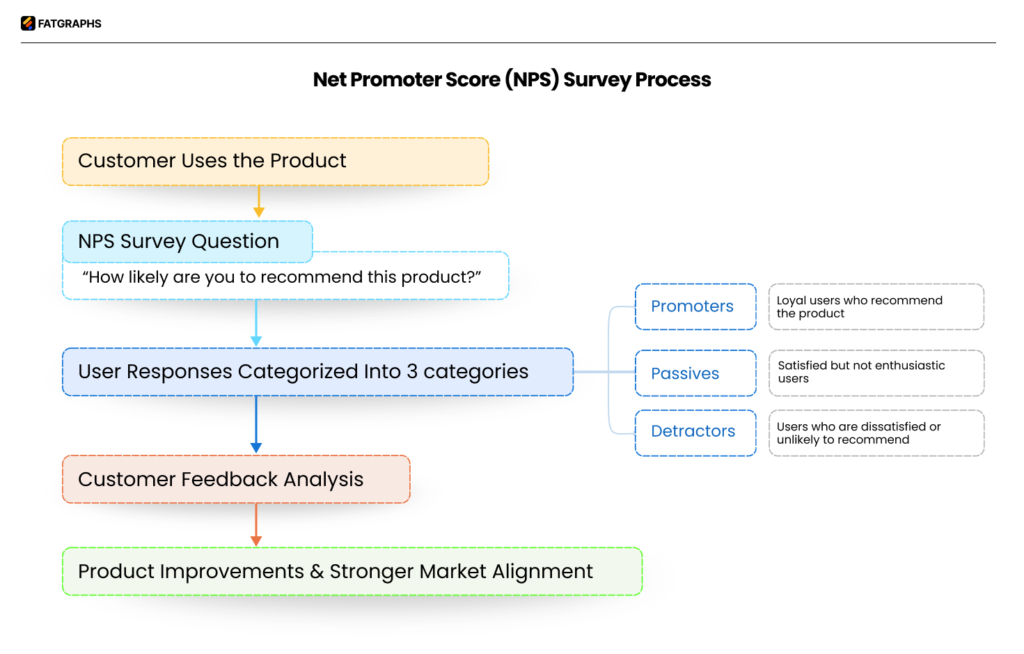
Customer satisfaction is another critical factor when evaluating product-market fit. One widely used method for measuring satisfaction and loyalty is the Net Promoter Score (NPS) survey.
➥ What an NPS Survey Measures
An NPS survey asks users a simple question: how likely they are to recommend the product to others. Based on their responses, users are typically categorized as promoters, passives, or detractors. This metric helps determine how strongly customers value the product.
➥ Why NPS Is Useful for Measuring Product-Market Fit
When a product achieves strong product-market fit, customers often become enthusiastic advocates. They recommend the product to colleagues, friends, or industry peers because it solves a real problem. High promoter responses suggest that the product delivers meaningful value to users. Promoter feedback can provide insights into the specific features or benefits that resonate most with customers.
➥ Learning from Customer Feedback
While the numerical score itself is useful, the qualitative feedback from users can be even more valuable. Promoters may highlight features they find essential, while detractors may reveal usability problems or missing functionality. Analyzing these responses allows product teams to refine the product and strengthen market alignment.
4- Reduced Customer Churn
Customer churn is another critical indicator used to measure product-market fit, particularly for SaaS and subscription-based businesses. Churn refers to the percentage of users who stop using or cancel a product within a given period. High churn rates typically indicate that customers are not finding enough value in the product to continue using it. In the early stages of a product, churn can be relatively high as the team experiments with features and positioning.
➥ Why Reduced Churn Signals Product-Market Fit
When product-market fit begins to emerge, churn rates typically decrease. Customers stay longer because the product provides ongoing value. A reduced value of churn suggests that:
- Users rely on the product regularly
- The product solves a meaningful problem
- Customers perceive long-term value in continuing to use it
Retention becomes a powerful indicator that the product fits the needs of its market.
➥ Monitoring Different Types of Churn
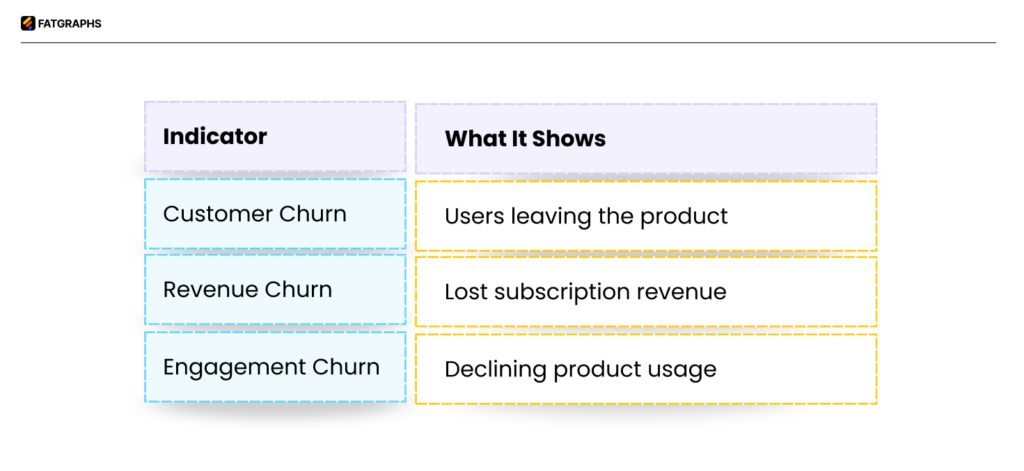
Tracking these metrics provides a more accurate picture of whether customers are truly committed to the product.
Additional Signals That Often Appear Alongside Product-Market Fit
Beyond the core metrics above, several additional indicators often appear when a product approaches strong market alignment.
1- Strong Customer Retention
Retention measures how many users continue using the product over time. Products with strong product-market fit tend to maintain high retention levels because customers rely on them for ongoing tasks or workflows. High retention suggests that the product has become valuable enough to remain part of users’ routines.
2- Word-of-Mouth Growth
Another clear signal of product-market fit is organic referrals. When customers genuinely value a product, they naturally recommend it to others. This creates a powerful growth loop where satisfied users introduce the product to new audiences without direct marketing efforts. Word-of-mouth growth often reduces customer acquisition costs and increases overall growth efficiency.
3- Customer Feedback Becomes More Specific
In the early stages of a product, feedback often focuses on basic functionality or usability issues. Once product-market fit begins to develop, customer feedback shifts toward feature improvements and optimization. Users stop asking what the product does and instead suggest ways to make it even better. This change indicates that customers already see the product as valuable.
Common Mistakes When Measuring Product-Market Fit
Many teams misinterpret signals when trying to measure product market fit, which can lead to premature scaling decisions.
1- Confusing Early Traction with Product-Market Fit
Early adoption or press coverage can create the impression that a product has achieved strong market demand. However, temporary attention does not necessarily translate into long-term engagement. Sustained growth and retention are stronger indicators than short-term traction.
2- Relying on a Single Metric
Product-market fit cannot be confirmed using one metric alone. Growth, retention, satisfaction, and engagement metrics must be evaluated together to form a reliable conclusion. Relying on only one indicator often creates a misleading picture.
3- Ignoring Qualitative Customer Insights
Quantitative metrics are valuable, but they do not always reveal why customers behave in certain ways. User interviews, feedback surveys, and customer conversations often provide deeper insights into product value and unmet needs. Combining data with qualitative insights leads to better product decisions.
A Practical Framework to Measure Product-Market Fit
A structured approach can make it easier for product teams to evaluate market alignment. A practical framework includes the following steps:
- Monitor user growth patterns to identify sustainable adoption trends
- Track retention and churn metrics over time
- Collect customer satisfaction feedback through surveys
- Analyze engagement with core product features
- Conduct user interviews to understand perceived product value
By combining these signals, companies can determine whether the product is truly resonating with its intended market.
Conclusion
Product-market fit represents the stage where a product successfully meets the needs of a specific market. Achieving this alignment is essential before investing heavily in growth or expansion. To measure product market fit, companies must analyze multiple indicators rather than relying on a single metric. Growth patterns such as the hockey stick curve, increasing subscriber adoption, strong Net Promoter Scores, and reduced customer churn all provide valuable signals.
Additional indicators such as strong retention, word-of-mouth referrals, and evolving customer feedback further confirm market alignment. When these signals appear consistently together, it suggests that the product delivers meaningful value to its users and is ready for scalable growth. Understanding how to measure product-market fit allows startups and SaaS companies to make smarter decisions, reduce risk, and build products that truly solve customer problems.