
 Book Call with Haroon
Businesses lose billions each year because customers leave. This number is shocking, yet more than two out of three businesses have no strategy to reduce churn in SaaS. The situation gets pricey when you realize that acquiring a new customer needs 5 times more resources than keeping an existing one.
Most companies focus solely on the SaaS acquisition system while neglecting retention when dealing with SaaS churn. Their approach creates a leaky bucket effect; new users keep flowing in while existing customers quietly slip away. A successful churn reduction strategy needs to address your entire customer lifecycle, not just the sales funnel.
The guide shows why customer retention starts before the first login and how emotional connections build loyalty. You’ll also learn about practical tools that help spot and address churn before it happens.
The Real Cost of Churn that SaaS Companies Ignore
SaaS companies track churn rates and try to reduce churn in SaaS, but don’t get their devastating financial damage. These hidden costs go way beyond lost subscription revenue. A chain of risks can end up slowing growth.
Why does obsessing over acquisition bring churn?
Numbers paint a worrying picture 44% of companies care more about customer acquisition than retention, while only 18% put existing customers first. This gap stays even as acquisition gets pricey. Costs shot up by nearly 50% in the last five years and jumped an eye-opening 222% in just eight years.
SOURCE: SaaSquatch
This addiction to acquisition can get pricey. Companies that chase volume instead of strategic fit and put new logos ahead of loyal customers often sign up the wrong users. These mismatched customers become tomorrow’s churn numbers. Companies lose $1.8 trillion annually when customers switch.
SOURCE: SaaSquatch
How churn affects long-term growth
Churn creates an invisible ceiling for growth. Your expanding customer base hits a point where new customers just replace those who left, growth of zero growth. This balance shows churn’s dramatic effect on scaling potential.
High churn rates raise red flags about product-market fit. Companies with small total addressable markets face bigger problems. Winning back trust from churned customers becomes a huge challenge.
| Profit Impact | A 5% drop in churn can boost profits by 25% |
| SaaS Average Churn | 5–7% |
| Small Business Churn | Up to 20% |
| Companies $10M+ Revenue | 8.50% |
Money talks. A 5% drop in churn can boost profits by 25%. This shows why unchecked customer losses hurt so much. Average SaaS churn rates sit between 5-7%. Small businesses see up to 20% churn, while companies with over $10M revenue average 8.5%.
The LTV vs. CAC imbalance
Sustainable SaaS growth needs a healthy balance between customer acquisition cost (CAC) and lifetime value (LTV). The sustainable LTV: CAC ratio should be 3:1. This means $1,000 in CAC should bring at least $3,000 in lifetime revenue.
Casper Sleep’s story serves as a warning. Despite high visibility and strong early backing, their low LTV: CAC ratio cut their valuation in half from $1.1 billion to $575 million. They sold for just $286 million.
CAC exceeding LTV (ratio below 1:1) means losing money on each new customer. No amount of growth hacking can fix this math problem.
Source: HiBob
What nobody tells you about customer retention
Customer retention doesn’t start after someone becomes a paying user. This old-school thinking misses significant elements that determine whether customers stay or leave.
Retention starts before the first login
The retention experience starts during the sales process, not after purchase. Long-lasting relationships need clear expectations about what your product can and can’t do. Many companies oversell features. This leads to disappointment when reality doesn’t match the promises.
Your approach should focus on understanding your customers’ Jobs to Be Done (JTBD). This understanding helps you tailor their experience from day one. Users need guidance to specific features that solve their unique problems rather than seeing everything at once.
Why onboarding is your biggest churn lever
The numbers tell a clear story about how onboarding affects retention:
- Onboarding that works increases customer retention by 50%
- 86% of customers show greater loyalty when they get educational onboarding
- More than half of B2B SaaS customers stop using products they don’t understand
Users leave for two main reasons: they don’t understand the product or don’t see its value. A personalized onboarding process fixes both problems by helping users quickly reach their “aha moment” – when your product’s value becomes crystal clear.
The role of emotional connection in SaaS loyalty
Emotional connections do more than just improve functionality. Companies that build emotional connections grow sales 85% faster than their competitors. These connected customers stick around for 5.1 years, while satisfied but uninvolved customers only stay 3.4 years.
These connections show up in business results. Emotionally connected customers bring 52% more value than just satisfied ones. Research shows this emotional bond can boost customer loyalty programs, leading to eight times more visits and sales.
Building these connections means understanding each customer’s needs and delivering more value than expected. It also means getting personalization right – 33% of consumers will leave brands that don’t deliver tailored experiences.
Reduce churn in SaaS: Strategies that actually work
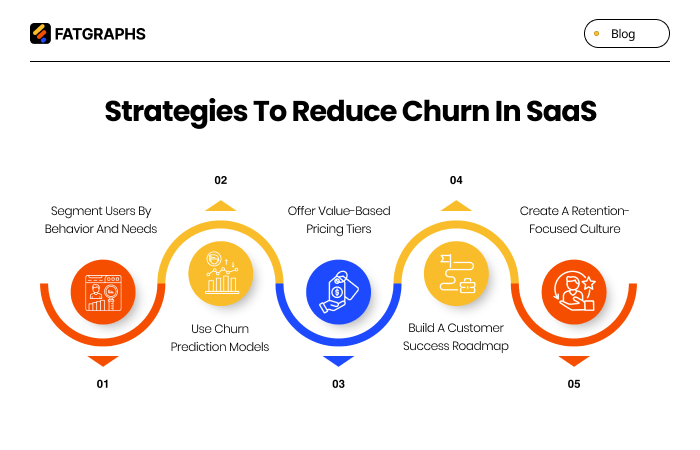
A systematic approach, not reactive firefighting, helps reduce customer churn. Research shows profits can jump 25% to 95% with just a 5% increase in customer retention rates. Here are five proven strategies that will help you get measurable results:
1. Segment users by behavior and needs
Smart segmentation goes beyond simple demographics. You can spot customers who need attention by analyzing their usage patterns, feature adoption, and engagement levels. Companies that adapt their strategies to different customer segments see annual profit growth of 15%. Those that don’t manage only 5% growth.
Dynamic segmentation responds to up-to-the-minute behavior and helps you spot early warning signs. You can step in before customer frustration leads to them leaving.
2. Use churn prediction models
Churn prediction models exploit historical data and statistical methods to spot customers likely to leave. These models unite many data points—usage patterns, support tickets, billing history—to create risk scores you can act on.
Most organizations (73%) now focus on growing existing customer relationships. Your prediction model should group customers by both their likelihood to leave and their value. This helps focus your retention efforts where they matter most.
3. Offer value-based pricing tiers
Companies using value-based pricing see 30% lower churn rates than those using cost-plus or competitor-based pricing. Value-based tiers let customers pick plans that match their needs and budgets.
Customers can naturally grow into higher tiers as their needs change. This tiered approach gives you more predictable revenue and gives customers the flexibility to stay rather than leave.
4. Build a customer success roadmap
Your customer success roadmap should cover everything in the customer lifecycle. Tailored onboarding helps users see benefits quickly and reduces time-to-value.
Regular check-ins and support through multiple channels help catch problems early. Customer feedback and usage data monitoring ensure your product stays relevant as needs change.
5. Create a retention-focused culture
Customers should be at the heart of everything you do in a retention-focused culture. Every team from product and engineering to marketing and customer success needs to prioritize keeping customers happy.
Teams working together matter because important insights can get lost in silos. Companies that connect their customer success and pricing teams see 23% higher net retention rates than those who keep these functions separate.
Tech stack to support churn reduction
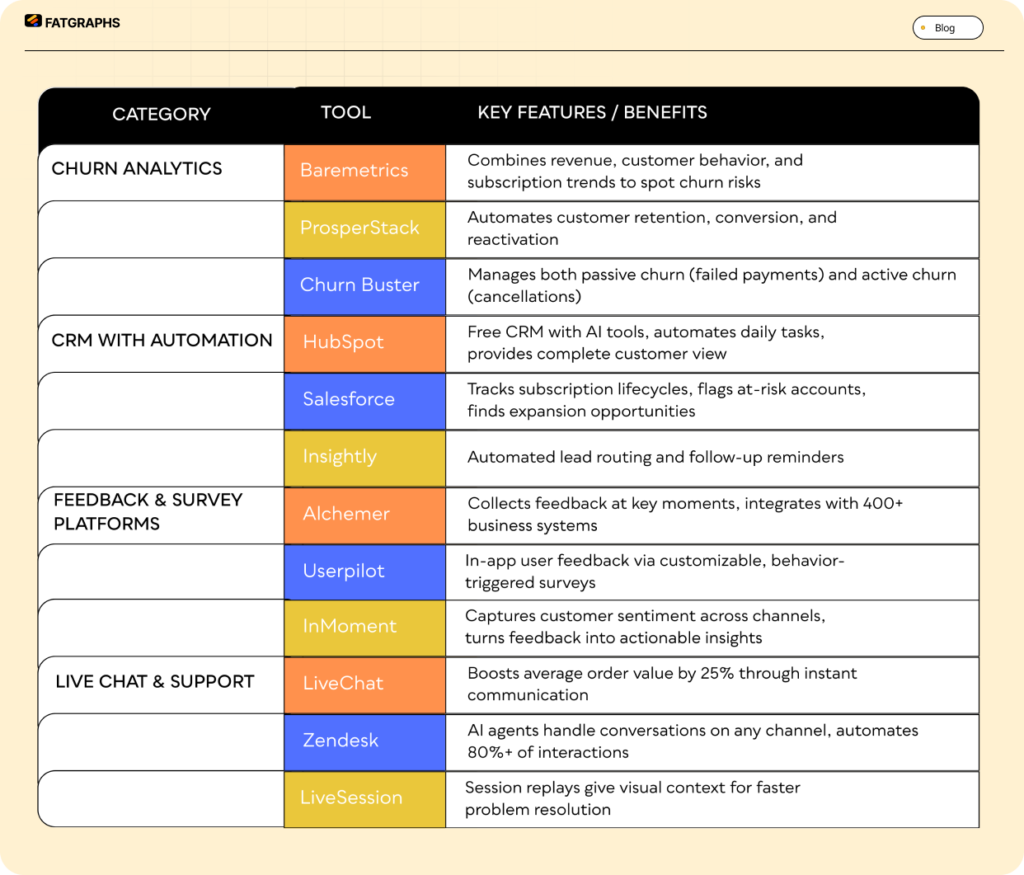
A well-designed tech stack is vital to execute your churn reduction strategy. The right tools are a great way to get insights into customer behavior, automate processes, and help you step in before problems arise.
Conclusion
A business needs to change from reactive measures to proactive strategies to reduce churn in SaaS. The retention process starts well before users think about leaving – it begins during the sales process when expectations are set clearly. Successful SaaS companies know that preventing churn needs attention throughout the customer’s experience rather than at specific points.
Effective onboarding is your most powerful tool to reduce churn in SaaS. Customers stay loyal when they quickly grasp your product’s value. This loyalty grows stronger when you promote emotional connections that turn satisfied users into devoted supporters.
Informed strategies make your retention efforts more effective. User segmentation based on behavior patterns helps spot at-risk customers early. Churn prediction models turn complex usage data into useful information. Value-based pricing ensures customers find plans that match their needs. Customer success roadmaps guide them through a well-designed experience. These elements need to exist within a company culture where every department focuses on retention.
Without doubt, the right tech stack makes your anti-churn efforts stronger. Analytics tools, automated CRM systems, feedback platforms, and support integrations work together to spot problems early and streamline solutions.
Customer churn silently kills businesses, yet you can address it with strategic focus. Common wisdom suggests new customers drive growth, but your existing customer base offers better profit potential with less effort. SaaS success depends on balancing acquisition with retention – the most sustainable path to growth comes from keeping your current customers.
FAQs
Q1. What is the real cost of customer churn for SaaS companies?
The real cost of churn extends beyond lost subscription revenue. It can create a growth ceiling, impact long-term scalability, and lead to an imbalance between customer acquisition costs (CAC) and lifetime value (LTV). Reducing churn by just 5% can potentially boost profits by 25-95%.
Q2. How does onboarding affect customer retention in SaaS?
Effective onboarding is crucial for reducing churn. It can increase customer retention by 50% and foster greater loyalty. A personalized onboarding process helps users quickly understand the product’s value, addressing the two major reasons for churn: lack of understanding and lack of perceived value.
Q3. What role does emotional connection play in SaaS customer loyalty?
Emotional connections significantly influence retention in SaaS. Companies that provide emotional connections outperform competitors’ sales growth by 85%. Emotionally connected customers typically stay with brands for 5.1 years compared to 3.4 years for merely satisfied customers, and they can be 52% more valuable.
Q4. What are some effective strategies to reduce churn in SaaS?
Effective strategies include segmenting users by behavior and needs, using churn prediction models, offering value-based pricing tiers, building a customer success roadmap, and creating a retention-focused culture. These approaches help identify at-risk customers, align pricing with value, and ensure the entire organization prioritizes retention.
Q5. How can technology support churn reduction efforts in SaaS?
A well-designed tech stack is crucial for executing churn reduction strategies. Key components include churn analytics tools for identifying risks, CRM systems with automation for managing customer relationships, feedback platforms for gathering user insights, and live chat integrations for providing instant support. These tools work together to flag potential issues early and enable proactive interventions.