
 Book Call with Haroon
Revenue leakage in SaaS is one of the most underestimated threats to sustainable growth. Many B2B SaaS founders focus heavily on pipeline, acquisition, and expansion. However, a significant amount of revenue can quietly disappear inside operational gaps long before it shows up in your dashboards.
In simple terms, revenue leakage in SaaS happens when your company delivers value to customers but fails to collect the full amount it has earned. These losses are usually not dramatic or obvious. Instead, they occur in small amounts across billing errors, failed payments, pricing inconsistencies, or usage tracking problems. Because each loss looks minor, the problem often remains hidden until it compounds into a material financial gap.
For B2B SaaS companies operating on recurring revenue, even small inefficiencies repeat every billing cycle. Over time, this makes SaaS funnel leaks far more dangerous than many founders initially assume.
Why founders often miss revenue leaks
Founders who treat Revenue leakage in SaaS as a minor finance issue often discover the problem much later during due diligence, fundraising, or late-stage scaling. By then, the cleanup is far more complex and expensive.
The compounding risk in subscription models
In a subscription business, revenue quality matters just as much as revenue growth. Investors and operators increasingly look beyond top-line ARR and focus on how much of that revenue is actually collected and retained.
When revenue leaks in B2B environments, the damage spreads across multiple areas. Forecasts become less reliable because booked revenue does not match collected cash. Net revenue retention weakens because expansion and renewal billing are inconsistent. Finance teams spend increasing time fixing invoices manually, which raises operational costs.
The most important factor is compounding. If a SaaS company underbills a customer by a small amount each month, that error repeats automatically across the lifetime of the account.
What Revenue Leakage in SaaS Means
Revenue leakage in SaaS refers to the portion of legitimate revenue that a SaaS company fails to capture because of gaps in systems, processes, or controls. The company has already delivered the product or service, but the full payment has never collected. This is different from churn, where customers intentionally leave. Revenue leakage is usually preventable and operational in nature.
Where revenue leaks typically occur
In SaaS businesses, leakage typically appears in the quote-to-cash journey. A deal may be closed correctly by sales, but somewhere between the contract, billing system, usage metering, or payment collection, the numbers stop aligning. Because modern SaaS stacks involve multiple connected systems, even small misalignments can create ongoing revenue leaks.
The Most Common Causes of Revenue Leakage in SaaS
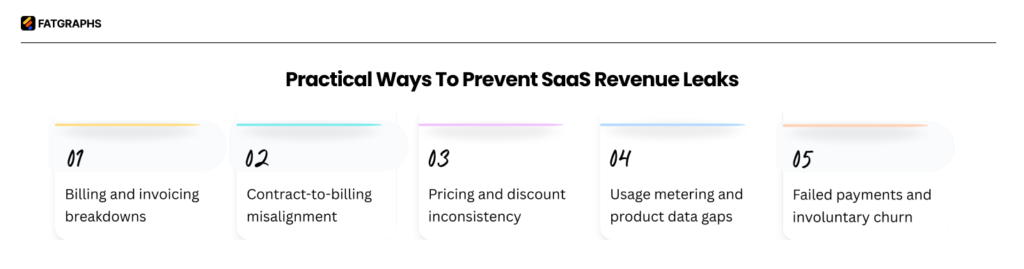
1- Billing and invoicing breakdowns
One of the most frequent causes is a billing and invoicing error. As SaaS companies grow, manual billing processes struggle to keep up with deal complexity. Finance teams may enter invoice data manually, apply discounts inconsistently, or miss billing cycles. Each small mistake may look harmless, but together they create a steady funnel leakage.
2- Contract-to-billing misalignment
Another major source is contract-to-billing misalignment. In many B2B SaaS companies, sales teams negotiate custom pricing, multi-year terms, or bundled add-ons. If this information is not perfectly synced into the billing system, the customer may be charged incorrectly. This problem becomes more common as deal complexity increases.
3- Pricing and discount inconsistency
Without strong governance, different customers end up on slightly different pricing structures. Legacy pricing remains active longer than intended, and discounts are applied without full visibility. Over time, these inconsistencies quietly erode SaaS revenue and margins.
4- Usage metering and product data gaps
Usage metering failures create a more technical form of leakage. In usage-based or hybrid SaaS models, revenue depends on accurately capturing product activity. If event tracking drops data or overages are not triggered properly, customers can consume more value than they are billed for. This type of funnel leakage often remains hidden until deep reconciliation is performed.
Failed payments and involuntary churn
Payment failure is another major driver. Many founders underestimate involuntary churn caused by expired cards or temporary payment issues. Without a strong recovery system, these payments simply fail, and the revenue disappears even though the customer may still be using the product.
Identifying SaaS Funnel Leaks
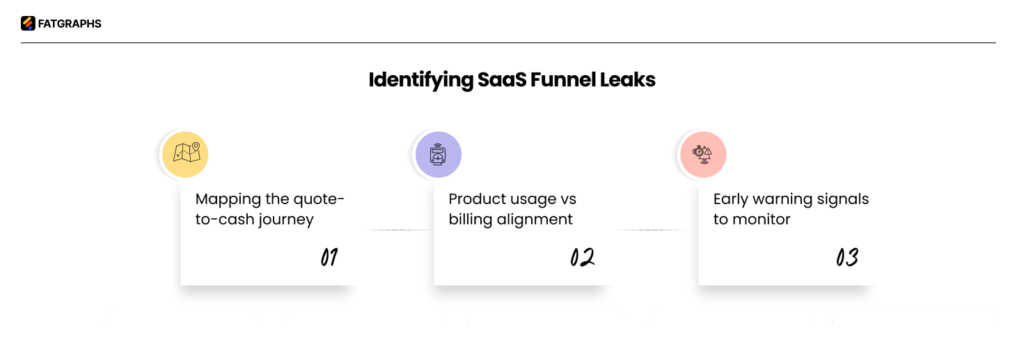
Mapping the quote-to-cash journey
Before you can reduce revenue leakage in SaaS, you must understand exactly where revenue is escaping. This requires looking at the full quote-to-cash funnel rather than isolated SaaS metrics. In most B2B SaaS companies, leakage occurs at transition points between systems or teams.
Product usage vs billing alignment
Founders should pay particular attention to the alignment between product usage and billing. If your platform is usage-based in any way, you need high confidence that every billable event is captured, processed, and invoiced correctly. Even sa mall event loss can create meaningful revenue gaps at scale.
Early warning signals to monitor
There are behavioral signals that often indicate hidden leakage. If ARR is growing but cash collection is not keeping pace, that is an early warning sign. Frequent manual invoice adjustments or rising billing disputes also typically point to underlying system misalignment.
How to Identify Revenue Leaks in Your SaaS
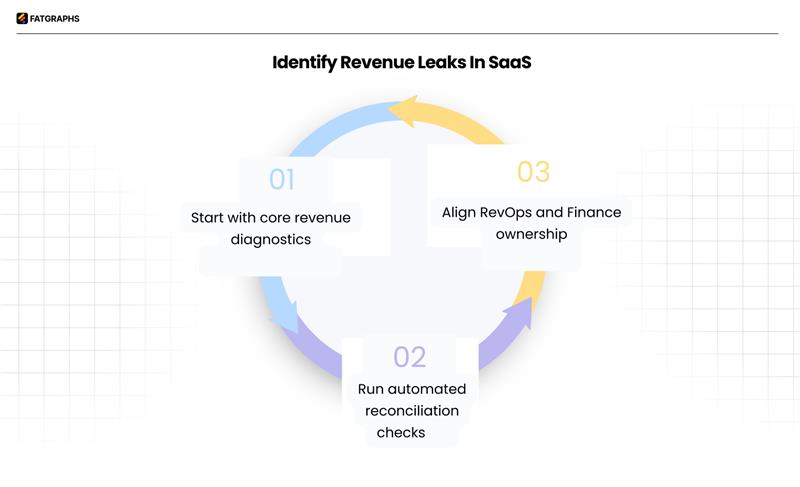
Start with core revenue diagnostics
The most effective way to identify revenue leaks is through disciplined reconciliation and cross-system visibility. Start by comparing ARR to actual cash collected. While timing differences will exist, large or widening gaps often indicate leakage.
Run automated reconciliation checks
High-performing SaaS companies run automated reconciliation between contracts, usage data, CRM records, and billing outputs. These checks expose mismatches that manual reviews often miss.
Align RevOps and Finance ownership
Revenue leakage prevention sits at the intersection of RevOps, finance, product, and sales. When each team optimizes only for its own metrics, gaps emerge. When data flows cleanly across the revenue stack, leaks become much easier to detect and fix.
Practical Ways to Prevent Revenue Leakage in SaaS
Automate contract-to-billing workflows
Preventing SaaS revenue leakage starts with eliminating manual handoffs between sales and billing. When closed deals automatically sync into billing with validated pricing rules, a large category of errors disappears.
Enforce pricing governance
Companies that maintain a centralized pricing catalog, enforce discount approvals, and standardize renewal logic tend to experience far fewer revenue leaks over time.
Strengthen payment recovery systems
Payment recovery often delivers quick wins. Intelligent retry logic, card updater tools, and multi-channel dunning workflows can recover a meaningful portion of otherwise lost revenue.
Improve usage accuracy
For usage-based models, monitoring event pipelines and regularly reconciling usage against invoices helps ensure customers are billed accurately for the value they consume.
How to Reduce revenue leakage in SaaS at Scale
1- Build process maturity early
As your customer base grows, leakage risk increases unless your processes mature alongside revenue. Growth-stage SaaS companies should formalize revenue workflows, remove manual dependencies, and introduce automated controls wherever possible.
2- Create a single source of truth
Fragmented data environments make leakage difficult to detect. The most effective companies build an integrated revenue system where CRM, product telemetry, billing, and finance operate from a shared source of truth.
3- Implement continuous monitoring
The most effective companies treat revenue assurance as an ongoing operational capability rather than a one-time cleanup project. Continuous monitoring, automated alerts, and regular RevOps reviews help ensure that once leaks are fixed, they stay fixed.
Conclusion
Revenue leakage in SaaS is rarely caused by one dramatic failure. It usually emerges from many small gaps across billing, pricing, usage tracking, and payment recovery. Because subscription models amplify small inefficiencies, these leaks can quietly erode ARR quality and margins over time. For B2B SaaS founders, the opportunity is significant.
Plugging revenue leaks often delivers immediate financial impact without increasing customer acquisition spend. Start by identifying SaaS funnel leaks across your quote-to-cash process. Then strengthen automation, enforce pricing discipline, improve payment recovery, and continuously monitor your revenue systems. Growth attracts attention. Revenue integrity builds durable SaaS companies.