
 Book Call with Haroon
Growing a SaaS business without a clear plan for getting new customers is like trying to fill a bucket with a hole; it’s exhausting and often fails. Many founders focus only on making their product better, hoping that customers will come automatically. The problem is, even if the best product cannot succeed if no one knows about it. With acquisition costs rising and buyer behavior changing, keeping up withcurrent B2B SaaS marketing trends is no longer optional. This is why the most successful SaaS companies build SaaS acquisition engine systems that consistently attract and convert users into paying customers.
What is a SaaS Acquisition Engine?
A SaaS acquisition engine is a system that brings new customers in a repeatable and scalable way. Unlike random marketing tricks, an acquisition engine is organized to:
◉ Find potential customers
◉ Engage them effectively
◉ Convert them into paying users
Companies that have good acquisition engines grow faster, often 19% faster than companies without one. In short, an acquisition engine is the main tool for growing your SaaS business smartly and predictably.
Why Acquisition is the Key to SaaS Growth?
Customer acquisition is the main growth lever for SaaS businesses. Each new user does not just give a one-time payment; they contribute recurring revenue. This means more cash to improve the product, expand the team, and reach new markets.
Investors also pay attention to how efficiently you acquire customers and manage the SaaS acquisition engine. If it costs too much to get a customer compared to how much money they bring in over time, your business won’t scale well. Efficient acquisition is important for survival, valuation, and long-term success.
Funnels vs. Growth Loops
For years, businesses used funnels to understand growth. A SaaS funnel maps a customer’s journey from first hearing about your product to becoming a paying customer. One common framework is the Pirate framework or AARRR: Acquisition, Activation, Retention, Referral, Revenue.
| • Funnels have limits. • They are linear, which means you must always bring in new users to keep growing. • This can be expensive and slow. | • Growth loops are different. • In a loop, the output of one user brings in more users. • The process is self-sustaining and can grow faster over time. |
For example, Venmo grows because when one person sends money to a friend, that friend is invited to join. Every transaction keeps feeding the loop. Modern SaaS growth often combines funnels for tracking and loops for compounding growth.
Payoneer users share referral links with others. When someone signs up and completes the required steps, both the referrer and the new user get rewards. This process continuously brings in new users through existing users.
When to Build Your First SaaS Acquisition Engine
You should build your first acquisition engine when you have:
| Product validation | Your product solves a real problem |
| Ideal customer profile | You know who benefits most from your product |
| Basic unit economics | You understand CAC compared to their lifetime value |
| Resources & Budget | You have a team and a budget to run campaigns |
Many startups fail because they try to grow too early or use too many channels at once. According to research, 70% of startups fail due to premature scaling. Building a proper acquisition engine at the right time increases your chances of long-term success.
Types of SaaS Acquisition Engines
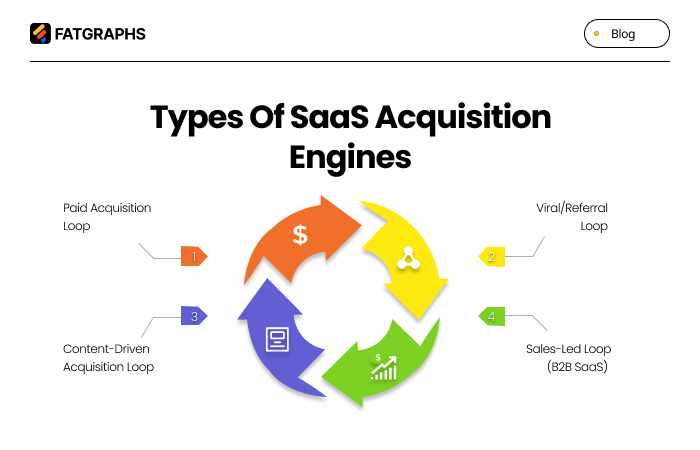
1- Paid acquisition loop
- You pay to attract customers whose lifetime value is higher than the cost of getting them.
- Works best if your product solves a problem users are actively searching for.
- Requires a clear understanding of cost per click (CPC), trial conversion rates, and paid conversion rates.
- Example: Dropbox initially spent too much on paid ads for a low-cost product and had to turn on other strategies.
2- Content-driven acquisition loop
- Use blogs, webinars, guides, and reports to attract users organically.
- Content works long-term, unlike paid campaigns that stop delivering once spending ends.
- Ideal for products that require research and education before purchasing.
3- Viral/referral loop
- Users invite others to use your product.
- Effective when each user brings in more than one new user (viral coefficient >1).
- Examples: Google Docs spread through collaboration; Zoom grows when users invite colleagues to meetings.
4- Sales-led loop (B2B SaaS)
- Your sales team is central to acquiring new customers.
- Works well for high-value or complex products with multiple decision-makers.
- Advantages include higher contract values and better visibility into revenue pipelines.
Building Your First SaaS Acquisition Engine: Step-by-Step
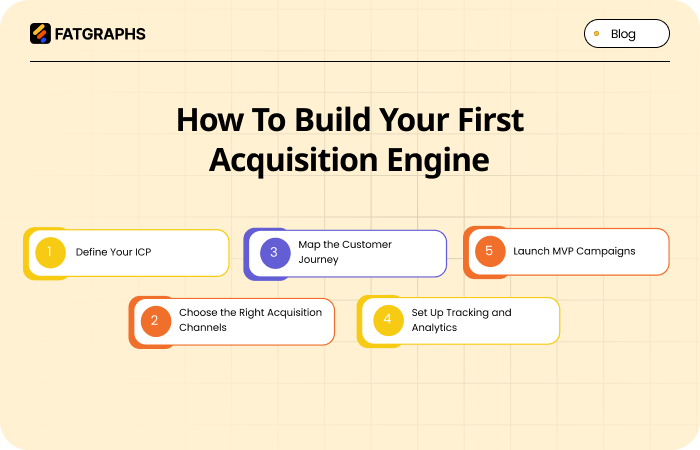
1. Define Your ICP (Ideal Customer Profile)
A clear understanding of your Ideal Customer Profile (ICP) helps you target the right audience, tailor messaging, and drive higher ROI. Here’s how to break it down:
| A. Demographics | |
| Age | Identify the most common age range among your buyers: millennials, Gen X, or older professionals. |
| Location | Determine where they are based, country, region, city, and consider urban vs. rural areas, time zones, and local market trends. |
| Gender | Understand if your product appeals more to a specific gender and how that may influence messaging or marketing channels. |
| B. Firmographics | |
| Company Size | Small, medium, or enterprise? Employee counts and revenue indicate purchasing power. |
| Industry | Identify sectors that gain the most value from your solution. |
| Revenue/Budget | Understand your customer’s financial capacity to invest. |
| Decision-Making Structure | Determine who typically makes purchasing decisions for C-level executives, managers, or individual contributors |
C. Pain Points & Challenges
Identify the key problems your product solves, considering both operational and emotional needs.
Operational Inefficiencies ➨ Time-consuming processes, manual workflows, and outdated tools.
Financial Challenges ➨ High costs, budget constraints, or poor ROI from current solutions.
Skill Gaps ➨ Lack of internal expertise or training.
Market Pressures ➨ Competition, regulatory changes, or evolving customer expectations.
Decision-Making Stress ➨ Uncertainty about choosing the right solution, fear of wasting money.
2. Map the Customer Journey
Identify how a customer goes from hearing about your product to becoming an advocate. Steps usually include:
Awareness → Consideration → Signup → Onboarding → Adoption → Retention → Advocacy
For each step, note:
- Customer goals
- Actions they take
- Challenges they face
- Key touchpoints with your product
3. Choose the Right Acquisition Channels
Focus on one to three channels that your customers naturally use to engage with your brand. These may include content marketing such as blogs, social media, and webinars, paid advertising, targeted email campaigns, or referral programs. Concentrating on a limited number of high-performing channels helps ensure consistent messaging and more effective customer outreach.
4. Set Up Tracking and Analytics
Measure what matters by tracking user behavior across devices, monitoring conversion rates, and analyzing SaaS-specific metrics such as subscription type and signup date to gain actionable insights and drive better decision-making.
5. Launch MVP Campaigns
Start small test messaging and channels. Gather feedback through surveys or in-app tools and refine your approach. Optimizing for Scale:
➥ Measure CAC, LTV, and payback period
CAC → cost to get a new customer
LTV → total revenue from a customer
Payback period → how long it takes to recover CAC
➥ Improve conversion rates
Test different user journeys (A/B testing), focus on early engagement; the first few days are critical, and analyze cohorts to find drop-off points
➥ Reduce churn
Good onboarding, personalized retention offers, and targeted win-back campaigns help re-engage churned customers and improve long-term retention.
➥ Use automation
Tools like Intercom, Zapier, and Chargebee can streamline lead scoring, follow-ups, and data entry. Automation helps scale without hiring more staff
Common Pitfalls
✔ Chasing too many channels; Focus on the one that works best
✔ Underestimating CAC; Include overhead, onboarding, and sales costs
✔ Ignoring product-channel fit, even a great product fails if it’s in the wrong channel
✔ Neglecting trust-building; Offer free trials, money-back guarantees, and clear security messaging
Conclusion
A SaaS acquisition engine is the backbone of predictable growth. Start by defining your ideal customer, mapping their journey, choosing the right channels, and tracking metrics like CAC and LTV. Optimize continuously, reduce churn, and use automation to scale efficiently.
Building your first acquisition engine may take time, and it may not be perfect at first. But a systematic approach focused on testing, learning, and refining creates a strong foundation for sustainable B2B SaaS growth in 2026 and beyond.
FAQs
1. What is a SaaS engine?
A SaaS (Software-as-a-Service) engine refers to the systems, processes, and strategies a SaaS company uses to attract, convert, and retain customers. It’s essentially the growth and acquisition framework that powers recurring revenue. This includes marketing, sales, onboarding, product engagement, and retention strategies to efficiently turn prospects into paying, loyal users while optimizing scalability.
2. What are common B2B SaaS mistakes?
Some of the most frequent mistakes B2B SaaS companies make include:
1- Ignoring customer validation ➔ Building features without confirming real user needs.
2- Focusing on features over outcomes ➔ Selling tools instead of solutions to problems.
3- Poor onboarding and activation ➔ Users don’t see immediate value, leading to churn.
4- Treating acquisition as disconnected campaigns ➔ Marketing, sales, and product work in silos instead of a holistic system.
5- Neglecting metrics ➔ Failing to track LTV, CAC, churn, and conversion rates.
6- Scaling too fast ➔ Investing growth without product market fit or sustainable economics.
3. How is CAC calculated in SaaS?
CAC (Customer Acquisition Cost) measures the average cost to acquire a single customer.
Formula:
CAC = (Total Sales + Marketing Spend) ÷ (Number of new customers Acquired)
Example:
- Marketing expenditure: $50,000
- Sales team costs: $30,000
- New customers acquired: 400
CAC = (50,000 + 30,000) ÷ 400 = 200
So, CAC = $200 per customer.
4. What are the Key Components of a SaaS Acquisition Engine?
The key components of the SaaS acquisition engine are: Lead generation, Lead conversion, and sales & onboarding.
1. Lead Generation – Attract Users:
- Inbound: SEO, content marketing, blogs, webinars, freemium/trials
- Outbound: Paid ads (PPC), emails, targeted prospecting
- Partnerships/Affiliates: Leverage other companies’ audiences
2. Lead Nurturing & Conversion – Guide Prospects:
- Personalized email sequences
- Educational content
- Product-led experiences
- Targeted campaigns to turn leads into paying users
3. Sales & Onboarding – Convert & Retain:
- Qualify leads and offer demos/trials
- Smooth onboarding to show immediate value
- In-product guidance and support to ensure adoption
5. What are the Core Principles or Metrics of a SaaS Acquisition Engine?
Holistic Approach: Combine inbound, outbound, and product-led strategies, focusing on the entire customer journey, not just sign-ups.
Product-Led Growth (PLG): Let the product drive acquisition using trials, freemium plans, and in-app experiences
LTV: CAC Ratio: Monitor Lifetime Value (LTV) against Customer Acquisition Cost (CAC) to ensure growth is profitable. A healthy benchmark is LTV ≥ 3× CAC.
Data-Driven Optimization: Continuously track and analyze metrics like conversion rates, churn, and engagement. Experiment and optimize campaigns at every stage of the funnel.