 Book Call with Haroon
You might have seen this problem countless times. You get users to sign up for trials; they seem engaged initially, but only 18% of activated users convert to paying customers. It’s frustrating when you know your product works, but somewhere between trial and payment, people just….. disappear!!
The customer journey in SaaS funnel optimization should flow smoothly from trial signup to upgrades and expansions. But here’s what actually happens: even when 60% of users reach the activation point, a massive chunk still bounces before pulling out their credit cards. I used to think this was normal until I realized how much revenue was walking out the door. Understanding what a SaaS acquisition engine is can help you see where users enter, engage, and drop off in your funnel.
Your SaaS funnel doesn’t have to leak like this. If you’re not tracking where people bail from your funnel, maybe they’re hitting your pricing page and running. This guide will show you how to spot those problems and fix them.
What is a SaaS funnel?
A SaaS funnel maps how people move from first hearing about your product to becoming long-term, paying customers. I think of it as a framework that guides people through awareness, consideration, trial, purchase, and this is key to ongoing retention.
The post-purchase stages matter just as much as getting the initial conversion. Here’s why: 95% of your target audience isn’t actively shopping for a solution right now. That means most of your potential customers will interact with your brand multiple times before they’re ready to make a purchase.
Stages of the B2B SaaS funnel optimization (AARRR model)
I find the AARRR framework helpful for thinking about funnel optimization. Dave McClure created this model in 2007, and it’s stuck around because it captures the complete SaaS customer journey. The five stages are:
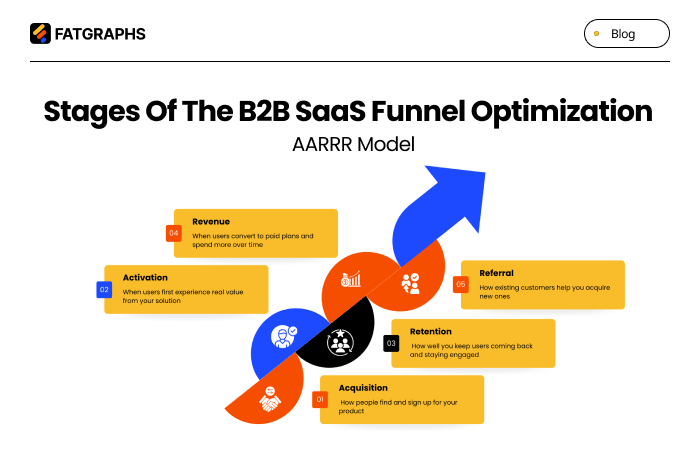
Acquisition ➤ How people find and sign up for your product
Activation ➤ When users first experience real value from your solution
Retention ➤ How well you keep users coming back and staying engaged
Revenue ➤ When users convert to paid plans and spend more over time
Referral ➤ How existing customers help you acquire new ones
Each stage needs different tactics and metrics. Tracking these “pirate metrics” helps you see the complete picture of user behavior and spot exactly where your funnel breaks down.
Why B2B SaaS Funnel Optimization is Important?
An optimized funnel affects your entire business model. Without it, you’ll run into problems like unqualified leads clogging your sales process, extended sales cycles that drain resources, payment friction that kills conversions, and retention gaps that hurt your unit’s economics.
I’ve seen how fixing these issues impacts the fundamentals:
- Customer acquisition costs drop when your funnel converts better
- Cash flow becomes more predictable with higher retention
- Revenue growth gets easier to forecast
Many SaaS companies excel at generating awareness but struggle with middle-funnel conversion. You’re essentially filling out a leaky bucket, for all that marketing effort goes to waste if people drop off before converting. Fixing these bottlenecks becomes critical for SaaS funnel optimization in building sustainable, scalable growth.
1- Getting Users Past Signup and Into Your Product
The first few minutes after someone signs up determine whether they’ll stick around or disappear forever. I’ve learned that 60% of customers see the onboarding experience as the deciding factor for subscribing. When you nail these early moments, everything downstream gets easier.
2- Remove friction from your signup flow
Signup friction kills conversions before they start. The data shows 40-60% of users abandon software right after signing up because of poor onboarding. Companies ask for everything upfront when they should focus on getting people into the product.
Minimal signup form ➛ essential details only ➛ optional data collected later ➛ SSO enabled to remove friction ➛ instant error validation ➛ 3-step free trial activation
3- Ask the right questions to personalize the experience
Welcome surveys help you send users down the right path from day one. These quick questionnaires collect key details about their industry, company size, role, and goals. If your product serves multiple use cases, this becomes even more valuable as you can tailor the entire onboarding to match their specific needs.
The information you gather lets you trigger personalized onboarding flows that guide users to value faster. Instead of showing everyone the same generic tour, you can highlight features that matter most to their particular situation.
4- Show users what matters, when it matters
Good onboarding doesn’t dump every feature on users at once. I’ve found that contextual walkthroughs work much better; they deliver guidance exactly when users need it. Show people only what they need to know to get activated, not everything your product can do.
Interactive walkthroughs work as on-screen tutorials overlaid right on your interface. Trigger these when users interact with new features or complete specific tasks. This approach feels helpful instead of being overwhelmed.
5- Create checklists that people want to finish
Onboarding checklists tap into something powerful, the Zeigarnik effect, which makes people want to complete unfinished tasks on priority.
✅ Break your onboarding into clear, manageable steps.
✅ Users can see their progress as they work through the list.
✅ Each completed item gives users a small win that encourages them to keep going.
✅ Pair your checklists with those contextual walkthroughs to show users exactly how to complete each task.
The combination makes onboarding feel less like work and more like progress.
6- What to Do After Users Sign Up
Once people are inside your product, the real work starts. I’ve found that keeping users engaged and eventually getting them upgraded requires a completely different approach than acquisition. You’re no longer fighting for attention; you’re proving ongoing value.
7- Track the small wins and big conversions
You need to measure two types of user actions to understand what’s really happening in your funnel.
| Micro conversions The smaller steps users take toward those big goals, such as downloading a resource, completing a profile, or using a key feature for the first time. | Macro conversions The big goals: subscriptions, purchases, and major feature adoptions. These typically convert at around 2.9% across most industries. |
I track micro conversions because they happen more often and give me early signals about user engagement. When macro conversion rates stay flat, micro conversions often show me which changes are actually working.
8- Find exactly where users drop off
Funnel analysis shows you the specific step where users abandon your product. I use this to calculate drop-off rates, the percentage of users who start a process but never finish it. The visual makes it obvious where the biggest leaks are happening.
What I love about this approach is that it stops you from guessing. Instead of making random changes, you can focus your efforts on the exact friction points that are costing you conversions.
9- Discover your product’s happy path
The “happy path” is the route your most successful users take to reach their goals. Path analysis reveals these different navigation patterns and shows you which ones lead to conversions.
I use session recordings and heatmaps to spot these optimal journeys. Once I know what the happy path looks like, I can guide more users along that same route with helpful prompts or subtle interface changes.
10- Target the right users for upgrades
Smart segmentation tells you which users are actually ready to spend more money. Companies that get good at this see 7% higher revenue retention than their competitors.
The key is timing your upgrade prompts to match user behavior. When someone consistently uses a feature that’s only available in higher plans, that’s your moment. I’ve found that upsells work best when they feel like helpful suggestions rather than sales pitches, and tie them directly to what users are already trying to accomplish.
Why does it work?
Users who see clear value in your product are naturally more likely to pay for additional capabilities. The data tells you when they’re ready.
How to Actually Listen to Your Users and Fix What’s Broken
You can’t fix what you don’t measure. I learned this the hard way when our team spent months optimizing features that users didn’t actually care about. We were making changes based on gut feelings instead of real feedback, and our conversion rates stayed flat. The solution isn’t complicated, but it requires being systematic about how you collect and act on users’ insights.
1- Collect in-app feedback
In-app surveys catch users when their experience is still fresh in their minds. They get 38% higher completion rates than email surveys, which makes sense, people are already engaged with your product. Here are the three metrics to track religiously:
| Metric | What It Measures | Scale / Calculation | Best For |
| Net Promoter Score (NPS) | Likelihood to recommend your product | 0–10 scale Promoters → 9–10 Passives → 7–8 Detractors → 0–6 NPS = % Promoters − % Detractors | Overall customer satisfaction |
| Customer Satisfaction Score (CSAT) | Satisfaction with a specific interaction | 1–5 scale 4–5 → Satisfied CSAT = % Satisfied | Onboarding, feature launches, support |
| Customer Effort Score (CES) | Ease of accomplishing a task | 1–5 or 1–7 scale Lower effort = better experience | Product usability, support, workflow efficiency |
2- Close the feedback loop with product updates
Here’s where most companies drop the ball. They collect feedback but never tell users what happened with it. Meanwhile, 73% of customers expect companies to understand their needs, and many feel completely ignored. The numbers prove this matters: companies that close the feedback loop see a 2.3% decrease in churn, while those that don’t see a 2.1% increase.
I always follow up personally when we implement user suggestions. Something like: “You requested a feature, and we’ve now implemented it in our latest update.” This approach makes customers 21% more likely to respond to future surveys. It shows you’re actually listening.
3- Use product analytics to monitor funnel performance
Surveys tell you what users think, but product analytics show you what they actually do. I combine both for a complete picture.
| Visitor-to-lead conversion | 1-3% | Top performers | 8-12% |
| Trial-to-paid conversion | 8-12% | Strong performers | 15-20%. |
These benchmarks help you spot where you’re falling behind. What I find most valuable is pairing quantitative data with session recordings. The numbers tell you where people drop off, but watching actual user sessions shows you why. You can see them struggling with confusing navigation or getting stuck on forms. That’s where the real optimization opportunities hide.
Building Your Funnel Fix Strategy
Fixing a leaky funnel isn’t something you do once and forget about. I’ve learned this the hard way after watching conversion rates dip months after what seemed like successful optimizations.
The strategies we’ve covered, from smoothing out your signup flow to timing your upsell prompts just right, work when you treat them as ongoing experiments rather than one-time fixes. Small changes add up. When I helped one SaaS team reduce its signup friction, we saw a 3% bump in conversions. That doesn’t sound huge, but it meant thousands more trial users over six months.
Here’s what I wish someone had told me early on: you don’t need to fix everything at once. Pick your biggest drop-off point first. Maybe it’s that 40% of people who bail during onboarding, or the pricing page, that makes visitors disappear. Focus there, test one change, and measure what happens.
The data tells you what’s broken, but your users tell you why. I love combining the numbers from your analytics with feedback from actual users. When someone says, “I couldn’t figure out how to connect my account,” that’s your next fix right there.
Your funnel will keep evolving as your product grows and your market changes. That’s normal. The companies that stay ahead are the ones that keep testing, keep measuring, and keep improving. It’s not glamorous work, but it’s what turns a struggling conversion rate into a growth engine that consistently delivers customers.
Start with one change this week. Track it. Then move to the next one. Building a funnel that actually converts isn’t about perfection; it’s about making progress.