
 Book Call with Haroon
Knowing SaaS growth stages can help prevent your startup from becoming part of a worrying statistic: about 70% of startups fail because they try to scale too early. Knowing where your company currently sits in the saas lifecycle helps you make smarter decisions about spending money, hiring people, and investing resources.
The problem is that many founders misunderstand their current stage or start using a saas growth strategy before building a strong foundation. This guide explains the 4 saas growth stages, starting from pre-startup and ending at maturity. You will learn when and how to scale a saas business at the right time and how to recognize when it is time to move from one stage to the next. You will also learn about common mistakes that cause saas companies to struggle while scaling.
What Are SaaS Growth Stages?
The SaaS lifecycle
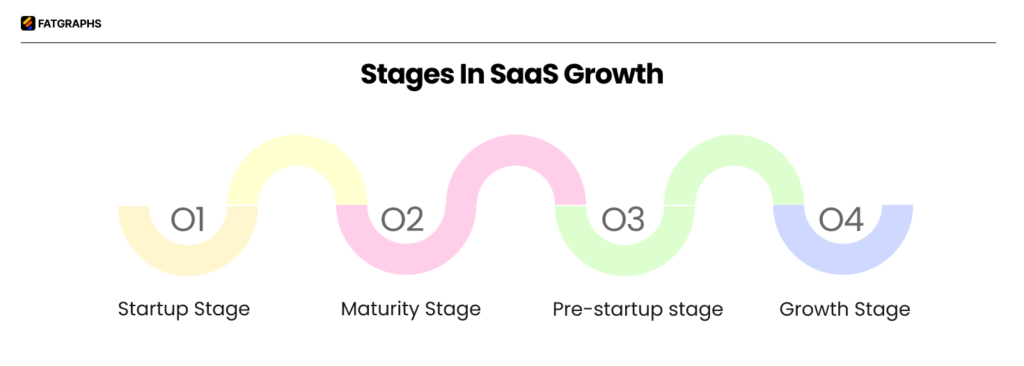
The SaaS lifecycle is a framework that explains how a SaaS business grows over time. It develops across five connected areas:
Customer ➔ Product ➔ Team ➔ Business Model➔ Financials
You can imagine these areas as gears in a machine that must move together. If one gear moves too fast or too slowly compared to the others, the system becomes unstable. The same thing happens in your SaaS product lifecycle when one dimension grows faster than the rest.
| Pre-startup | In the pre-startup stage, the focus is on finding a problem-solution fit. |
| Startup | During the startup stage, the goal is to achieve product-market fit. |
| Growth | The growth stage focuses on scaling operations and increasing customer acquisition. |
| Maturity | The maturity stage is about maintaining a strong market position and finding new expansion opportunities. |
Your SaaS growth stages usually move through four main steps. Each stage has different priorities and metrics that matter most. The key to growing a SaaS business successfully is keeping these five dimensions aligned with customer progress. Your team size, product features, revenue model, and financial planning must match your current level of customer traction. When they become misaligned, the company experiences instability and often enters what experts call premature scaling.
Why 70% of Startups Fail due to Premature Scaling?
Premature scaling happens when a company spends money on growth activities before confirming that its product truly fits the market. This often includes hiring sales teams too early, launching expensive marketing campaigns, or building complex product features before validating customer demand.
The results of this mistake can be serious. Premature scaling reduces financial runway and leaves fewer chances to adjust the business when early assumptions turn out to be wrong. The financial effects go beyond spending too much money. Inconsistent startups often raise almost three times more funding before they begin scaling.
However, when they reach the original scaling stage, their teams are still about 38% smaller compared to companies that grew correctly. Startups that follow the proper scaling process tend to grow about 20 times faster than those that rush into expansion too early.
How identifying your stage helps scale successfully
Understanding your current stage prevents you from measuring your company using the wrong standards. Different SaaS growth stages require different SaaS metrics and expectations. Measuring an early-stage startup using late-stage benchmarks creates confusion and unrealistic pressure.
Stage identification helps you focus on the metrics that actually show progress at your current level. Startups that follow structured diagnostic processes before making major decisions consistently perform better than others. They avoid expensive mistakes and focus resources on areas that produce real results rather than chasing vanity metrics. This method also helps extend the financial runway because resources are used to solve real problems instead of assumed ones.
1- Pre-startup stage: Finding problem-solution fit

During the pre-startup stage, the most important question is simple: Does a real problem exist that people are willing to pay to solve? In this phase, the goal is to identify a serious customer problem in a market that is not well served by existing solutions. At this point, you are not building a full product yet. Instead, you test your ideas through research, conversations, and small experiments.
Problem-solution fit happens when you have clear evidence that your solution actually solves a customer problem and that customers are willing to pay for it. Entrepreneur Steve Blank suggests that you only need about three to five satisfied paying customers to confirm this fit. These early users are sometimes called early evangelists. They are customers who would feel very disappointed if your product suddenly stopped existing.
Typical activities in the pre-startup stage include speaking with potential customers and raising small amounts of funding from friends and family. Founders may also connect with advisors, join startup incubators, and develop a basic minimum viable product. The biggest risks in this stage include failing to design a business model that can eventually become profitable. Another common mistake is underestimating how long initial funding needs to support daily operations.
2-Startup stage: Achieving product-market fit
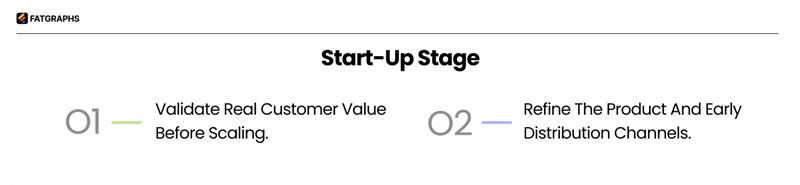
Product-market fit means that you are operating in a strong market with a product that truly satisfies customer needs. Your product delivers clear value and solves real problems better than alternative solutions. During this stage, the focus should remain on validation rather than rapid scaling.
At this point, founders work on improving the product’s core features and discovering effective distribution channels. Companies also start building basic analytics systems, hiring important team members, and acquiring their first paying customers. Many founders underestimate how long it takes to confirm a real market opportunity. In reality, startups usually need two to three times more time than expected to verify their market. If validation is rushed, the company often feels pressure to scale before the foundation is ready.
Common activities and risks in the early SaaS growth stages
Both early SaaS growth stages share several common risks. One major challenge is failing to identify the ideal customer and targeting an audience that is too broad. Startups may also struggle to gain enough customers to maintain a stable cash flow. Hiring mistakes at an early stage can become very expensive later. Another risk is spending too much money on customer acquisition before reaching product-market fit. Security vulnerabilities are also common because small teams often prioritize speed over secure development practices.
When to move from startup to growth
A company should move into the growth stage only after reaching strong product-market fit signals. These signals include stable customer retention rates, indicating that users continue to use the product over time. Another indicator is the Sean Ellis test, where at least 40% of users say they would feel very disappointed if they could no longer use the product. In addition, the company should have a repeatable and reliable customer acquisition process.
3- Growth Stage: How to Scale a SaaS Business

Scaling becomes possible only after confirming product-market fit through clear, measurable signals. Customer retention data should show that users continue using the product. The Sean Ellis test should indicate that about 40% of customers would be very disappointed if the product disappeared. Growth should appear consistently across several quarters rather than appearing as a single viral spike. In some cases, companies may even start turning away potential customers because current capacity cannot support additional demand. At this stage, customer acquisition also becomes predictable with known conversion rates.
Key activities for scaling a SaaS business
The growth stage often begins when the company raises Series A funding. The focus shifts toward expanding customer acquisition and hiring experienced leaders. Infrastructure improvements become important so the system can support a growing number of users. Activities like A/B testing and conversion rate optimization become valuable because even small improvements in conversion rates can significantly increase revenue. At this stage, the product, marketing, and sales teams must align their messaging and strategies. Go-to-market strategy becomes one of the most important priorities after product-market fit has been established.
Building a repeatable sales process
A scalable sales system requires a clear understanding of the ideal customer. Companies often use lead qualification frameworks such as BANT(Budget, Authority, Need, and Time) to evaluate potential buyers. The sales process must include clearly defined SaaS growth stages that guide prospects through the buying journey.
Maintaining pipeline coverage between three and five times the revenue target is important. For example, if the goal is to close one deal worth one dollar, the pipeline should contain three to five potential deals because not every opportunity converts. Strong sales messaging also helps communicate value and ensures that all customer-facing teams speak with a consistent voice.
Managing costs and cash flow during growth
Cloud infrastructure costs typically represent between six and twelve percent of SaaS revenue. Companies must plan their cash flow carefully, using weekly or monthly forecasts to understand upcoming financial needs. Monitoring accounts receivable is important because delayed payments can interrupt cash flow.
Businesses should also negotiate favorable payment terms with suppliers whenever possible, including longer payment periods or discounts for larger purchases. Efficient inventory and resource management prevents unnecessary cash from being locked into unused assets. Controlling operational expenses requires reviewing every cost and ensuring it supports growth objectives.
Common risks when scaling a saas business
The largest risk during scaling is running out of cash while trying to support rapid growth. Costs may increase faster than revenue, leading to unsustainable burn rates. Technical debt can also grow quickly when teams prioritize speed instead of maintaining code quality. Over time, this slows future development and innovation. Scaling before true product-market fit wastes resources and reduces the chance of success.
Hiring the wrong people can damage company culture and productivity. Security issues are also a major concern. Research shows that more than 75% of organizations using SaaS applications experience security-related incidents. Another risk is feature creep, where constant additions make the product overly complex for users. Companies with strong governance systems often achieve more than 20% higher revenue than competitors.
4- Maturity Stage: Sustaining and Expanding SaaS Growth

Characteristics of a mature SaaS company
At the maturity stage, the organization has built strong systems that consistently develop and deliver products. However, leadership must still remain cautious and attentive to market changes. Recognized revenue becomes an important metric because it reflects payments for services that have actually been delivered.
This helps companies avoid the mistake of counting deferred revenue as current income. EBITDA (Earnings Before Interest, Taxes, Depreciation, and Amortization) becomes a primary financial indicator because it demonstrates long-term profitability and operational efficiency to investors and stakeholders. Business processes must also be clearly documented and repeatable. Many companies develop detailed playbooks to standardize operations and maintain consistency.
Global expansion and new product opportunities
International expansion becomes a realistic option when at least twenty-five percent of the company’s revenue comes from international markets. Entering global markets can increase revenue growth by about thirteen percent. However, companies must manage challenges such as cultural differences, language barriers, currency fluctuations, and regional tax regulations. Pricing strategies often become the most complex issue during international expansion. In fact, about twenty-seven percent of companies report that pricing decisions are their greatest difficulty in global markets.
Maintaining a competitive edge and innovation
Even mature SaaS companies must avoid becoming complacent. Continuous monitoring of market trends and customer needs remains essential. Companies must also experiment with new product features and additional solutions. Studies show that the average mid-sized company replaces about thirty-nine percent of its SaaS applications over time in order to gain improved functionality. Because competitors can quickly replicate existing features, consistent innovation is necessary to maintain long-term market leadership.
Exit strategies and IPO considerations
SaaS founders usually consider three main exit options: mergers and acquisitions, initial public offerings, or private equity investments. Most SaaS businesses are valued between five and ten times their annual revenue. The best exit strategy depends on the founder’s long-term goals, the company’s growth stage, and overall market conditions.
Conclusion
Success in scaling a SaaS business depends largely on correctly identifying your current stage of development. Expanding too quickly often creates more problems than it solves. Founders should focus first on achieving strong product-market fit before investing heavily in growth. Keeping the five key business dimensions aligned and measuring the right metrics for each stage helps maintain stability. By following these fundamentals SaaS growth stages carefully, companies can build sustainable growth and avoid becoming another example of premature scaling failure.