
 Book Call with Haroon
Many SaaS companies have solid products, strong teams, and decent traffic, yet growth feels slow and expensive. Customer acquisition costs creep up; conversions stall, and no channel seems to scale cleanly. In most cases, the issue is not the product or the channel. It is weak or outdated for SaaS ICP development. When you target the wrong customers, even great marketing looks broken. This article explains what SaaS ICP development really means, why it matters for growth, and how to build an ideal customer profile that aligns marketing, sales, and demand generation around scalable acquisition.
What Is SaaS ICP Development?
SaaS ICP development is the process of defining the ideal customer profile a SaaS company should focus on to drive efficient, repeatable growth. It describes the type of company that gets the most value from your product and delivers the most value back to your business.
A strong ICP acts like a filter. It helps you say no to low-fit accounts and double down on customers that convert faster, retain longer, and expand more. Without clear SaaS ICP development, teams chase volume instead of quality, which leads to high CAC and poor funnel performance.
1- SaaS ideal customer profile vs buyer persona
An ideal customer profile describes the company, not the individual. It covers attributes like industry, size, maturity, and tech stack. Buyer personas describe people inside that company, such as titles, goals, and objections. ICP comes first, personas come after.
2- Why SaaS ICP development is critical for demand generation
Demand generation works best when targeting is tight. When campaigns speak to the right accounts, messaging feels relevant, and conversion rates rise. A clear SaaS ICP development process keeps demand gen focused and efficient.
3- How ICP affects acquisition channels and funnel performance
Different ICPs perform better on different channels. Some convert best through outbound, others through content or partnerships. Your ICP shapes which channels scale and which quietly burn budget.
How Is SaaS ICP Development Different From Buyer Personas?
SaaS ICP development focuses on account-level fit and scalability, while buyer personas focus on individual behavior and decision-making. The difference matters because growth breaks when teams confuse the two. Think of ICP as the map and personas as the turn-by-turn directions. Without the map, even perfect directions lead nowhere.
1- B2B SaaS ICP vs buyer persona
An ICP answers, who should we sell to. A buyer persona answers who inside that company buys and why. SaaS ICP development defines the market you want to win.
2- When to use ICP in SaaS marketing and sales
ICP should guide targeting, channel strategy, and pipeline qualification. Marketing uses ICP to attract the right accounts. Sales uses it to prioritize deals and avoid poor-fit prospects.
3- How ICP and personas work together in SaaS acquisition
Once the ICP is clear, personas help tailor messaging. Together, they align acquisition around both the right companies and the right conversations.
How Do You Build an ICP for SaaS Companies?
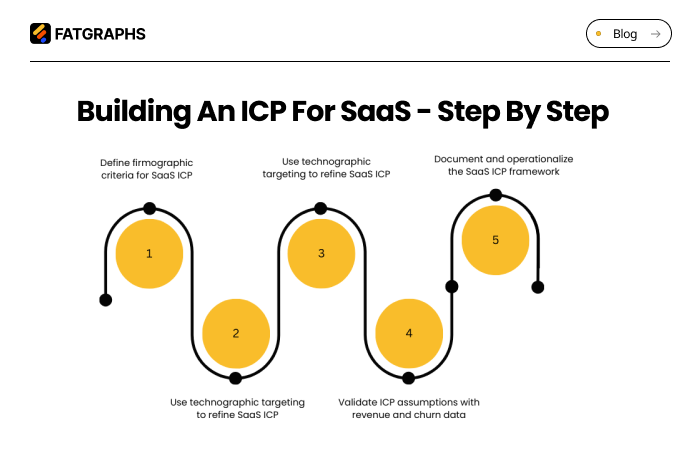
You build an ICP for SaaS by combining firmographic, technographic, and behavioral data with revenue and retention insights. This process turns guesswork into a repeatable system. A helpful analogy is fitness tracking. You do not change habits based on feelings alone. You use data to see what works.
1- Define firmographic criteria for SaaS ICP
Start with company-level basics. Look at existing customers who succeed with your product.
Common firmographic factors include
• Industry or vertical
• Company size by employees or revenue
• Geography
• Business model and maturity
Patterns usually show up quickly when you review your top accounts.
2- Use technographic targeting to refine SaaS ICP
Technographics explain what tools a company already uses. This matters because software stacks reveal readiness and fit.
Examples include
• CRM and marketing automation platforms
• Data infrastructure and analytics tools
• Cloud providers or legacy systems
Customers with compatible stacks adopt faster and churn less.
3- Identify pain points and buying triggers
Strong SaaS ICP development connects company traits to real problems. Look for triggers like growth milestones, compliance needs, or operational bottlenecks. These moments drive urgency.
4- Validate ICP assumptions with revenue and churn data
This step is where many teams stop short. Compare revenue, LTV, and churn across segments. The best ICP is not the loudest buyer, it is the most profitable one.
5- Document and operationalize the SaaS ICP framework
Write your ICP down and share it. Sales, marketing, and product should all reference the same definition. An undocumented ICP does not exist in practice.
What Data and Metrics Power Effective SaaS ICP Development?
Effective SaaS ICP development is driven by metrics, not opinions. The goal is to identify which customers fuel sustainable growth. Think of your data as a mirror. It reflects where value truly comes from.
| Revenue concentration and LTV by customer segment | Analyze which segments generate the most revenue over time. High LTV clusters often point directly to your ideal customer profile. |
| CAC, payback period, and ICP alignment | If certain segments cost more to acquire and take longer to pay back, they are likely poor ICP fits. Strong ICPs reduce friction across the funnel. |
| Retention, expansion, and churn signals | Retention is the clearest signal of product-market fit. Segments that expand usage and upgrade plans are usually the best ICP candidates. |
| ICP metrics for SaaS acquisition optimization | Track conversion rate by segment, sales cycle length, and win rate. These metrics show how well your ICP aligns with your go-to-market motion. |
How Does SaaS ICP Development Improve Demand Generation and CAC?
SaaS ICP development improves demand generation by focusing resources on accounts most likely to convert and retain. This shift alone can unlock meaningful efficiency gains. It is like fishing with a net sized for the right catch instead of casting everywhere.
1- ICP-driven channel selection
Some ICPs respond better to outbound, others to organic content or paid search. Knowing your ICP helps you choose channels that scale instead of plateauing.
2- Reducing CAC with ICP targeting
When targeting improves, waste drops. Ads reach fewer but better-fit accounts, sales cycles shorten, and conversion rates climb.
3- ICP alignment across marketing and sales
Misalignment creates friction. A shared ICP ensures marketing delivers the leads sales actually want, improving trust and pipeline velocity.
4- ICP in account-based marketing (ABM)
ABM depends on precise targeting. Without strong SaaS ICP development, ABM becomes expensive personalization without return.
What Are Common Mistakes in SaaS ICP Development?
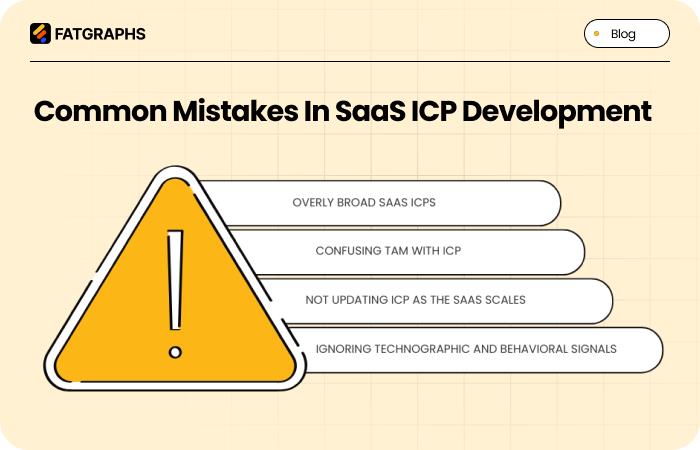
Most SaaS ICPs fail because they are too broad, static, or disconnected from real data. These mistakes quietly erode growth over time. Avoiding them often matters more than chasing perfect definitions.
Overly broad SaaS ideal customer profiles
If your ICP includes almost everyone, it helps no one. Broad ICPs dilute messaging and inflate acquisition costs.
Confusing TAM with ICP
The total addressable market shows how big the opportunity is. ICP shows where you should focus now. Mixing the two leads to unfocused execution.
Not updating the ICP as the SaaS scales
Early-stage ICPs rarely survive scale. As products mature, ideal customers change. Ignoring this creates growth plateaus.
Ignoring technographic and behavioral signals
Firmographics alone are not enough. How companies operate and what tools they use often predict success better than size alone.
How Often Should You Revisit and Update Your SaaS ICP?
You should revisit SaaS ICP development whenever growth slows, CAC rises, or the product evolves. ICPs are living frameworks, not static documents. Regular reviews keep targeting alignment with reality.
| ICP updates during product expansion | New features often attract new segments. Validate whether these segments match your core ICP or require a new one. |
| ICP changes driven by market or channel shifts | If a channel stops performing, the ICP may be misaligned. Markets evolve, and ICPs must adapt with them. |
| Using experimentation to refine ICP | Treat ICP updates like experiments. Test messaging, channels, and segments, then follow the data. |
Conclusion
SaaS ICP development is not a one-time exercise. It is a strategic growth lever that shapes acquisition efficiency, demand generation, and long-term revenue quality. A clear, data-driven ideal customer profile helps teams focus on accounts that convert faster, stay longer, and grow bigger. If growth feels harder than it should, the problem may not be execution. It may be who you are targeting. Take time to audit your current ICP, validate it with data, and rebuild it for where your SaaS is going next.
FAQs
What is SaaS ICP development?
SaaS ICP development is the process of defining the type of company that gains the most value from your SaaS product and delivers the most value back to your business. It focuses on company-level traits like size, industry, and tech stack. A strong ICP improves acquisition efficiency and retention.
How is a SaaS ideal customer profile different from a buyer persona?
A SaaS ideal customer profile describes the company you want to target. A buyer persona describes the individual decision-makers inside that company. ICP guides targeting, while personas guide messaging.
What data is needed to build an ICP for SaaS?
You need firmographic data, technographic data, and performance metrics like LTV, CAC, and churn. Revenue concentration and retention trends are especially important. These data points validate real customer fit.
How does SaaS ICP development reduce CAC?
By focusing on high-fit accounts, marketing waste decreases, and conversion rates improve. Sales cycles shorten, and fewer resources are spent on poor-fit leads. Over time, this drives down CAC.
How often should a SaaS company update its ICP?
At a minimum, review your ICP annually. You should also revisit it when launching new products, entering new markets, or seeing rising acquisition costs. ICPs should evolve as the business evolves.