
 Book Call with Haroon
SaaS marketing tools can make or break your growth strategy, and picking the right ones from so many choices can be confusing. SaaS product marketing isn’t about guessing; it needs the right tools. The best SaaS marketing tools help you get more users and keep them interested, whether you run a big B2B SaaS company or a small micro SaaS product.
This guide explains everything you need, including a list of useful SaaS marketing tools, both paid and free, and tips on picking the ones that fit your business. You’ll see top platforms for product growth and lead generation that can make your marketing better. Automation and analytics tools are included, too.
Best SaaS Marketing Tools for Product Growth and User Engagement
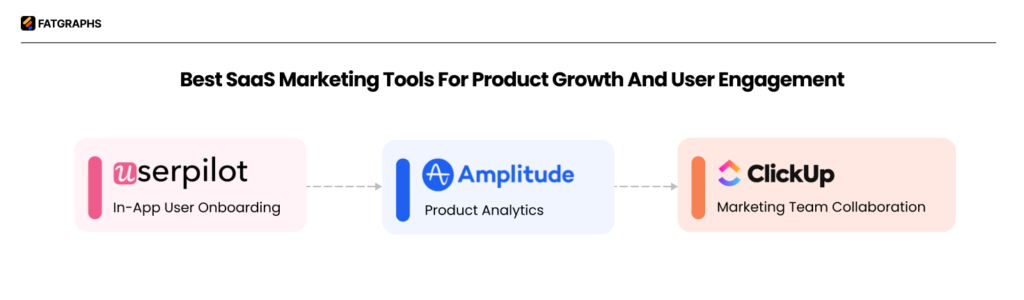
Product growth depends on knowing how users use your software and helping them become active users. Userpilot, Amplitude, and ClickUp each focus on different parts of user engagement and teamwork.
1- Userpilot for In-App User Onboarding
Userpilot is a tool that helps get customers more involved by giving them helpful experiences inside your app. You can make onboarding guides, tips, pop-ups, and checklists without coding. It works for web and mobile apps, and you can control everything from one dashboard.
It also tracks what users do, lets you group users based on behavior, and shows where users stop using the app. You can test different ideas to improve user experiences. Prices start at $249 per month if paid yearly, or $299 monthly. The Growth plan costs more and has extra features.
2- Amplitude for Product Analytics
Amplitude is a tool that tracks how users act inside your software. It shows what actions users take and works on different devices without counting the same user twice. Main features include tracking events, dashboards to compare data, and connections with other tools like Userpilot. You can also watch sessions to see what users did before leaving. There’s a free Starter plan for basic analytics. The Plus plan starts at $49 per month for advanced features.
3- ClickUp for Marketing Team Collaboration
ClickUp helps teams plan campaigns, create content, and track progress all in one place. Marketing teams can brainstorm ideas, manage content calendars, and track tasks. It also has AI tools to create campaign ideas, content briefs, and emails. ClickUp connects with many other tools like HubSpot, Slack, and Google Workspace, so teams don’t need to switch platforms.
Top B2B SaaS Marketing Tools for Lead Generation and CRM
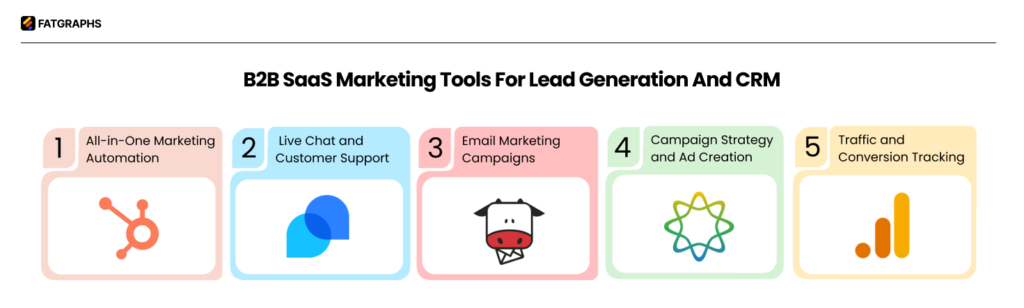
To turn website visitors into customers, you need tools that automate emails, nurture prospects, and manage relationships. B2B SaaS marketing tools make lead generation easier and help manage customer info to close deals faster.
1- HubSpot for All-in-One Marketing Automation
HubSpot combines marketing automation, CRM, and lead generation in one platform. It helps generate leads, close deals, and manage customer support.
It can automate emails, score leads, and create workflows. You can make custom forms that remember visitors and change based on their actions. Smart calls-to-action show different messages depending on who visits. HubSpot also has free tools like landing pages, forms, ad management, and CRM.
2- Moosend for Email Marketing Campaigns
Moosend is a cheap email marketing tool. Paid plans start at $9 per month and include unlimited emails and automation. It has a drag-and-drop editor and ready templates so you can make emails easily. You can split email lists, automate email sequences, and create landing pages. Moosend connects with Salesforce, Segment, and other apps through Zapier.
3- Tidio for Live Chat and Customer Support
Tidio captures leads using AI chatbots and live chat that work all day. Chatbots reply instantly and help qualify leads faster. Businesses using Tidio get faster responses and better leads. Prices start at $24.17 per month for the Starter plan.
4- Elsa AI for Campaign Strategy and Ad Creation
Elsa AI helps with audience research and marketing plans. It creates Ideal Customer Profiles and suggests marketing strategies based on your target audience. You can make customer profiles, build marketing plans, create content for different platforms, and design ads. It helps save time on research and planning.
5- Google Analytics for Traffic and Conversion Tracking
Google Analytics is a free tool that tracks website and app performance. It measures important actions like newsletter signups or purchases. The newer GA4 version tracks unlimited events and follows users through their journey. It also uses AI to predict what customers might do next. But it has some limits, like a shorter tracking window, which may not work for businesses with long sales cycles.
Best Free SaaS Marketing Tools to Get Started
Some platforms have strong free plans. Brevo allows up to 300 emails per day with unlimited contacts. Mailchimp lets you send 1,000 emails per month with 500 contacts. Moosend has unlimited emails during its trial. For project management, Trello and Asana have free plans for teams. Hotjar gives free heatmaps and session recordings, and Microsoft Clarity gives unlimited session recordings and heatmaps.
Budget-Friendly Options for Micro SaaS Businesses
Some paid tools are still cheap for small businesses. Buffer starts at $6 per month per channel, Zoho Social at $15 per month. Freshsales has a free plan for up to three CRM users, with paid plans starting at $18 per user per month.
How to Choose the Right SaaS Marketing Tools for Your Business
Picking the right tools needs planning. The tools you pick affect your marketing, team productivity, and revenue.
Identify Your Marketing Goals and Priorities
Start by defining clear goals. SaaS marketing usually focuses on getting new leads, converting leads to paying customers, increasing revenue, keeping customers, and improving efficiency. Match your challenges with these goals. Track key metrics like cost per lead, cost of getting a customer, and customer lifetime value. Automation works best when it matches your business goals.
Consider Integration Capabilities with Existing Systems
Integration matters because tools that don’t work together create more work. Pick platforms that connect well with your CRM, analytics, and communication tools. Good integration makes data flow smoothly, reduces manual work, and improves automation. Ask vendors about their integrations before choosing.
Evaluate Pricing Models and Scalability
Pick pricing that fits your current needs and future growth. Many SaaS tools have tiered, usage-based, or mixed pricing. Choose tools that grow with your business without getting too expensive or complicated. Decide whether per-user, usage-based, or result-based pricing works best for your team.
Test Tools with Free Trials Before Committing
Most SaaS tools have free trials from one week to a few months. Trials without credit cards are easier for testing. Before trying a tool, set clear goals. Include team members who will use it every day to see if it really works for you.
Conclusion
The right SaaS marketing tools can help you get more users, connect with customers, and make more revenue. There are tools for every stage of marketing, whether your budget is small or you can pay for premium platforms. Start by identifying your goals, then test tools that work well with your current systems. Use free trials to see features before buying. Your marketing tools should help your growth, not slow it down.
FAQs
Q1. What are the most important types of SaaS marketing tools I should consider?
SaaS marketing tools usually fall into five types: product growth and engagement tools, lead generation and CRM systems, email marketing automation, analytics and tracking tools, and team collaboration software. Pick tools based on your goals, like onboarding users, converting leads, or keeping customers.
Q2. How much should I expect to spend on SaaS marketing tools?
Costs depend on your business. Many tools have free plans with basic features. Paid plans start from a few dollars per month and go up. Most have free trials so you can test before buying.
Q3. Why is email infrastructure more important than just having good copy?
A good email setup makes sure emails get delivered. It protects your domain, reduces bounces, and improves delivery. Even well-written emails fail if they go to spam. Proper setup saves money and protects your leads.
Q4. Should I choose tools that integrate with my existing systems?
Yes. Integration makes work easier and reduces manual tasks. Tools that connect with your CRM, analytics, and communication systems improve automation and data accuracy.
Q5. How long should I test a tool before making a purchase decision?
Most tools offer trials lasting one week to a few weeks. Use this time to test key features and see if it works for your team.