
 Book Call with Haroon
B2B SaaS marketing is the process of promoting subscription-based software to other businesses. It covers acquisition, activation, retention, and expansion across the full customer lifecycle. Unlike traditional marketing, it focuses on recurring revenue, long-term relationships, and continuous value delivery.
Marketing a B2B SaaS product is not just harder than normal marketing. It works in a completely different way. Sales cycles are longer, more people are involved in decisions, customers pay every month, and there is always a risk they might leave.
If your website is getting traffic but not enough demos, trials, or paying customers, the problem is rarely the product. Most SaaS companies fail because their marketing does not match how business buyers think and choose software. B2B buyers complete up to 70 percent of their research before ever speaking to a sales representative, which means your marketing has to do most of the selling before your sales team ever enters the picture.
This guide explains what B2B SaaS marketing really means, what to get right before building a strategy, and 11 proven strategies built for revenue growth in 2026.
What Exactly Is B2B SaaS Marketing?
B2B SaaS marketing is the process of promoting subscription-based software solutions to businesses to acquire customers, activate them, retain them, and expand their accounts over time. Unlike traditional product marketing, SaaS marketing focuses heavily on recurring revenue, long-term relationships, and continuous value delivery. It involves multiple people, including CEOs, managers, IT teams, and finance departments, each with different concerns and decision criteria.
Unlike physical products, SaaS is invisible. Prospects cannot touch it, hold it, or see it on a shelf. That means you must explain the value, not just list the features. Your messaging must answer one question clearly: why is this software worth paying for every single month?
You are not only acquiring customers. You are also responsible for keeping them. Retention plays a huge role because recurring revenue is the backbone of SaaS growth. Every customer touchpoint influences churn, which means marketing does not end at the point of sale.
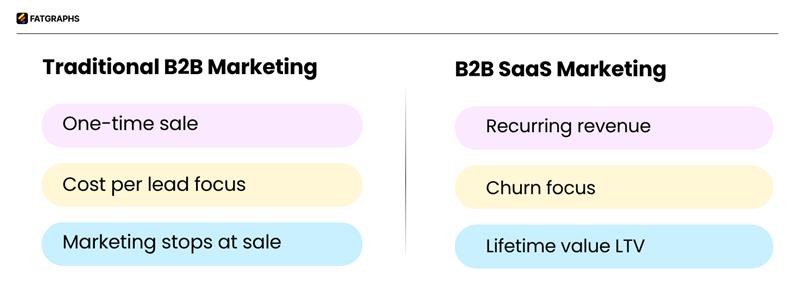
How B2B SaaS Marketing Differs from Traditional Marketing
| Factor | B2B SaaS Marketing | Traditional B2B Marketing |
|---|---|---|
| Revenue model | Recurring subscriptions (MRR and ARR) | One-time purchase or project fees |
| Sales cycle | Weeks to months, multiple stakeholders | Shorter or project-based |
| Key metric | LTV, churn, CAC payback, NRR | Cost per lead, deal size |
| Content role | Educates, qualifies, and nurtures over time | Primarily generates leads |
| Marketing does not stop at | The sale. Retention is a marketing job. | The sale. Post-sale is handled separately. |
Steps to Take Before Building a Strategy
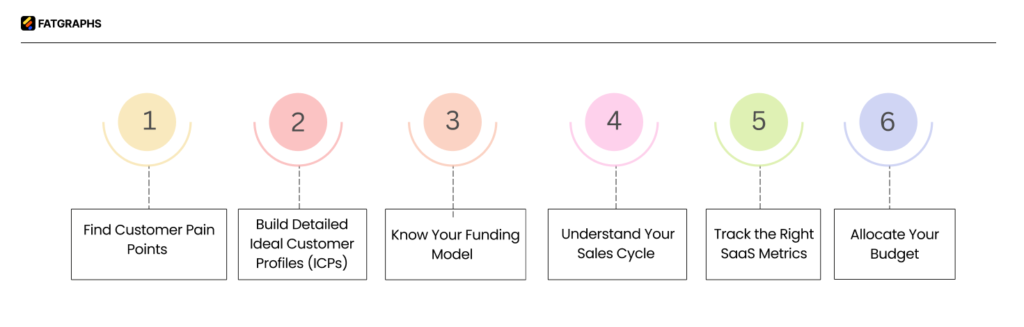
Before investing in channels, tools, or campaigns, you need to align on fundamentals. These decisions directly shape your CAC, retention rates, and long-term growth trajectory.
1. Understand Customer Pain Points
The best SaaS marketing starts with empathy. When your messaging speaks directly to the problems your target customer is actively trying to solve, every channel performs better.
2. Build a Detailed Ideal Customer Profile
Your ICP defines who you are marketing to. It includes industry, company size, revenue, region, team structure, tech stack, and key business challenges. Well-defined ICPs reduce wasted ad spend, shorten sales cycles, and improve conversion rates across every channel. For more on building one, read our guide on SaaS buyer personas.
3. Know Your Sales Motion
Your strategy changes completely depending on how customers buy. Freemium products require product-led growth tactics. Trial-to-paid models require strong onboarding and activation content. Enterprise deals require case studies, ROI calculators, and outbound sequences.
4. Track the Right Metrics
Vanity metrics look good in reports but do not drive decisions. The B2B SaaS metrics that matter include new paying customers, Lifetime Value (LTV), Customer Acquisition Cost (CAC), churn rate, activation rate, and MRR growth. Healthy benchmarks to target:
| Metric | What it measures | Healthy benchmark |
|---|---|---|
| LTV to CAC ratio | Revenue vs cost to acquire | 3:1 minimum, 5:1 is strong |
| Monthly churn rate | Customers leaving per month | Below 2% for SMB SaaS |
| CAC payback period | Months to recover acquisition cost | Under 12 months |
| MRR growth rate | Month-on-month revenue growth | 10 to 20% MoM for early-stage |
For a full breakdown, read our guide on B2B SaaS marketing KPIs that actually move revenue.
5. Allocate Budget by Stage
Under 1 million ARR: spend 60 to 70 percent on organic, 20 to 30 percent on paid, and 10 to 20 percent on experimentation. Between 1 and 10 million ARR, shift toward a more balanced mix and increase paid investment to scale faster.
11 B2B SaaS Marketing Strategies for 2026
These strategies are selected based on scalability, cost efficiency, and long-term revenue impact. The most effective approach in 2026 blends long-term compounding channels with fast-learning channels based on your product motion and growth stage. Do not try all 11 at once. Pick two or three that match your current stage and execute them well before expanding.
1. Referral and Affiliate Programs
Referrals convert well because customers trust peer recommendations far more than brand messaging. Referral programs can generate highly qualified leads with 30 percent better conversion rates than traditional acquisition channels. Tools like Rewardful make management simple. The key rule: build referral programs only after retention is strong. A referral program on top of a poor product just accelerates churn.
2. Community Marketing
Communities are one of the most powerful growth channels in B2B SaaS today. Platforms like Slack, Discord, and Circle help you build a space where users share feedback, discuss use cases, and connect with your brand. HubSpot built a community that generates organic sign-ups and reduces support costs. Notion’s community creates templates that bring in new users without paid advertising. A strong community reduces churn and increases advocacy at the same time.
3. Email Newsletter Marketing
Email remains one of the strongest B2B channels. Around 44% of B2B marketers say newsletters are their most effective content distribution tool. The key difference in SaaS newsletters is that they should deliver insights and value first, not sales pitches. Buffer and Intercom both built large audiences this way. A consistent newsletter keeps your brand in front of buyers who are not ready to purchase today but will be in 60 to 90 days.
4. Micro-Influencer Partnerships
Creators with 10,000 to 100,000 followers consistently deliver better engagement than large accounts in B2B SaaS. They are more relatable, more trusted by their specific audiences, and more affordable. To find the right ones, search for LinkedIn creators in your category who write about the problems your product solves. Offer them a free account, a co-created piece of content, or a small fee per qualified lead. Track conversions, not follower counts.
5. Product Hunt Launches
A well-executed Product Hunt launch brings instant visibility among early adopters and tech buyers. To rank well, you need clean visuals, a strong demo video, a clear one-line description, founder involvement on launch day, and a warm community ready to upvote. The best results come from spending two to three weeks building momentum in relevant communities before the launch date.
6. Growth Loops
Growth loops embed acquisition directly into the product so that each new user helps bring in the next one. Dropbox gave extra storage to users who referred friends. Slack’s team invite loop meant that one user joining automatically pulled in teammates. Notion’s template-sharing loop created public content that attracted new users without ad spend. These loops compound over time instead of resetting like paid campaigns.
7. Website and Landing Page Optimization
Your website is your most important sales asset. Sites that load in one second can see up to five times higher conversion rates than slower competitors. Beyond speed, your homepage must answer the visitor’s question in the first five seconds: what does this do, who is it for, and why should I trust it. Read our full guide on landing page optimization for SaaS to see which elements improve conversion most.
8. Strategic Outreach
Personalized outreach via LinkedIn or email remains one of the highest-ROI channels for early-stage B2B SaaS. The message must be written for a specific problem the recipient is facing, not a generic pitch. Tools like Apollo.io and Lemlist help you scale personalized sequences without losing relevance. A realistic benchmark for well-targeted cold outreach is a 15-25% reply rate when the message directly addresses the recipient’s role and situation. Read our breakdown of the best marketing channels for B2B SaaS to see where outreach fits in your overall mix.
9. Account-Based Marketing (ABM)
Account-based marketing targets specific high-value companies with personalized campaigns instead of casting a wide net. It treats each target account as a market of one. ABM delivers three to five times higher conversion rates than broad demand generation when implemented correctly. The starting point is a tight ICP list. Sales and marketing must agree on which accounts to target, and every touchpoint from ads to outreach to content must be built for that specific account. ABM works best for companies with a high average contract value, where winning one account justifies a significant investment.
10. G2 and Review Platform Optimization
B2B buyers increasingly use G2, Capterra, and TrustRadius to shortlist vendors before they ever visit your website. Having strong review profiles on these platforms is a passive acquisition channel that works around the clock. The approach is simple: after a customer reaches a positive activation moment, send them a short email asking for an honest review. Include a direct link to your G2 profile. Respond to every review, including negative ones. Capterra research shows that 92% of B2B buyers read online reviews before making a purchase decision. This channel requires almost no ongoing budget once the review collection process is set up.
11. Content-Led SEO and Demand Generation
Organic search is where most B2B buying decisions start. A content-led B2B SaaS SEO strategy targets buyers at every stage of the funnel. Top-of-funnel content builds awareness by addressing the problems your ICP faces. Middle-of-funnel content covers solutions and use cases. Bottom-of-funnel content includes comparison pages, alternatives pages, and pricing guides that capture buyers who are actively evaluating vendors. The companies that rank well for bottom-of-funnel keywords consistently report the lowest blended CAC because these visitors arrive already knowing they have a problem and looking for a specific type of solution.
Working on your B2B SaaS marketing strategy?
Fatgraphs works with B2B SaaS founders to build acquisition systems that connect marketing spend directly to pipeline and revenue. We identify where MQL quality drops, what is wasting your budget, and how to reach payback faster.
Conclusion
B2B SaaS marketing is about understanding people, solving real problems, and building long-term relationships. The intangible nature of software, longer buying cycles, and multi-stakeholder approvals require a strategic approach that blends trust, value, and consistency across the full customer lifecycle.
Your success depends on how well you understand your ICP, identify real pain points, track meaningful metrics, and choose the right channels for your current growth stage. The strategies in this guide compound over time. Referrals, communities, review platforms, ABM, and content-led SEO all build momentum that paid campaigns cannot replicate.
Start with two or three strategies that match where your business is today. Execute them well, measure the results, and expand from there. For your next step, explore our full guide to building an effective B2B SaaS marketing funnel.
Frequently Asked Questions
What is the difference between B2B SaaS marketing and B2C marketing?
B2B SaaS marketing targets businesses with subscription-based software. Buying decisions involve multiple stakeholders, longer sales cycles, and a strong emphasis on ROI, security, and scalability. B2C marketing targets individual consumers and relies more on emotional triggers, faster decision cycles, and impulse purchases. The key difference is that B2B SaaS marketing must justify value to an entire organization, not just one person.
How long does B2B SaaS marketing take to show results?
B2B SaaS marketing typically shows early traction within 3 to 6 months and delivers consistent revenue-driven results within 6 to 12 months. Paid campaigns and outbound efforts produce results faster. SEO, content, and community-led strategies take longer to compound but deliver stronger returns over time.
What is the best marketing channel for B2B SaaS in 2026?
There is no single best channel. High-performing SaaS companies use a multi-channel approach that matches their product motion and ICP. B2B SaaS SEO, content marketing, email newsletters, community building, referral programs, and targeted outreach all work when paired with a clear ICP and measurable success criteria.
How do you reduce CAC in SaaS marketing?
You reduce CAC by improving targeting, increasing conversion rates, and investing in compounding channels. Tactics include refining your ICP, optimizing onboarding and activation, improving landing page conversion rates, building referral programs, and investing in review platforms. Reducing churn also lowers effective CAC because longer customer lifetimes improve the LTV to CAC ratio over time. Read our detailed guide on SaaS demand generation for a full system built around reducing acquisition costs.