
 Book Call with Haroon
Your ICP keeps changing because you’re describing situations, not customers. When Siyotekonen listed “individual rental property owner, UBER driver Lift, driver, DOORDASH driver, taxi driver” as his target for Storatax, he wasn’t defining an ICP; he was listing tax situations. This is why your marketing never works.
“I’m Targeting Everyone Who Needs My Solution”
Yaser started confidentiality with Digital Cortex targeting “Busy Professionals, Students and Lifelong Learners, Self-improvement Enthusiasts.” Then he added “regular/average person, not the tech-savvy type who finds usual project management tools like Asana, Trello complex and overwhelming.” Finally: “We also specifically target productivity and personal growth enthusiasts,” and “We have a specific pack of modules for neurodivergent people.”
Four different audiences in one conversation. His ICP kept expanding because he was confused about having a solution with customers. Every time someone could theoretically use his productivity app, he added them to his target list.
This is The Situation Trap. You define your ICP by describing who has the problem, not who will pay to solve it. The difference determines whether your marketing budget disappears into LinkedIn ads that convert no one.
When Your ICP Changes Mid-Pitch
Rudy defined his ICP as “SMEs in all economic sectors shipping more than 50 cross-border shipments per year by sea, air, and land.” Clear and quantified. Then he immediately qualified it: “specifically cargo owners (importers, exporters, traders) not their 3rd party shipping providers.”
He shifted from volume-based criteria to role-based exclusions because his original definition was situational. Anyone shipping 50+ cross-border shipments could include his actual target (importers) and people who would never buy (freight forwarders who already have systems). One conversation, two different ICPs.
Related: How to Define ICP With Zero Customers?
Jeremy made the same error differently. He defined his auction platform target as “clearance sellers with stock to clear; people looking to sell products/vehicles/machinery, and buyers looking to bid on clearance items.” Three separate audiences with different motivations, different objections, and different sales cycles. His ICP wasn’t unstable; it didn’t exist.
The Conversation Quality Framework
The Conversation Quality Framework is a diagnostic tool that reveals why your ICP keeps changing. It works by measuring how specifically you can predict a prospect’s response to your value proposition. Apply it by testing whether your ICP description lets you anticipate their exact objections, budget discussions, and timeline concerns.
Quality levels:
Situational (Unstable): You describe circumstances. “Small businesses that need cybersecurity” or “developers working with GIS data.” These descriptions capture problems, not purchasers.
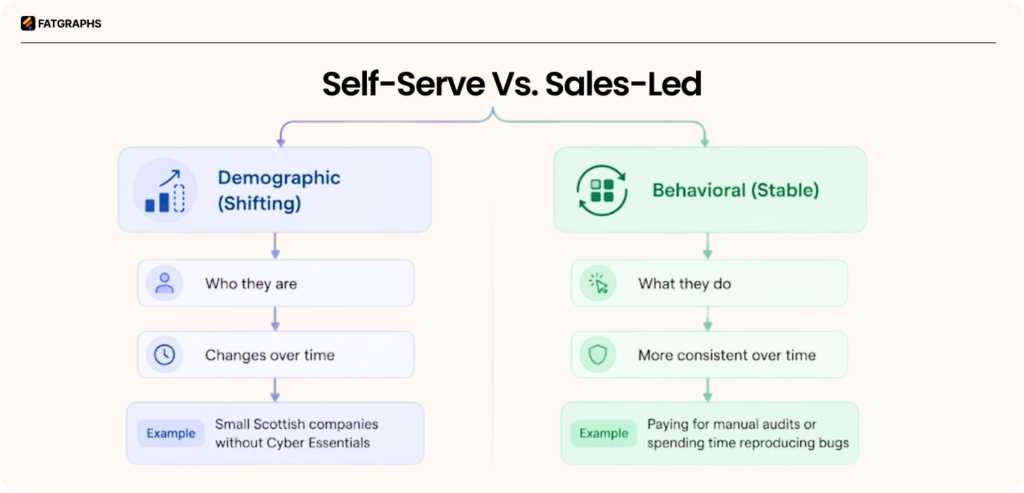
Demographic (Shifting): Add firmographic filters. “Small companies in Scotland without Cyber Essentials certification” or “Freelance programmers and software development companies (NOT enterprise).” Better than situational, but still prone to drift.
Behavioral (Stable): You identify specific actions that predict buying intent. “Companies currently paying for manual compliance audits” or “Development teams spending 40% of time on bug reproduction.”
Jacob started situational: “small companies with IT presence who don’t have Cyber Essentials certification.” His ICP seemed clear until you realize it includes companies forced to get certified (price sensitive, compliance driven) and companies choosing to get certified (value focused, proactive). Same situation, completely different sales conversations.
Why High Intent Keywords Don’t Save Bad ICPs
Mouad defined his target as “developers in geospatial and GIS,” a perfect situational trap. GIS developers include government employees (long sales cycles, procurement processes), consultants (project-based, price-sensitive), and enterprise developers (feature-focused, integration-heavy). Same job title, different buying behaviors.
When your ICP is situational, your marketing hits three problems simultaneously: your messaging resonates with no one specifically, your channels reach the wrong mix of people, and your conversion tracking becomes meaningless because you’re mixing different customer types.
Doug avoided this by going behavioral immediately: “Lotto scratcher players in Texas who play 40+$ a month in spend on tickets.” Not just lottery players (situational) or Texas residents who play lottery (demographic), but people who demonstrate specific spending behavior that predicts willingness to pay for information.
When Solo Founders Change ICPs Every Week
Kevin Schenker described his Play Trybe audience as “People currently open to play try or be something new travelers, people searching specific hobbies, people going on vacation who want to experience someone’s day on their own vacation.” Three different use cases masked as one ICP.
Solo founders change ICPs constantly because they’re optimizing feature adoption, not revenue. Every potential user feels like validation. But Melissa showed the alternative: “Indie authors are my target audience right now.” Readers are a secondary audience, but right now we want to focus on attracting authors to sign up for the platform.”
She picked one side of a two-sided marketplace and stuck to it, even though both sides needed her platform to work. Her ICP stayed stable because she chose a revenue-first focus over usage-first thinking.
The Geographic Precision Trap
Ali defined his AI call agent target as “Software companies, for example creating booking systems for hotels.” Situational definition that seems precise but includes everyone from one-person WordPress agencies to enterprise software teams. His budget was $1000, enough to test one narrow segment, not enough to figure out which of dozens of software company types converts.
Geographic constraints don’t fix situational ICPs. Hoon’s “people who enjoy the grind and stay hustling” for arbitrage opportunities was just as unstable, limited to the US market as it would have been globally. The behavior (“enjoy the grind”) was too vague to predict buying intent.
How to Stop Your ICP From Drifting
Use the three-conversation test. Write your current ICP definition. Then predict how three different prospects fitting that description would respond to your cold outreach. If you can’t anticipate their specific objections, timeline concerns, and budget expectations, your ICP is too situational.
Jakub passed this test by accident. His target of “Freelance programmers, Software development companies (NOT enterprise), Internet Startups” seemed demographic, but the exclusion of enterprise revealed behavioral insight. He understood that enterprise developers have different buying processes, budget cycles, and decision-making structures than his actual targets.
Most founders fail the three-conversation tests because their ICP describes a market segment, not a customer type. Market segments share demographics. Customer types share buying behaviors.
Bottom Line
Your ICP keeps changing because you’re defining it situationally instead of behaviorally. 8 of the 12 conversations I reviewed for this article showed founders describing circumstances (who has the problem) rather than customers (who will pay to solve it). The Conversation Quality Framework reveals whether your ICP can predict prospect responses or just identify potential users. Test your current ICP by predicting how three different prospects would respond to your outreach if you can’t anticipate their specific objections and timeline concerns; your definition is too broad to drive consistent marketing results.
Common Questions
1- How do I know if my ICP is too broad?
Test the three-conversation rule: write your ICP definition, then predict how three different prospects fitting that description would respond to your cold email. If you can’t anticipate their specific objections, budget expectations, and timeline concerns, your ICP is situational rather than behavioral.
2- What’s the difference between demographic and behavioral ICP criteria?
Demographic criteria describe who someone is (company size, job title, industry). Behavioral criteria describe what someone does (current spending patterns, existing tool usage, specific pain points they’re actively addressing). Behavioral criteria predict buying intent better than demographics.
3- Should I exclude potential customers to make my ICP more specific?
Yes, if the exclusion reveals different buying behaviors. When Jakub excluded enterprise developers, he wasn’t limiting his market; he was recognizing that enterprise buying processes are fundamentally different from startup and freelancer decision-making patterns.
4- How often should I update my ICP?
Only when you discover new buying behaviors, not when you find new use cases. Finding out that your project management tool works for event planning doesn’t mean event planners belong in your ICP unless they demonstrate the same purchasing patterns as your core customers.
5- Can I have multiple ICPs for the same product?
Only if each ICP represents genuinely different buying behaviors that require separate marketing approaches. Most founders who think they have multiple ICPs have one ICP with different use cases.