
 Book Call with Haroon
If you searched “SaaS demand generation,” you probably already know the definition. What you actually need is a system one that maps specific tactics to each funnel stage, tells you what to measure at each step, and scales differently depending on whether you’re pre-$1M ARR or pushing toward $10M.
This guide skips the theory and focuses on what moves the pipeline. We’ll cover how demand gen differs at early vs growth stage, what metrics actually predict revenue (not just lead volume), and the specific tactics that belong at each stage of the funnel, not a generic list of channels.
What Is SaaS Demand Generation?
SaaS demand generation is the process of creating interest in your SaaS product, attracting potential buyers, and nurturing them throughout the customer journey. It combines marketing, content, and sales strategies to make your product visible to the right audience at the right time.
The goal is to increase qualified leads, accelerate pipeline generation, and drive revenue growth. Effective SaaS demand generation builds trust, educates your audience, and ensures your marketing efforts align with sales objectives.
Demand Generation VS Lead Generation
Understanding the difference between demand generation and lead generation is important for B2B SaaS companies. Demand generation creates awareness, educates the market, and positions your SaaS product as a solution to business problems. Lead generation captures contacts from prospects already interested in engaging with your product.
How They Work Together
While demand generation focuses on building long-term interest, lead generation converts that interest into actionable contacts. Activities like publishing whitepapers, hosting webinars, and running targeted educational campaigns fall under demand generation. Lead generation includes capturing demo requests, newsletter subscriptions, or form fills. Both are essential but serve distinct roles in SaaS growth marketing strategies.
Building a B2B SaaS Demand Generation Strategy
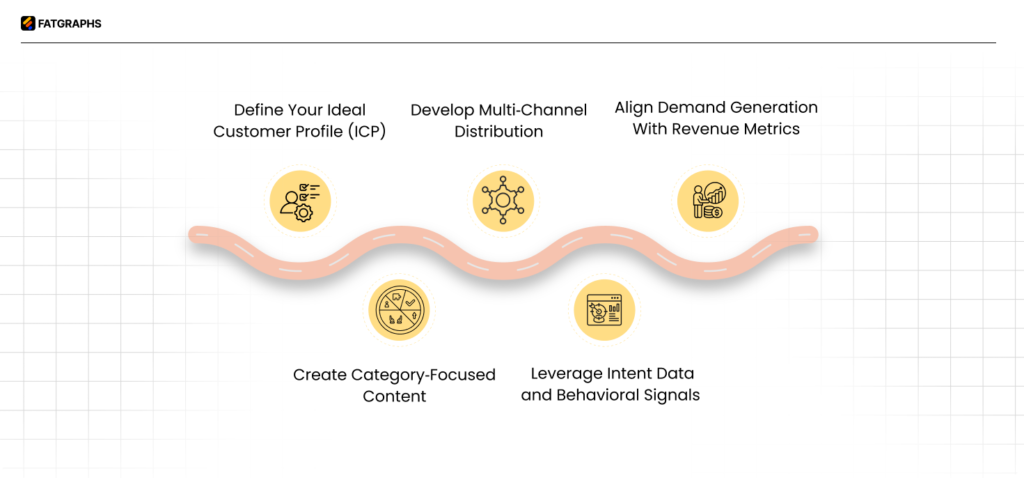
1- Define Your Ideal Customer Profile
The first step is defining your Ideal Customer Profile (ICP). Knowing the company size, industry, and decision-makers allows precise targeting. ICP clarity improves campaign efficiency and reduces wasted marketing spend.
2- Craft Valuable and Educational Content
Content should educate prospects and address their pain points. Examples include blogs, case studies, industry reports, ebooks, and executive thought leadership. Valuable content builds trust and positions your SaaS solution as essential.
3- Develop Multi-Channel Distribution
Multi-channel distribution ensures your content reaches your audience wherever they engage. Effective channels for B2B SaaS demand generation include LinkedIn organic and paid campaigns, Google search and display ads, email nurture campaigns, webinars, and virtual events. Multi-channel campaigns maximize reach and engagement.
4- Leverage Intent Data and Behavioral Signals
Tracking visitor behaviors such as page visits, content downloads, and webinar attendance provides insights into purchase intent. This data allows marketing teams to prioritize high-value leads and deliver personalized messaging.
5- Align Demand Generation With Revenue Metrics
Focus on metrics that impact revenue, not just lead volume. Track influenced pipeline, deal velocity, and conversion rates. Aligning marketing KPIs with sales ensures demand generation activities directly support business growth.
SaaS Demand Generation Tactics
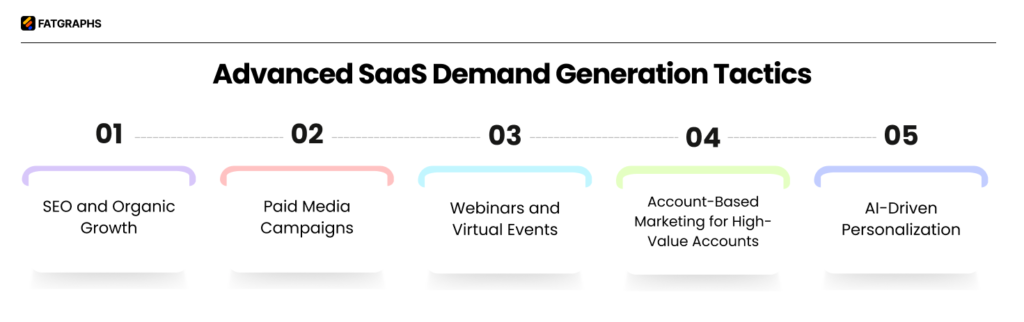
1- SEO and Organic Growth
Optimize content for high-intent keywords like SaaS lead generation strategies, SaaS pipeline generation, and how to generate SaaS leads. This improves visibility, attracts the right audience, and establishes authority in your niche.
2- Paid Media Campaigns
LinkedIn ads target decision-makers, while Google search campaigns capture prospects with clear intent. Retargeting campaigns reinforce brand awareness and maintain engagement with interested prospects.
3- Webinars and Virtual Events
Webinars educate prospects, demonstrate product capabilities, and showcase customer success stories. These events convert interested participants into qualified leads.
4- Account-Based Marketing for High-Value Accounts
ABM focuses on personalized campaigns for strategic accounts. Combined with intent data, ABM increases engagement and improves pipeline quality.
5- AI-Driven Personalization
AI helps scale tailored messaging across channels. Automating content recommendations, email sequences, and lead scoring ensures campaigns remain relevant and effective.
SaaS Pipeline Generation Framework
A strong demand generation strategy should directly contribute to pipeline creation. The framework moves prospects from awareness to engagement, intent, sales-qualified leads, and opportunities.
Top of Funnel (Awareness)
Goal: Get in front of buyers who don’t know they have a problem yet.
Tactics: SEO-led blog content targeting problem-aware keywords (“why is my SaaS churn high”), LinkedIn thought leadership posts from founders, ungated industry reports, podcast appearances, and YouTube explainers.
What bad looks like: Running brand ads to a cold audience with no retargeting layer and no content to capture those who aren’t ready to buy.
Middle of Funnel (Education)
Goal: Nurture prospects who know the problem but are still evaluating options.
Tactics: Comparison pages (“us vs competitor”), customer case studies with specific ROI numbers, email sequences triggered by content downloads, webinars on solving a specific pain point (not product demos), and retargeting ads pointing to high-intent content.
What bad looks like: Jumping straight from a blog post to a “Book a Demo” CTA with nothing in between. This is the education gap that collapses pipelines.
Bottom of Funnel (Capture)
Goal: Convert buyers who are actively evaluating vendors.
Tactics: Demo request pages with social proof, ROI calculators, sales-assisted trials, personalized outreach triggered by intent signals (3+ page visits, pricing page view), and competitor displacement content.
What bad looks like: Treating all demo requests the same, regardless of ICP fit or engagement history.
Tracking metrics at each stage ensures campaigns optimize conversion and minimize wasted effort.
Metrics to Track at Each Stage of SaaS Demand Generation
| Funnel Stage | Primary Metric | Secondary Metric | What It Tells You |
|---|---|---|---|
| Awareness (ToF) | Branded search volume growth | Organic impressions | Are people starting to look for you by name? |
| Education (MoF) | Content engagement rate | Email open + click rate | Are prospects absorbing enough to self-qualify? |
| Intent (BoF) | Demo request rate | Pricing page visits | Are educated prospects converting to pipeline? |
| Pipeline | MQL-to-SQL conversion | Deal velocity (days) | Is marketing generating sales-ready demand? |
| Revenue | CAC payback period | Pipeline-influenced revenue | Are educated prospects converting to the pipeline? |
How to Generate SaaS Leads From Demand Generation
Generating SaaS leads is the natural result of effective demand generation. Tactics include gated content, demo requests, webinar registration, and newsletter subscriptions. Lead nurturing is critical to move prospects through the funnel. Segment campaigns, personalize communication, and retarget engaged leads. Lead scoring helps sales focus on high-value prospects. Systematic demand generation ensures continuous pipeline growth.
Common Challenges and Solutions in Demand Generation
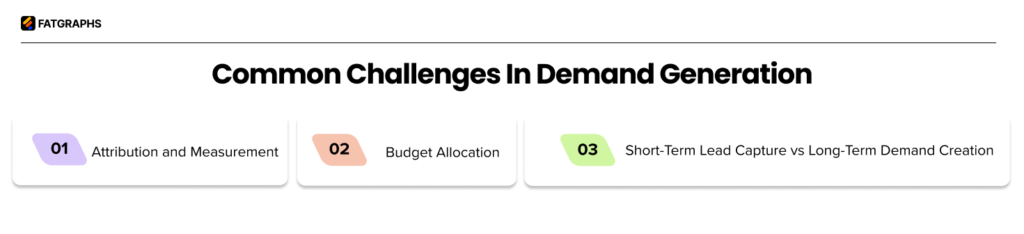
1- Attribution and Measurement
Tracking multiple channels can be complex. Use CRM and marketing automation tools to ensure each touchpoint is recorded and attributed accurately.
2- Budget Allocation
Balancing brand awareness campaigns with direct lead capture efforts is essential. Analyze metrics like pipeline contribution and conversion rates to optimize spend.
3- Short-Term Lead Capture vs Long-Term Demand Creation
Content and educational campaigns may not show immediate results, but they build sustainable growth. Combining both approaches ensures predictable revenue and market awareness.
Examples and Case Studies
Successful B2B SaaS companies integrate demand generation into their marketing. For example, a SaaS company targeting marketing managers may run educational webinars combined with LinkedIn campaigns, SEO content, and email nurture. This approach generates consistent qualified leads, shortens sales cycles, and increases pipeline value. Metrics like demo requests, engagement scores, and influenced pipeline track performance.
Early-Stage SaaS Demand Generation (0–$1M ARR)
At the early stage, demand gen is founder-led and manual. You don’t have the budget or brand recognition to run multi-channel campaigns.
What works?
- Founder posting on LinkedIn 3–5x per week on the specific problem your product solves (not product features)
- Direct outbound to your ICP with hyper-personalized messaging, not templates
- One anchor content piece (a definitive guide or original research report) that you drive all traffic to
- Community participation in Slack groups, Reddit, and niche forums where your ICP spends time
What to avoid:
Spreading the budget across 4 channels simultaneously. Pick one paid channel and own it before expanding.
Metric to watch: Conversation rate (how many discovery calls per week are coming from inbound vs outbound)
Growth-Stage SaaS Demand Generation ($1M–$10M ARR)
At the growth stage, the goal shifts from manual to systematic. You now have enough customer data to precisely define your ICP and enough case studies to build credibility.
Build a full content engine:
- SEO-led blog, gated assets for MoF, and comparison/alternative pages for BoF
- Layer paid media on top of organic: LinkedIn for brand + retargeting, Google Search for high-intent terms
- Implement lead scoring tied to behavioral signals, not just form fills
- Create a dedicated demand gen function separate from content marketing
- Start ABM motions for enterprise accounts while keeping PLG or self-serve active for SMB
Metric to watch:
Pipeline influenced by marketing (not just MQLs), deal velocity, and CAC payback period
Conclusion
SaaS demand generation is essential for B2B SaaS founders seeking predictable growth. It goes beyond lead generation, focusing on creating awareness, nurturing intent, and building a reliable pipeline. By defining your ICP, creating educational content, leveraging multi-channel campaigns, and tracking pipeline influence, you can accelerate revenue growth and achieve sustainable success.
FAQs
Q1- What is SaaS demand generation?
It is the process of creating awareness and interest in your SaaS product, attracting potential customers, and nurturing them through the buying journey.
Q2- How does demand generation differ from lead generation?
Demand generation builds interest and positions your solution. Lead generation captures contact information from prospects ready to engage.
Q3- Which channels work best for SaaS demand generation?
LinkedIn, Google Search, display ads, email nurturing, webinars, and virtual events are highly effective channels.
Q4- How long until SaaS demand generation shows results?
Sustained campaigns typically begin influencing the pipeline within three to six months.
Q5- Do SaaS companies need demand generation agencies or in-house teams?
Both options are viable. Agencies offer expertise and scale quickly, while in-house teams provide control and alignment with product and sales objectives.