
 Book Call with Haroon
Your B2B SaaS ICP isn’t wrong because it’s imprecise. It’s wrong because it’s answering the wrong question entirely. The right question is never “who is this person?” It’s “what just happened to this person that makes them need this now.”
Of 225 founder conversations I’ve analyzed, 31 opened with demographic ICP language. Zero of those 31 converted to paying clients. Every converted buyer described their ICP in situational terms.
One founder building a job-tracking tool (Tasksprout) for contractors had been running LinkedIn ads for three months. Zero conversions. His B2B SaaS ICP was textbook precise: “blue collar tradesmen like landscapers, handymen, contractors, pest control, roofing, electricians.” He knew his demographic. He missed his situation entirely.
When I asked what happened to his three existing customers the week before they found him, the answer had nothing to do with their job title. All three had just hired their second employee. All three realized text messages and spreadsheets were breaking down. The demographic was accurate; they were all contractors. The buying trigger was situational, rapid team growth creating operational chaos.
Why do demographic ICPs produce zero conversions?
Demographics tell you where to find people. They don’t tell you when those people will buy it.
Steven defined his B2B SaaS ICP as “Men, 30 to 65.” That’s 35% of the adult male population. His three paying customers fit that demographic perfectly. They are also inherited family businesses within 18 months of buying. The age range was irrelevant. The inheritance trigger was everything.
The pattern is consistent across every non-converting founder conversation. Demographic precision without situational clarity produces ads that find the right people at the wrong time. Your SaaS customer targeting works. Your timing doesn’t matter.
Alex understood this intuitively when he said, “Find repeatable signal: who converts, why, through which channel.” The “why” question is situational. It’s about business circumstances, not business demographics.
Read more: SaaS ICP Development: How Do You Build an ICP That Actually Scales Growth?
What converted buyers mean when they say ICP
Converted buyers describe their customers through the lens of recent business events. Not job titles. Not company sizes. Not industry verticals. Business circumstances create urgent needs.
The founder behind NovaVoca.ai opened with “We produce AI Call agents for various industries.” Horizontal ICP. No segment ownership. Compare that to a converted buyer’s description: “SaaS companies that just lost their head of sales and need to maintain pipeline velocity while they recruit.”
Same solution. Different B2B SaaS ICP framework. The first describes what the product does. The second describes when someone needs it badly enough to buy immediately.
This distinction matters because timing is everything in B2B SaaS. People don’t buy when they understand your product. They buy when not having your product becomes more expensive than having it.
The Situation Layer Diagnostic
The Situation Layer Diagnostic reveals whether your ideal customer profile framework captures buying triggers or just targets demographics. It works by mapping your last 10 customers against three specific business circumstances.
Run your customer list through these questions:
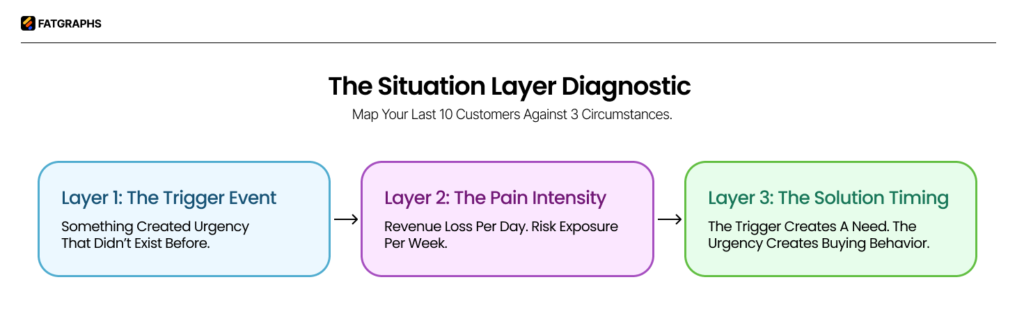
Layer 1: The Trigger Event
What changed in their business the week before they found you? New hire. Lost client. System failure. Compliance deadline. Funding round. Something created urgency that didn’t exist before.
Layer 2: The Pain Intensity
What was the daily cost of not solving this? Revenue loss per day. Risk exposure per week. Team productivity breakdown. If they couldn’t quantify the cost, they probably didn’t buy, and if they did, they likely churned.
Layer 3: The Solution Timing
Why this week and not last month? What made now urgent versus someday important? The trigger creates a need. The urgency creates buying behavior.
Apply this to the contractor tool founder’s customers. All three had:
- Same Layer 1 trigger: hiring employee number two.
- Same Layer 2 pain: daily communication breakdown costing billable hours.
- Same Layer 3 urgency: new hire starting Monday, needed system in place immediately.
The diagnostic revealed Task Sprout’s real ICP: “Service businesses transitioning from solo operations to team management who need operational systems before their growth becomes their constraint.”
When your ICP changes mid-conversation with prospects
B2B SaaS ICP instability signals demographic thinking, not situational thinking. Stockito started with “Art Buyers, designers, editors, marketers,” then shifted targets during our conversation. Four different job titles. No connecting business situation.
This happens when founders reverse engineer ICP from existing customers instead of identifying the business circumstances that created those customers. You end up with a list of job titles that happened to buy, not the situational triggers that caused them to buy.
The corrective:
Map your customer’s business situation the week before purchase, not their demographics the day of purchase. The situation is replicable. The demographics are incidental.
Josh defined his crypto platform’s ICP as “18-30 Male/Female (crypto user).” That’s 40 million people in the US alone. No business context. No urgency indicator. No problem specificity. Pure demographics with no situation layer.
How to rebuild your ICP around business circumstances
Pull your last 10 customers. If you don’t have 10, pull your last 5 and 5 prospects who engaged seriously but haven’t bought them yet.
For each customer, answer these questions:
- What specific business problem were they trying to solve the week they found you?
- What event created urgency around that problem?
- What was their operational situation that made this problem critical now versus later?
- What alternative solutions did they try before finding you?
The patterns that emerge become your situational ideal customer profile. Not job titles. Not company sizes. Business circumstances that create buying urgency.
One founder discovered all his customers were “SaaS companies that just implemented a new CRM and realized their existing reporting doesn’t integrate.” Another found “accounting firms during their first busy season after adding a new service line.”
The specificity feels narrow until you realize how many companies fit in these circumstances at any given time. Business circumstances are more common than you think. They’re also more urgent than demographic categories.
Why situation-based B2B SaaS ICPs convert, and demographic ICPs don’t
Situation-based marketing speaks to the problem someone is experiencing right now. Demographic marketing speaks to the person experiencing the problem.
When TaskSprout shifted from targeting “contractors” to targeting “service businesses that just hired their second employee,” conversion rates increased because the messaging changed. Instead of “job tracking for contractors,” the message became “operational systems before your growth breaks your business.”
Same audience. Different timing. The second message reached contractors exactly when they needed the solution most urgently.
Kevin asked, “What social media platforms to use for his gaming platform. The question revealed demographic thinking on where to find gamers. The better question: what situations create an urgent need for gaming platforms? Tournament organizers are planning events. Community managers building engagement. Creators monetizing audiences.
Different situations, different urgency levels, different buying timelines. Demographics group people. Situations group buying triggers together.
Bottom Line
Your B2B SaaS ICP is not a job title or demographic profile. It’s a business situation that creates an urgent need for your solution. Demographic ICPs tell you who might buy someday. Situational ICPs tell you who will buy this week. The difference is everything in B2B SaaS marketing. Stop targeting people. Start targeting circumstances. Run the Situation Layer Diagnostic on your last 10 customers. Map the business events that preceded their purchase. That pattern is your actual ideal customer profile framework.
FAQs
1- How do I find prospects who match my situational ICP?
Monitor trigger events instead of demographic databases. Track funding announcements, leadership changes, system implementations, and compliance deadlines. Use intent data providers, LinkedIn alerts for job changes, and industry publications for situational intelligence. Your CRM should track business circumstances, not just contact information.
2- What if my customers don’t remember what triggered their purchase?
Ask about their business situation six months before they bought, not their decision-making process. “What was breaking in your operations?” gets better answers than “Why did you choose us?” People remember pain better than purchase decisions. Focus the conversation on their business problems, not your product benefits.
3- How specific should my situational B2B SaaS ICP be?
Specific enough that you can predict when someone needs your solution, broad enough that the situation occurs regularly. “SaaS companies that just lost their head of sales” is specific. “Companies experiencing change” is too broad. Test: Can you set up Google Alerts to monitor for this situation? If yes, it’s specific enough.
4- Should I completely ignore demographics in my ICP?
Demographics are targeting filters, not ICP definitions. Use them to narrow distribution channels after you’ve defined the situational ICP. A marketing automation tool might target “SaaS companies that just hired their first marketing person” (situation) and filter for “50-200 employees” (demographic). Situation drives the message. Demographics drive the media buy.
5- What if I have customers in completely different situations?
You likely have multiple ICPs, not one horizontal B2B SaaS ICP. Segment by situation and run separate campaigns. One founder discovered three distinct situational ICPs for his project management tool: “agencies that just landed their biggest client, “startups that just raised Series A,” and “departments that just got new compliance requirements.” Same product, different situations, different messaging.