
 Book Call with Haroon
Your B2B SaaS marketing KPIs might look impressive on paper. The charts go up. The reports look polished. But are those numbers actually helping your company grow revenue? Many companies track dozens of metrics without knowing which ones truly affect their bottom line. After many years of working with B2B SaaS marketing clients, one clear pattern appears: only a small group of KPIs truly matter.
These important SaaS marketing metrics include maintaining a healthy churn rate, achieving strong lead-to-MQL conversion, and growing unique website visitors steadily each month, with most traffic coming from organic channels.
This article will help you understand whether you are tracking vanity metrics, which look good but do not drive results, or B2B SaaS marketing KPIs that connect to revenue.
Why Page Views and Social Media Followers Don’t Really Matter
Page views, social media followers, and email list size often look impressive in reports. However, they mainly measure visibility, not real business impact.
Industry research shows that many of the metrics used in marketing reports focus on campaign delivery or digital activity rather than actual business outcomes. These numbers do not answer the most important question: are visitors turning into qualified leads or paying customers?
Traffic without quality can create a false sense of success. For example, a B2B software company may celebrate a large increase in website visitors. However, if those new visitors rarely convert into leads, the business does not truly benefit. Extra traffic without conversion only increases surface-level numbers, not revenue.
Many marketers admit that follower growth does not strongly connect to revenue. Yet follower count continues to be one of the best B2B SaaS marketing KPIs.
The Cost of Tracking the Wrong KPIs
Tracking the wrong B2B SaaS marketing KPIs wastes time and money. Marketing managers often spend hours each week reviewing data that does not influence important decisions. Companies without clear SaaS marketing metrics frequently invest large parts of their budget in campaigns that do not generate meaningful results. The biggest problem appears at the leadership level.
Financial executives often express concern when marketing reports focus on visibility metrics while sales performance weakens. Leaders may see growing brand awareness and website traffic, while revenue does not improve. When this happens, marketing’s credibility suffers. Instead of being seen as a driver of growth, marketing may be viewed as a cost center. This can lead to reduced budgets and team instability.
How Vanity Metrics Create False Confidence
Vanity metrics create emotional excitement. When numbers increase, teams naturally assume their strategy is working.
- Rising email subscriber counts can hide low engagement. High website traffic can hide weak conversion rates. Positive surface-level numbers can distract from deeper performance problems.
- This false confidence prevents companies from making necessary adjustments. Leadership may continue investing in campaigns that are not truly effective, while ignoring better growth opportunities.
- The result is scaling the wrong strategies, targeting the wrong audience, and optimizing for numbers that are disconnected from what truly matters: a strong pipeline that converts into paying customers.
The 7 B2B SaaS Marketing KPIs That Actually Matter
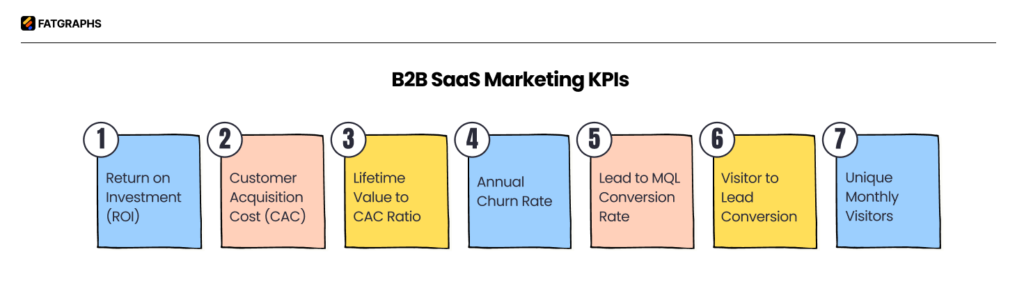
A focused set of B2B SaaS Marketing KPIs separates growing SaaS companies from those stuck measuring the wrong things. These metrics connect directly to revenue, profitability, and sustainable growth.
1- Return on Investment (ROI)
ROI measures how much revenue your marketing generates compared to how much you spend. It shows whether your marketing activities are profitable.
Different channels perform differently. Some long-term strategies, like search optimization and email marketing, often produce strong returns over time, while paid advertising may produce smaller margins if not carefully managed. ROI helps you understand whether your marketing investments truly contribute to business growth.
2- Customer Acquisition Cost (CAC)
CAC shows how much you spend to gain each new customer. It includes both sales and marketing costs. This number varies depending on the size of your company, your target market, and the complexity of your product. What matters most is understanding whether the cost of acquiring customers makes financial sense for your business model.
3- Lifetime Value LTV to CAC Ratio
The CAC to LTV ratio compares the total value a customer brings over time to the cost of acquiring that customer. It helps you understand whether your business is sustainable. If acquisition costs are too high compared to customer value, your company may struggle to grow profitably. If the ratio is healthy, you can confidently invest in expansion.
4- Annual Churn Rate
Churn measures how many customers stop using your product over a period of time. A lower churn rate means customers stay longer, which leads to more stable revenue. Churn can happen voluntarily, when customers choose to leave, or involuntarily, due to issues like payment failures. Strong SaaS companies work consistently to reduce churn and improve customer retention across different market segments.
5- Lead to MQL Conversion Rate
This metric measures lead quality. It shows how many of your leads meet the criteria to become marketing-qualified leads. A strong conversion rate suggests that your marketing efforts are attracting the right audience. Referral leads often perform especially well because trust already exists.
6- Visitor to Lead Conversion Rate
This metric shows how effectively your website turns visitors into leads. It reflects the quality of your messaging, design, and user experience. While general website conversion rates tend to be modest, well-optimized landing pages can perform much better. Improving this metric strengthens your entire marketing funnel.
7- Unique Monthly Visitors
Monthly unique visitors indicate the health of your top-of-funnel strategy. Steady growth in visitors, especially from organic sources, shows that your content and brand visibility are improving. However, traffic growth must be supported by strong conversion and retention to truly impact revenue.
Warning Signs You’re Tracking Wrong B2B SaaS Marketing KPIs
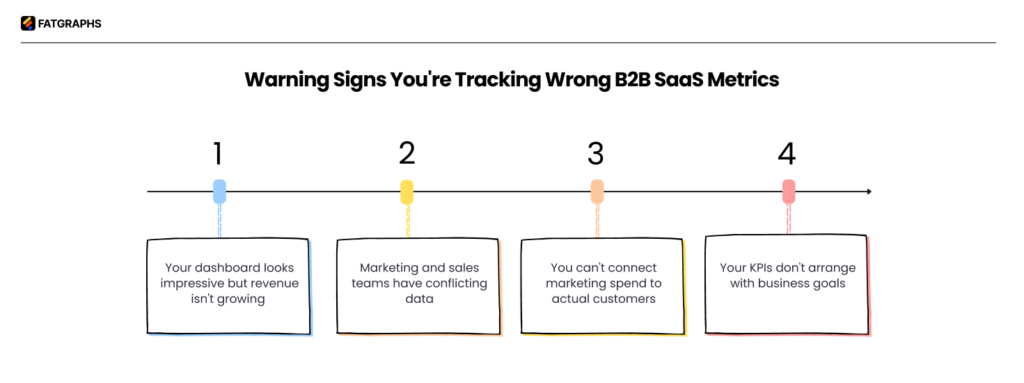
Several red flags suggest your B2B SaaS Marketing KPIs may be misleading.
➔ Your dashboard looks impressive, but revenue isn’t growing
All your charts may show growth, yet your pipeline remains flat. Revenue increases may come mainly from existing customers rather than new ones. Marketing costs may appear lower because spending shifts toward remarketing instead of new customer acquisition.
On the surface, the business appears successful. In reality, long-term growth may be weakening.
➔ Marketing and sales teams have conflicting data
Marketing may track engagement in one system while sales manages leads in another. This often leads to blame and confusion.
Marketing believes it delivered enough leads, while sales argues that the quality was not strong enough. Leads may sit untouched in the CRM, allowing competitors to move faster.
Disconnected systems prevent clear visibility and alignment.
➔ You can’t connect marketing spend to actual customers
Poor attribution leads to wasted resources. Without a clear understanding of which channels drive paying customers, companies struggle to measure true performance.
Some teams attempt to judge success too quickly or rely on simple metrics like cost per click, which do not reflect long-term business results.
➔ Your KPIs don’t align with business goals
Many business improvement efforts fail because KPIs do not match the overall strategy. Companies that clearly connect their metrics to strategic goals perform better than those that do not.
However, in many organizations, employees do not fully understand how KPIs connect to broader objectives. Without alignment, measurement becomes an isolated reporting activity rather than a growth driver.
How to Build a B2B SaaS Marketing KPIs Framework That Works
Building a strong KPI framework requires linking marketing metrics directly to revenue outcomes.
1- Audit your current SaaS marketing metrics
Begin by reviewing your current KPIs. Identify which metrics directly support your business priorities and which simply report activity.
Different SaaS companies focus on different measurements depending on their growth stage and model. The key is ensuring your metrics reflect your real objectives.
2- Set benchmarks to measure each B2B SaaS Marketing KPI
Compare your performance with realistic industry standards based on company size, pricing structure, and target market. Benchmarks create context and help you understand whether your results are competitive and sustainable.
3- Create attribution models to track multiple channels
Use consistent tracking methods and ensure your CRM captures customer source data at every stage.
Modern B2B buyers interact with many touchpoints before making a decision. A multi-touch attribution model provides a clearer picture of the full customer journey.
4- Align B2B SaaS Marketing KPIs with sales team goals
When sales and marketing teams share common goals and data, performance improves. Alignment increases win rates, strengthens retention, and supports steady revenue growth.
Misalignment, on the other hand, weakens results and creates internal friction.
5- Review and adjust your metrics quarterly
Regularly review your KPI framework. Quarterly reviews help you identify bottlenecks, test improvements, and adjust strategies before problems grow larger. Continuous evaluation ensures that your measurement system evolves with your business.
Conclusion
B2B SaaS marketing success depends on tracking metrics that directly influence revenue, not vanity numbers that simply look impressive in reports. The KPIs discussed in this article provide a foundation for meaningful measurement. Start by reviewing your current metrics and building a framework that aligns with your business strategy. When you focus on the right numbers, you identify problems earlier, scale effective strategies, improve profitability, and support long-term growth. Better measurement leads to better results.
FAQs
Q1. What are vanity metrics and why should B2B SaaS companies avoid them?
Vanity metrics are numbers such as page views, social media followers, and email list size. They may look impressive but do not directly connect to revenue or growth. They measure exposure rather than true business impact and can hide deeper problems like weak conversion or poor lead quality.
Q2. What is a healthy Customer Acquisition Cost (CAC)?
A healthy CAC depends on your business model and customer value. What matters most is ensuring that the revenue generated from a customer over time clearly exceeds the cost of acquiring that customer.
Q3. What is an acceptable churn rate?
An acceptable churn rate is one that allows stable and predictable revenue growth. Strong SaaS companies focus on keeping churn low and improving customer retention across all segments.
Q4. How can I tell if we’re tracking the wrong KPIs?
Warning signs include dashboards that show positive trends while revenue stays flat, disagreement between marketing and sales data, difficulty connecting marketing spend to actual customers, and KPIs that do not clearly support business goals.
Q5. What is a good lead-to-MQL conversion rate?
A good lead-to-MQL conversion rate indicates that your marketing is attracting the right audience and generating qualified interest. Strong referral channels often perform particularly well because trust already exists between the prospect and your brand.