
 Book Call with Haroon
Your ICP is probably wrong, and you can prove it in 10 minutes. But how to test if ICP is right? Pull your last 20 customers and ask them what specific situation they were in the week before they bought. If you can’t explain why those exact people converted when they did, your customer acquisition is running on luck, not strategy.
“We have hundreds of success stories, but I can’t explain them.”
The founder of Jeremy runs a 12-year-old auction platform with his wife. They’ve helped clearance sellers move millions in inventory. But when I asked him to describe his ideal customer, he said “clearance sellers with stock to clear,” which describes everyone who might use his platform, not the specific people who actually do.
He had hundreds of success stories, but couldn’t explain what triggered those specific sellers to find and choose his auction platform over alternatives. His ICP was a job title, not a situation. That’s why, after 12 years, he still had no systematic marketing approach and was running a two-person operation when he could have been scaling.
The pattern repeats across every conversation I’ve analyzed. Founders define their ICP as demographics (“indie authors”) or job functions (“developers in geospatial”) rather than the specific circumstances that drive someone to buy right now.
The Situation Analysis Framework
The Situation Analysis Framework is a 10-minute exercise that reveals how to test if ICP is right, whether your ICP captures the moment of purchase or just describes who might buy someday. It works by identifying the specific trigger events that drove your actual customers to convert when they did. Apply it by interviewing your last 20 customers about their situation the week before they bought.
Here’s how it works:
- Pull your last 20 customers (or however many you have)
- Ask one question: “What specific situation were you in the week before you decided to buy?”
- Look for patterns in their trigger events, not their demographics
- Rewrite your ICP based on situations, not segments
“I Target Busy Professionals and Students.”
Yaser built Digital Cortex, a productivity app launching in Q1 2025. He stated ICP was “busy professionals, students and lifelong learners, self-improvement enthusiasts, regular/average person, not the tech-savvy type who find usual project management tools like Asana, Trello complex and overwhelming.”
That’s seven different demographics rolled into one unusable definition. It tells you nothing about when someone becomes ready to buy a new productivity system or what triggers them to look for an alternative to their current approach.
Compare that to what happened with Jakub, who built an AI debugging platform. His ICP was also demographic: “freelance programmers, software development companies, internet startups.” But when I dug deeper, his real insight was situational: developers spend 40% of their time finding and solving bugs, and reproducing user-reported bugs is expensive and often impossible.
The difference is between trigger and trait. Jakub identified the specific problem that drives developers to seek his solution. Yaser listed personality types.
“My First Target Customer Enjoys the Grind.”
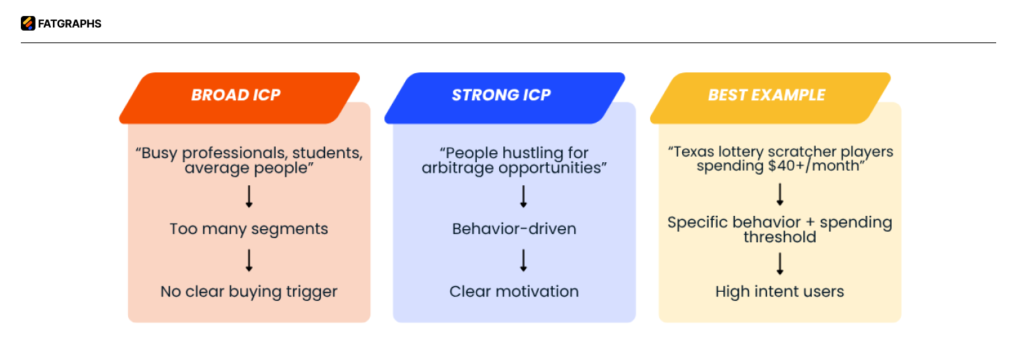
Hoon launched OddClover, a sports betting analytics platform. His ICP definition started strong: “people who enjoy the grind and stay hustling for arbitrage opportunities.” This actually captures a behavioral trigger, people actively seeking arbitrage plays.
But then he added a second segment that got cut off in our conversation. Multiple segments usually mean you haven’t found the real pattern yet. The strongest ICPs describe one specific situation so clearly that the person experiencing it immediately recognizes themselves.
Doug built a lottery scratcher analysis tool for Texas. His ICP was precise: “Lotto scratcher players in Texas who spend $40+ a month on tickets.” The spending threshold matters because it identifies people with both the means and motivation to pay for better information.
“We’ve Only Done Direct Outbound So Far.“
Rudy launched Naviflow, a shipment management platform for importers and exporters. His ICP was situational and specific: “SMEs in all economic sectors shipping more than 50 cross-border shipments per year by sea, air, and land, specifically cargo owners (importers, exporters, traders), not their 3rd party shipping providers.”
The “50 shipments per year” threshold identifies companies with enough volume to justify new software but not so large that they’d need enterprise solutions. The exclusion of 3rd party providers shows he understood the difference between users and decision makers.
But here’s what’s telling: even with this precise ICP definition, Rudy said, “We have only done direct outbound sales actions so far.” If your ICP is truly accurate, you should be able to identify where these people gather, what content they consume, and how to reach them systematically.
When Your ICP is Actually Wrong & How to Test if ICP is Right?
5 of the 12 founders I analyzed had ICPs that were too broad to be actionable. Melissa defined her target as “indie authors” for her Patreon-like platform BookBackr. Golo from Novavoca said “software companies, for example, creating booking systems for hotels” for his AI call agents.
These aren’t ICPs, they’re market categories. They don’t explain timing, urgency, or why someone would switch from their current solution to yours.
The other 7 had situational elements but couldn’t explain why their actual customers converted when they did. That’s the gap the Situation Analysis Framework fills.
Bottom Line
Your ICP needs to explain not just who buys, but when and why they buy. Pull your last 20 customers and ask what situation they were in the week before they purchased. If you can’t identify consistent trigger events, your customer acquisition is running on hope, not strategy. The founders who scale systematically know exactly which situations create urgency for their solution.
FAQs
1- How do I contact customers who bought months ago to ask about their situation?
Send a simple email: “Quick question to help improve our service, what specific situation were you dealing with right before you decided to try a product?” Most customers remember the problem that drove them to seek a solution.
2- What if I only have a few customers to analyze?
Start with what you have. Even 3-5 customer situations can reveal patterns. The framework works with small sample sizes because you’re looking for trigger events, not statistical significance.
3- Should I focus on demographics or situations when defining my ICP?
Always situations. Demographics tell you who might buy someday. Situations tell you who’s ready to buy right now and why they’re actively looking for solutions.
4- What if different customers had completely different trigger situations?
That usually means you’re serving multiple markets or haven’t identified the deeper pattern yet. Look for the underlying problem or circumstance that connects seemingly different triggers.
5- How often should I validate my ICP with this exercise?
Every 20-30 new customers, or whenever your conversion rates drop unexpectedly. Customer situations evolve, especially in early-stage companies where you’re still finding product-market fit.