
 Book Call with Haroon
Most founders with horizontal SaaS products waste 6–12 months chasing every possible market instead of completing an ICP Narrowing Exercise to find their strongest wedge. The solution isn’t complex: focus on the segment with the shortest sales cycle, highest retention, and lowest cost to serve, then expand from there.
The AI debugging founder, Jakhaj, felt confident his platform could help “freelance programmers, software development companies, and internet startups.” Meanwhile, Siyotekonen built tax preparation tools for “rental property owners, Uber drivers, Lyft drivers, DoorDash drivers, taxi drivers, courier delivery drivers, real estate agents, and self-employed workers on the road.” Both founders had built genuinely horizontal products that could serve multiple markets. Both were about to make the same expensive mistake.
In 11 of the 12 conversations I reviewed for this article, founders listed 37 different target segments. Only one founder, Melissa with BookBackr, had already narrowed to indie authors first, readers second. She converted immediately and scaled efficiently. The others spent months discovering what she already knew: horizontal doesn’t mean unfocused. A structured ICP Narrowing Exercise could have helped them identify their best-fit segment much earlier.
ICP Narrowing Exercise Example: “We could help anyone who ships internationally”
Rudy runs Naviflow, an AI-enabled command center for cross-border shipment operations. His initial target: “SMEs in all economic sectors ship more than 50 cross-border shipments per year by sea, air, and land.” Every vertical was fair for game manufacturing, retail, agriculture, and technology. If they shipped cargo internationally, Naviflow could handle their operations.
Three months into his go-to-market, Rudy discovered something critical: manufacturing companies with predictable shipping schedules signed in 23 calls and stayed for years. Retail companies with seasonal spikes took 68 calls to close and churned after peak season. Same product, same value proposition, completely different unit economics.
The difference wasn’t product-market fit. Both segments had genuine pain around manual shipment tracking. The difference was the decision-making process, budget cycles, and operational complexity. Manufacturing companies plan technology investments annually. Retail companies evaluated solutions quarterly based on immediate needs.
Rudy didn’t abandon retail entirely; he just stopped leading with them. His outbound campaigns now target manufacturing first, using retail success stories as social proof. Same horizontal product, focused go-to-market strategy.
The framework everyone ignores until month six
This framework effectively functions as an ICP Narrowing Exercise by helping founders prioritize the segments most likely to generate sustainable revenue. The Sales Cycle Priority Framework is a systematic approach to rank horizontal market segments by speed to revenue and cost to serve. It works by measuring three metrics across all potential segments: average sales cycle length, 12-month retention rate, and customer acquisition cost. Apply it by testing each segment for 3060 days, then doubling down on the combination that generates revenue fastest with lowest churn.
Yaser with Digital Cortex learned this the expensive way. His life management app targets “busy professionals, students and lifelong learners, and self-improvement enthusiasts.” During our conversation, he mentioned busy professionals have budget authority but need multiple stakeholders to approve productivity tools. Students love the product but have zero budget. Self-improvement enthusiasts buy immediately but expect constant feature updates.
The data told the story: self-improvement enthusiasts signed in on one call; professionals needed six weeks; students never converted to paid status. But the retention numbers flipped: professionals stayed for years; enthusiasts churned after three months when the novelty wore off.
Yaser shifted his launch strategy to target professionals first, using free tiers to capture students and enthusiasts as testimonial sources. Same horizontal platform, different sequence of market entry.
“But every business needs what we built”
Jacob offers cybersecurity certifications to UK businesses. His original scope: “UK customers focused on Scotland, small companies with IT presence who don’t have Cyber Essentials certification, small businesses needing ISO 27001 alternative.” Every small business theoretically needed cyber certification, but the sales reality was brutal.
Companies with compliance requirements (healthcare, finance, government contractors) moved fast; certification was mandatory, not optional. General small businesses treated cybersecurity as a nice-to-have that could wait until next quarter. Same certification service, completely different urgency.
The pattern held across industries: Ali targeting “software companies creating booking systems for hotels” discovered hotel booking systems had immediate AI integration needs while general software companies were still evaluating AI strategies. Jeremy found clearance sellers with distressed inventory moved faster than sellers with regular overstock.
When horizontal works
Mouad builds geospatial tools for developers. His target: “developers in geospatial and GIS.” Single segment, horizontal application within that segment. The difference: every developer in this space shares the same technical context, evaluation criteria, and procurement process.
Hoon with Odd Clover targets “people who enjoy the grind and stay hustling for arbitrage opportunities” in sports betting. Again, one behavioral segment with consistent characteristics across different demographics.
The successful horizontal founders started narrowing within a segment, not wide across segments. They built one type of person with one type of problem, even if their solution could technically serve multiple types.
The 30-Day ICP Narrowing Exercise
Track these metrics for each segment you’re considering: average sales cycle length from first contact to signed contract, monthly churn rate, and total cost to acquire one customer. Test 23 segments simultaneously for 30 days using identical outbound sequences.
Kevin Schenker with Playtrybe tested “travelers, people searching specific hobbies, and people going on vacation” using the same content and messaging. Travelers engaged immediately but wanted free guides. Hobby enthusiasts paid for detailed guides but had specific niche requirements. Vacation planners fell between both extremes.
The math determined his focus: hobby enthusiasts had the highest lifetime value despite lower volume. He shifted Playtrybe’s positioning from general experience guides to specialized hobby instruction, using travel content as free lead magnets.
Stop optimizing for the wrong thing
Doug built a Texas lottery scratcher analysis tool for “lotto scratcher players who spend $40+ monthly on tickets.” He spent weeks debating whether to target casual players ($1020 monthly) or serious players ($100+ monthly). The answer came from operational reality, not market size.
Serious players understood probability and math and converted immediately. Casual players needed extensive education about why data analysis mattered for lottery tickets. The cost to serve casual players exceeded their lifetime value by 3x. Same product, same Texas market, completely different unit economics based on customer sophistication.
Bottom Line
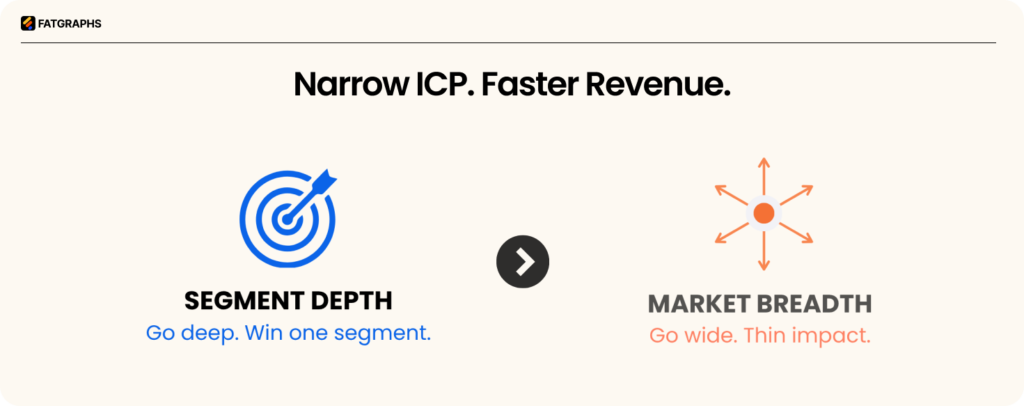
Most horizontal SaaS founders chase market breadth when they should chase market depth. An ICP Narrowing Exercise helps founders identify where to focus before investing heavily in sales and marketing. Test 23 segments simultaneously for 30 days, measuring sales cycle length, retention rate, and acquisition cost. Double down on the segment combination that delivers revenue fastest with lowest churn. Use your success there to expand into adjacent segments with proven case studies and refined messaging. Horizontal platforms win by sequence, not by scope.
Common Questions
1- How do I know if my product is truly horizontal or just unfocused?
Test whether different segments evaluate your product using the same criteria and have similar procurement processes. If manufacturing companies need 6-month pilots while retail needs immediate implementation, you’re serving different segments. If both evaluate productivity software the same way, you’re horizontal within one segment.
2- Should I build different landing pages for each segment I’m testing?
Yes, but keep the same underlying offer and pricing. Change only the messaging, case studies, and problem framing. If you need different features or pricing for each segment, they’re different products, not different markets.
3- During an ICP Narrowing Exercise, how many segments can I realistically test at once without diluting my efforts?
Maximum three segments with identical sales processes. If any segment requires different outbound sequences, onboarding processes, or customer success approaches, count it as two segments worth of effort.
4- What if my fastest converting segment is also my smallest market?
Take the fast conversion. Small markets with short sales cycles generate cash flow and case studies faster than large markets with complex sales processes. Use early revenue to fund expansion into larger segments later.
5- How do I avoid alienating other segments when I focus on one?
Position is the best solution for your primary segment rather than the only solution for them. Keep broader messaging on your homepage with specific landing pages. Never say you don’t serve other markets; just lead where you’re strongest.