
 Book Call with Haroon
Build your ICP first, then buyer personas. Your target market defines the addressable universe; your ICP identifies who buys, and buyer personas explain how they buy. Most founders skip the ICP step and jump straight to personas, building marketing for people who never convert. Understanding Target Market vs ICP is critical because most founders confuse who could buy with who actually does buy.
Melissa from BookBackr learned this the expensive way. She started with “indie authors are my target audience” but couldn’t explain why some authors subscribed immediately while others ignored her outreach. After mapping out her actual customers, she discovered her ICP wasn’t just any indie author; it was serial fiction writers with existing readerships who publish monthly. Her buyer personas then focused on how these specific authors made platform decisions.
This confusion costs founders months of spinning their wheels. In 12 conversations I reviewed for this article, 9 founders described their market using demographic labels like “small businesses” or behavioral descriptions like “people who enjoy the grind” without identifying the situational triggers that create buyers.
When you describe your market like a census category
Doug built a lottery analysis tool and defined his target as “Lotto scratcher players in Texas who play $40+ a month.” This demographic description told him nothing about why someone would pay for his analysis versus continuing to play with gut feel.
The demographic approach feels logical because it’s measurable. You can count lottery players. You can estimate their spending. But demographics don’t buy products; people in specific situations do.
After mapping his paying users, Doug discovered his actual ICP: Texas lottery players who track their wins and losses but lack systematic analysis to improve their strategy. The demographic stayed the same, but the situational context explained why someone would subscribe versus just continue playing randomly.
When your ICP looks like a job posting
Jacob from a UK cybersecurity consultancy stated his ICP as “small companies with IT presence who don’t have Cyber Essentials certification.” This reads like a qualification checklist, not a buying trigger.
The job posting approach happens when founders think about who should buy rather than who does buy. Small companies need cybersecurity; therefore, small companies must be the ICP. But need and purchase are different verbs.
His real ICP emerged from client analysis: UK small businesses responding to insurance requirements or customer security questionnaires that mandate Cyber Essentials certification. The situational trigger of external pressure explained why these companies moved from “should have” to “will buy.”
When buyer personas become marketing assumptions
Jakub from an AI debugging platform wanted to target “freelance programmers and software development companies” but couldn’t articulate how these segments discovered or evaluated debugging tools. He had demographic targets without behavioral understanding.
Buyer personas without ICP foundation become marketing fiction. You invent how people buy based on what seems reasonable rather than mapping how they buy. Freelance programmers might care about time savings, but that assumption drives generic marketing that converts nobody.
The missing link is the buying trigger. Freelancers dealing with recurring client complaints about bugs behave differently than freelancers building new features. The persona how they research, who influences decisions, what messaging resonates only matters after you know the situational context that creates buyers.
The Target ICP Persona Hierarchy
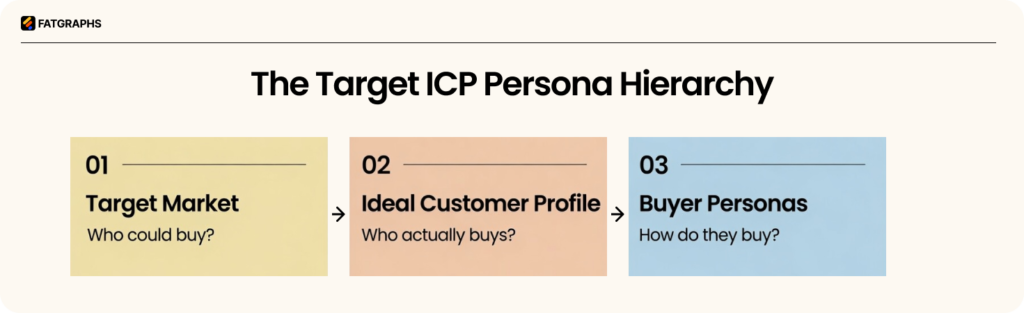
The Target ICP Persona Hierarchy is a three-layer customer definition system. Your target market defines who could potentially buy, your ICP identifies who does buy, and buyer personas explain how they buy. Each layer serves a different GTM function and must be built in sequence. This is where the distinction between Target Market vs ICP becomes operational rather than theoretical.
Target market establishes your total addressable market for investors and strategic planning. Mouad targeting “developers in geospatial and GIS” defined a $2.8B market for his investor deck. But this number doesn’t help with messaging or channel selection.
ICP defines your highest converting customer segment based on situational characteristics, not demographics. Ali discovered his ICP wasn’t “software companies” generally but “booking system providers struggling with phone support volume during peak seasons.” This situational specificity drove his entire GTM strategy.
Buyer personas map the decision-making process within your ICP. How do booking system CTOs discover new solutions? What triggers budget approval for AI call agents? Who influences the buying committee? These behavioral patterns only make sense after you’ve defined the situational context through ICP work.
When founders skip the ICP step entirely
Kevin Schenkers from Playtrybe jumped straight to channels: “I need a plan for attracting the right audiences and what social media platforms to use.” He wanted tactics without strategy, personas without ICP definition.
This backwards approach burns cash and time. You can’t select channels without knowing your ICP’s information consumption habits. You can’t write messaging without understanding their situational context. You can’t build personas without mapping actual buyer behavior.
His target market “people open to try something new” was too broad for any meaningful marketing. His attempted personas “travelers, hobby enthusiasts” lacked the situational triggers that create demand for experience guides. When ICP keeps changing without clarity, his channel selection became random social media spraying.
When situational context trumps demographics
Rudy from Naviflow described his ICP as “SMEs shipping 50+ cross-border shipments annually” but couldn’t explain why some prospects converted immediately while others stayed stuck in evaluation. The demographic qualifier was accurate but incomplete.
The breakthrough came from analyzing his fastest deals. His real ICP was SME cargo owners experiencing shipment visibility problems with 3PL providers who were manually tracking shipments in spreadsheets. The pain point: loss of control over shipment status created immediate buying urgency.
This situational context drove everything: messaging focused on regaining visibility, channels targeted operations managers dealing with shipping chaos, and personas mapped how these managers typically discovered and evaluated supply chain software. Demographics provided the universe; situation created the buyers.
Build ICP first, always
Start with your existing customers if you have them. Map their common situational characteristics before you touch demographics. What trigger event prompted them to seek a solution? What operational pain point reached a breaking point? What budget or timing constraints influence their purchase? “The entire framework of Target Market vs ICP breaks when founders reverse this order and start with personas or channels.
If you’re pre-launch, interview 10 people in your suspected target market about their current process and pain points. Don’t ask if they’d buy your solution; ask what would need to change in their situation for them to actively seek alternatives to their current approach.
Once you have situational clarity, layer in demographics for market sizing and channel selection. Then build buyer personas to map the decision-making process within your defined ICP segment.
Bottom Line
Target market vs ICP, and buyer personas serve different purposes in your GTM strategy and must be built in sequence. Your target market defines the addressable universe for planning and sizing. Your ICP identifies the situational characteristics that create actual buyers within that market. Buyer personas map how your ICP makes purchasing decisions. Skip the ICP step and your personas become marketing fiction that converts nobody. Build ICP first by analyzing existing customer situations or interviewing prospects about triggering events and pain points, then layer demographics and decision-making patterns on top.
Common Questions
1- Should I build buyer personas or ICP first if I’m pre-launch?
Build ICP first, always. Interview 10 people in your target market about their current pain points and what would trigger them to seek new solutions. Personas without situational context become marketing assumptions that waste budget and time.
2- Can my target market and ICP be the same thing?
Only if you’re in an extremely narrow niche; most founders discover their ICP is a subset of their target market defined by specific situational characteristics like operational pain points, trigger events, or external pressures that create buying urgency.
3- How do I know if my ICP is too narrow or too broad?
Your ICP is too broad if you can’t explain why some prospects convert quickly while others get stuck in evaluation. It’s too narrow if you can’t find enough prospects to build a sustainable business. Test with 20 prospects; if conversion patterns vary widely, narrow further.
4- What’s the difference between firmographic and situational ICP criteria?
Firmographic criteria are company characteristics like size, industry, or revenue. Situational criteria are triggering events, pain points, or operational challenges that create buying urgency. Situational criteria predict conversion better than firmographic ones.
5- How often should I update my ICP definition?
Review quarterly based on actual customer data, not market assumptions. If your fastest deals share new common characteristics or your messaging stops resonating, your ICP may have shifted. Don’t change based on single anecdotes; wait for patterns across multiple customers.