 Book Call with Haroon
A SaaS acquisition engine isn’t just about driving traffic. The real challenge is turning those visitors into paying customers. That’s where many SaaS founders struggle and make mistakes in building a SaaS acquisition engine. Small mistakes can slow growth, burn budget, and hold back even strong products. Most acquisition strategies hit roadblocks at some point.
And often, the difference between SaaS companies that scale and those that stall comes down to avoiding a few common traps. Here is a breakdown of the five most damaging mistakes and shows how to fix them, so your acquisition engine consistently attracts and converts the right customers.
How to build a SaaS acquisition engine?
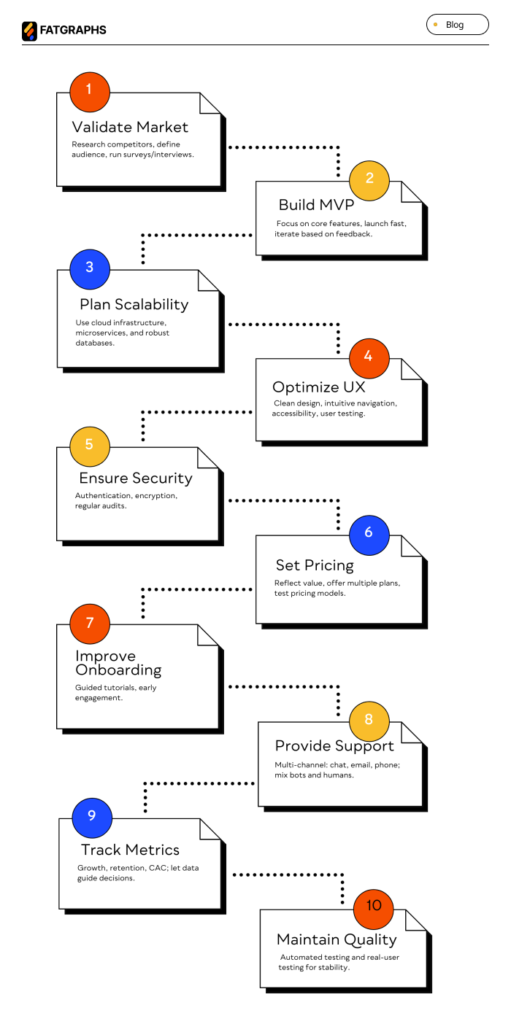
Building a successful SaaS acquisition engine takes planning and discipline, not random marketing experiments. The best SaaS companies don’t just chase users; they build systems that support long-term growth.
Top 5 Common Mistakes in Building a SaaS Acquisition Engine
Even the most innovative SaaS products can fail if acquisition is mishandled. These five mistakes are some of the most common reasons for promising startups to fall short.
1. Neglecting Market Validation
Many founders build products based on assumptions instead of real data. The result is a solution nobody wants to buy. Market validation means talking to potential customers early, studying competitors, and defining your ideal customer profile. Without this step, you risk solving the wrong problem or having no problem at all.
2. Early Feature Expansion
Trying to launch with too many features slows you down and wastes resources. Most successful SaaS products start with a focused MVP that delivers core value. Overengineering adds complexity, increases costs, and makes the product harder to use exactly when speed and clarity matter most.
3. Ignoring Scalability and Technical Debt
Quick shortcuts today often turn into major obstacles tomorrow. Rushing to launch without a scalable architecture leads to technical debt that blocks growth later. Your system should handle rising traffic and data smoothly through optimized databases, cloud infrastructure, and modular services.
4. Underestimating the Importance of UX/UI Design
Even great products fail when the experience is confusing. Users make judgments in seconds, and poor UX kills conversions. Strong UX design reduces friction, simplifies workflows, and makes navigation intuitive for all users. A website builds credibility through its compelling design and performance as well.
5. Failing to Plan for Security and Compliance
Security breaches instantly destroy trust. Treating security as an afterthought is a costly mistake. You need encryption, authentication, audits, and compliance with regulations like GDPR and CCPA, especially if you operate globally.
Other Mistakes in Building a SaaS Acquisition Engine
➥One major issue is treating acquisitions like a set of disconnected campaigns. Paid ads, content, SEO, and social media shouldn’t work in silos. When they do, messaging becomes inconsistent, and results suffer.
➥ Another big problem is focusing on vanity metrics instead of meaningful data. High traffic numbers might look impressive, but they don’t matter if visitors never convert. Strong SaaS marketing teams track the full user journey and prioritize lead quality over volume.
➥Targeting the wrong audience is another frequent mistake. Without a clearly defined ideal customer profile, teams waste time and money on users who will never buy. The smarter move is to identify exactly who benefits most from your product before scaling acquisition efforts.
➥Impatience also kills many acquisition engines. Channels like content marketing and SEO take time, often six to twelve months, to show real results. Yet many companies abandon these strategies too early, before momentum builds.
➥One of the big mistakes in building a SaaS acquisition engine are technical issues can quietly harm an acquisition as well. Broken tracking, poor analytics, and confusing conversion paths make it impossible to learn what’s working and what isn’t.
Post-acquisition engagement is often overlooked, too. Acquisition shouldn’t stop at signup. It should flow directly into onboarding, helping users reach their “aha moment” quickly and understand your product’s value.
How Common Mistakes to Avoid in SaaS SEO Affect Growth
Bad SEO doesn’t just hurt rankings; it weakens your entire acquisition engine. The way SaaS companies approach SEO often separates fast-growing businesses from struggling ones. When keyword research misses real user intent, the wrong traffic arrives. These visitors don’t convert, budgets get wasted, and insights become misleading.
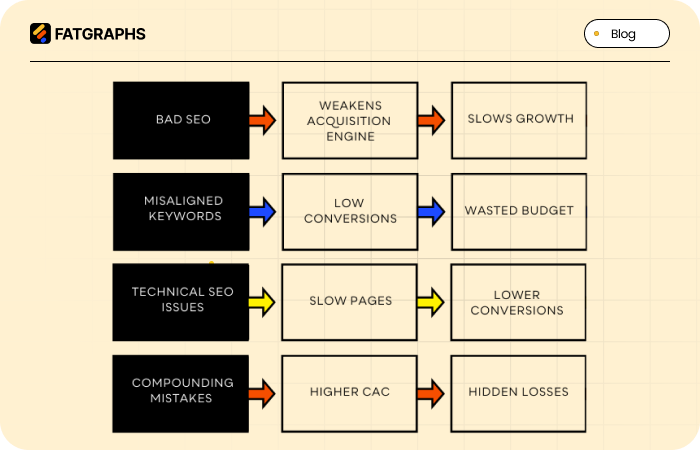
These mistakes compound over time. Acquisition costs rise, sales cycles stretch, and customer acquisition costs become unsustainable. The biggest risk is that this damage happens quietly. While competitors improve, your position erodes often unnoticed until recovery becomes expensive.
The solution is systematic evaluation. Audit technical SEO, assess content relevance, and ensure keyword targeting matches search intent, especially for long-tail, high-intent queries. Fixing these issues transforms SEO from a cost center into a predictable growth channel.
Conclusion
A strong SaaS acquisition engine requires planning, patience, and execution. Market validation is the foundation of success. Confirm real demand before investing heavily. Launch with a focused MVP and improve based on user feedback instead of assumptions.
Your technical foundation matters as much. Scalability, security, and compliance protect both your users and your business as you grow. User experience determines whether interest turns into revenue. Even the best solutions fail if users struggle to understand or use them.
SEO mistakes quietly inflate acquisition costs and weaken market position. Poor keyword targeting, slow performance, and irrelevant content all add up. Channels like SEO and content need months to mature. Giving up early wastes effort and opportunity.
Most importantly, the acquisition should function as one unified system; this is the most common mistakes in building a SaaS acquisition engine. When ads, content, SEO, and social media work together, they guide prospects smoothly through the funnel. Fix these issues, and your acquisition engine becomes a growth driver bringing in qualified leads who turn into loyal customers.
FAQs
Q1. What is the most critical mistake SaaS founders make when building an acquisition engine?
Neglecting market validation. Building based on assumptions instead of real customer input often leads to products that don’t sell.
Q2. How important is user experience in SaaS product development?
Extremely important. Poor UX reduces conversions, regardless of how innovative the product is. Clear journeys and intuitive design are essential.
Q3. Why should SaaS companies prioritize scalability from the beginning?
Because short-term shortcuts create long-term barriers. Scalable infrastructure prevents performance issues as traffic and data grow.
Q4. How does SEO impact SaaS growth?
SEO directly affects acquisition costs and market visibility. Poor SEO increases costs, while strong SEO consistently attracts qualified leads.
Q5. What role does security play in building a successful SaaS product?
Security is foundational. Strong protection and compliance build trust, prevent breaches, and allow SaaS businesses to operate confidently at scale.