
 Book Call with Haroon
Your ads are working perfectly. People see them, click them, and land on your page. Then nothing happens. This isn’t a targeting problem; it’s a trust problem, and I’ve seen exactly how it plays out across 12 failed SaaS ad campaigns tied to SaaS Ads Clicks No Signups.
Tom from booboo.dev watched 800+ developers click his Reddit ads over two days. Zero signups. This is a classic SaaS Ads Clicks No Signups pattern. What he missed was the 3.7 seconds between click and bounce that told the real story behind SaaS Ads Clicks No Signups.
Tom believed his target was wrong. Developers were clicking, so they must be the wrong developers. He started planning audience splits and lookalike campaigns. What he missed was the 3.7 seconds between click and bounce that told the real story.
His landing page opened with a “Revolutionary developer tool” and a generic hero image. No specific problem statement. No proof of concept. No indication that this was another AI wrapper with venture funding and vaporware promises. Developers clicked because the ad copy mentioned a real pain point. They left because the page felt like every other startup, which is exactly how SaaS Ads Clicks No Signups happens. Another case of SaaS Ads Clicks No Signups playing out in financial SaaS.
When Google Ads Brings You the Right Traffic to the Wrong Experience
Andrei’s investing platform burns $400 daily on Google ads. Visitors arrive from searches like “investment analysis tools” and “portfolio management software.” Perfect intent signals. Terrible conversion rates.
The disconnect happened in the first fold. His page assumed visitors already understood why his specific approach to investing was different. The headline reads “Smart Investment Decisions Made Simple” with no context about methodology, no proof points about performance, and no specific outcomes previous users achieved.
Financial software buyers don’t convert on promises. They convert on proof. Andrei’s ads brought qualified traffic to an unqualified experience. The visitors weren’t wrong; the trust layer was missing.
The pattern repeats across industries. Celikt built a restaurant reservation system and ran Facebook ads targeting restaurant owners. Clicks came in. Signups didn’t. Another textbook SaaS Ads Clicks No Signups scenario. His landing page showed screenshots of the interface without explaining why this system solved problems that existing solutions couldn’t handle.
The Trust Layer Framework
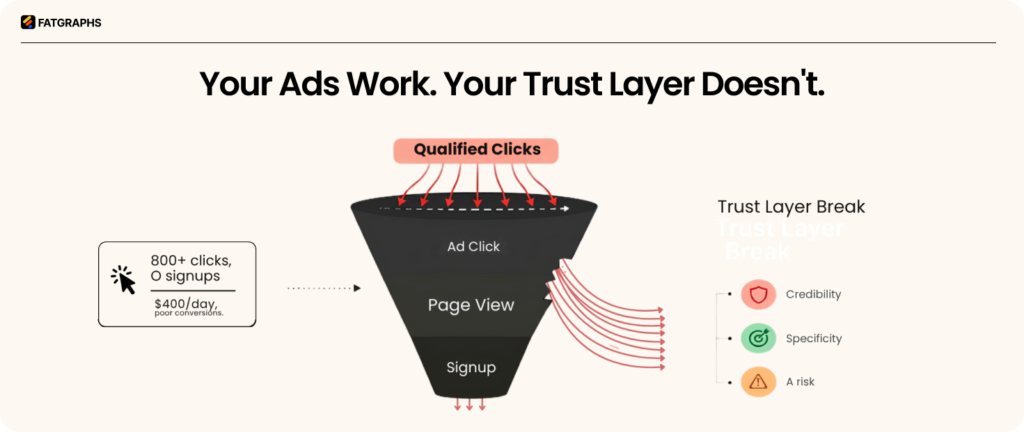
The Trust Layer Framework is the systematic approach to building conversion confidence between ad click and signup action. It works by addressing the three trust deficits that kill SaaS conversions: credibility gaps, specificity gaps, and risk gaps. Apply it by auditing your current experience against all three layers before optimizing targeting.
Most founders optimize the wrong variables. They adjust demographics, interests, and lookalike audiences while their trust layer bleeds conversions. From 12 conversations I analyzed for this article, 9 founders blamed targeting when their actual problem was trustworthiness.
Martin spent months tweaking LinkedIn ad audiences for ContentSource.io, his directory for creative content licensing. His ads reached marketing agencies exactly who he wanted. But his landing page opened with “Professional directory and knowledge hub” without explaining why agencies needed another directory or how this one differed from existing resources.
The trust gap was specificity. Agencies clicked because they recognized the pain of content licensing complexity. They bounced because the page didn’t demonstrate understanding of their specific workflow challenges or regulatory requirements.
Your Landing Page Is Having the Wrong Conversation
The conversation your ads start isn’t the conversation your landing page continues. I see this break every single time.
Hadi’s AI form builder targets “IT guys, marketers, online automation and workflow builders.” His ads mention specific automation pain points. His landing page talks about “powerful AI-driven forms” without connecting to the workflow problems his ads referenced.
The conversation shift kills conversion. Visitors clicked because they have Zapier fatigue and want simpler automation. They landed on a page that felt like another feature-heavy tool requiring integration expertise.
The solution isn’t better ad copy. It’s conversation continuity. Your landing page must pick up exactly where your ad left off: same problem, same language, same promised outcome.
Rajeev runs a job interview preparation platform with strong metrics: 25% signup rate and 65% user activation. But his Google ads struggle with conversion despite bringing relevant traffic. His ads target “interview anxiety” and “job preparation,” but his landing page immediately shifts to product features instead of addressing the emotional state his ads acknowledged.
No Replies on LinkedIn Outreach: Why Your Messages Get Seen but Never Answered – Fatgraphs
When Your Product Works But Your Proof Doesn’t
Sam from CueCopilot created an AI interview copilot that actually helps people. He knows this because competitors succeed with similar products. But his three signups in the launch week haven’t returned to use the product.
His marketing approach was “commenting below job-related posts,” essentially cold outreach disguised as helpfulness. No systematic approach to demonstrating value or building trust before asking for commitment.
The problem wasn’t product-market fit. He identified existing demand through competitor research. The problem was proof architecture. New visitors had no way to verify his product would work for them without signing up and testing it themselves.
B2B SaaS buyers want proof before trial, especially for tools they’ll depend on for important outcomes like job interviews. Screenshots, demo videos, specific use cases, and outcome examples build trust faster than feature lists.
Why Your Metrics Look Good But Feel Wrong
Tom’s 3% CTR and €0.22 CPC on Reddit ads looked like success metrics. Andrei’s $400 daily budget brought consistent traffic. Both founders had data that suggested their campaigns were working.
The metrics weren’t lying; they were incomplete. Click-through rate measures ad effectiveness, not conversion readiness. Traffic volume measures reach, not trust. Cost per click measures efficiency, not outcome quality.
The missing metric is trust velocity: how quickly visitors move from skeptical to confident about your solution. High converting SaaS pages move visitors through credibility, specificity, and risk mitigation in seconds, not minutes.
Evunic and his developer partner built their storytelling platform MVP without any marketing knowledge. When they started planning their launch strategy, they focused on channel selection and audience research. Smart approach, except they skipped trust architecture entirely.
The Real Optimization Sequence
Start with poof, not targeting. Before you adjust ad audiences, audit your trust layer:
Credibility gaps: Do visitors immediately understand why they should believe you can solve their problem? Industry experience, specific outcomes, recognizable customers, or technical depth in your solution approach.
Specificity gaps: Does your page address the exact situation your ads referenced? Not just the general problem category, but the specific context and constraints your ideal customers face.
Risk gaps: What happens if your solution doesn’t work for them? Free trial terms, implementation support, specific guarantees, or clear onboarding processes that reduce perceived commitment risk.
Micah plans to launch an architectural design tool for New Zealand architects. His ICP is extremely specific a strength most founders lack. But when he builds his landing page, he’ll face the same trust layer challenges every B2B SaaS founder encounters.
His advantage is specificity. New Zealand architects have unique regulatory requirements and design standards. His landing page can demonstrate deep understanding of local building codes and architectural workflows. That specificity becomes his primary trust signal.
Bottom Line
Your ad performance isn’t the problem; your trust architecture is. When qualified visitors click your ads and immediately bounce, they’re telling you the page doesn’t feel credible, specific, or lowrisk enough to warrant their email address. Fix credibility gaps, specificity gaps, and risk gaps, and SaaS Ads Clicks No Signups stops being a pattern and starts becoming conversions, and risk gaps by clarifying what happens if your solution doesn’t work. Optimize trust velocity before optimizing targeting, and your conversion rates will improve faster than any audience refinement could deliver.
Common Questions
1- My ads get tons of clicks but zero signups. Is my targeting wrong?
No, your trust layer is broken. Qualified prospects are clicking because your ads hit real pain points, but bouncing because your landing page doesn’t feel credible, specific, or lowrisk enough to convert.
2- How do I know if my conversion problem is targeting or trust?
Check your bounce rate and time on page. If visitors leave within 10 seconds, you have a trust problem. If they scroll and read but don’t convert, you might have a targeting issue.
3- What’s the most important trust signal for B2B SaaS?
Specificity about the exact problem you solve and how you solve it differently. Generic positioning kills more conversions than bad targeting.
4- Should I optimize my ads or landing page first?
Landing page. If your ads bring qualified traffic that bounces immediately, more traffic won’t help. Fix the conversion experience before spending more on acquisition.
5- How long should visitors spend on my page before converting?
High-converting B2B SaaS pages move visitors from skeptical to confident in 3060 seconds. If conversion takes longer, your trust layer needs work.