
 Book Call with Haroon
Buyer personas are the foundations of marketing, and SaaS companies can boost their revenue when they create accurate saas buyer personas. SaaS organizations are different from traditional businesses. They work with product-led growth models, and their customers take unique trips. These companies also have access to rich data sets that can shape their strategy.
What makes a buyer persona so important in B2B SaaS? A good b2b saas buyer persona takes complex information and turns it into something useful that everyone in your organization can understand. It combines demographic details, behavior patterns, firmographic data, customer feedback, and market research. The digital world has changed a lot. From 2000 to 2015, software companies sold mainly to the C-suite. Now we’re in what experts call the end-user era. This progress means we need better ways to understand who makes buying decisions in target companies.
What is a SaaS buyer persona?
A SaaS buyer persona shows a detailed, semi-fictional picture of your ideal customer that goes way beyond simple demographic information. This marketing tool covers the customer’s pain points, motivations, decision-making processes, and specific needs related to software solutions.
Definition and purpose
SaaS buyer personas create a real-world picture of people who influence or make purchasing decisions about your software product. These detailed profiles help you understand who these people really are at both professional and psychological levels. You’ll learn about their professional goals, personal motivations, current inefficiencies, and what worries them.
These personas turn raw customer data into practical insights that boost conversion rates. Well-developed buyer personas let you create targeted content, build features users want, and write messages that strike a chord with specific pain points, rather than guessing what works.
How is it different from an ideal customer profile
SaaS marketers often mix up buyer personas with ideal customer profiles (ICPs), but each serves a unique purpose. ICPs define which companies fit your product best, while buyer personas help you understand the decision-makers within those companies.
Your ICP points to the right organizations, and buyer personas help you connect with specific people you need to convince in those organizations. You need both to target companies effectively that match your ICP perfectly, as they don’t deal very well with messages that miss their mark.
To name just one example, a company sold marketing automation software to mid-market SaaS companies (great ICP). Their message failed because they wrote for CMOs when marketing operations managers made the actual buying decisions. These managers had completely different priorities and pain points.
B2B SaaS buyer persona vs. B2C personas
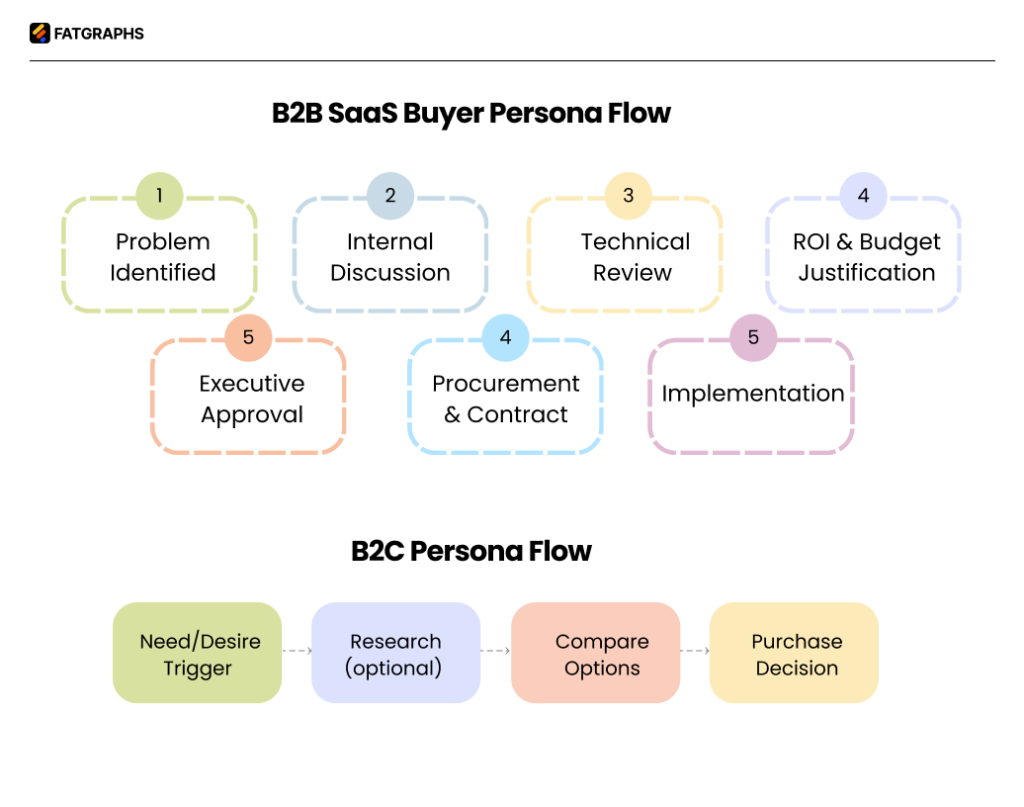
B2B SaaS buyer personas are nowhere near similar to B2C personas. B2C personas look at individual consumers’ emotions and personal needs for quick purchase decisions. B2B SaaS personas must consider multiple stakeholders who take longer to make decisions.
B2B purchases usually involve several employees who buy or use the product. B2B personas focus on roles, logical reasons, ROI, security concerns, and how well they line up with company goals rather than emotional appeals.
The buyer often isn’t the end user in SaaS environments. A vice president might sign off on the contract while the core team handles daily tasks with your software. This setup means you might need multiple personas to address what different stakeholders care about during the buying process.
Why SaaS buyer personas are different
SaaS purchasing has changed dramatically over the last several years. Traditional buyer personas don’t deal very well with these new challenges. Your saas buyer personas need to work and generate revenue growth.
1- The rise of the end-user era
Software companies targeted C-suite executives from 2000 to 2015. The industry has now entered what experts call the “end-user era.” Purchasing decisions have moved away from executives. Employees who use these tools daily now have a stronger voice. Research shows that 40% of professional workers will choose their companies’ business applications by 2023. Your saas buyer persona should reflect these end-users’ needs and motivations, not just budget holders.
SOURCE: Product Plan
2- Multiple decision-makers in the B2B buying process
B2B buying processes make SaaS personas challenging to create. Each buying decision now involves 6.8 people on average. This creates a network of stakeholders with different priorities. B2B buying committees typically need five decision-makers to approve purchases. A CFO might focus on financial stability and risk management. A VP of Sales cares more about easy implementation and integration features. Your b2b saas buyer persona must reflect this complex decision-making process.
3- The role of product-led growth strategy
Product-led growth (PLG) has become a dominant strategy in response to these changes. Three-quarters of B2B buyers would rather learn independently than talk to sales representatives. The product becomes the main channel for acquiring customers. PLG “pulls” customers through product experience, unlike traditional sales-led approaches that “push” through representatives. Users can experience value before they commit to buying. Companies like Slack and Zoom gained popularity when end-users adopted their tools first. This bottom-up approach led to wider enterprise adoption.
How to build effective SaaS buyer personas?
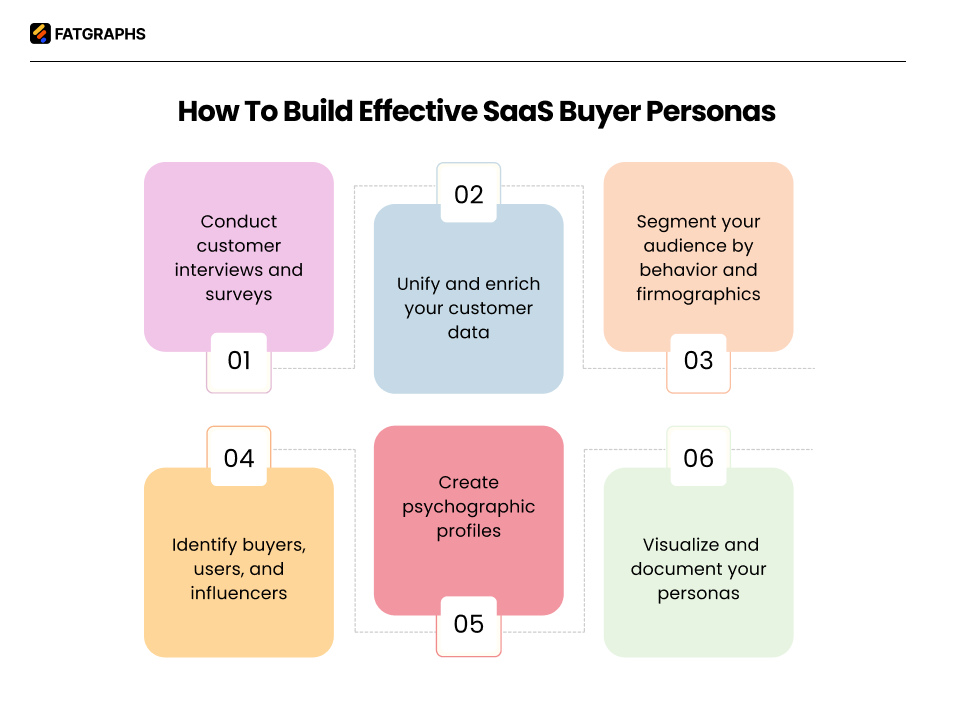
Building SaaS buyer personas needs careful research that turns raw data into applicable information. Here’s a practical approach to creating personas that accelerate revenue growth.
1. Conduct customer interviews and surveys
Your existing customers are the best source of information. Talk to them about their roles and industries. Direct conversations with product users provide the most accurate information. Customers who love your product will tell you what started their search. Ask open-ended questions about their challenges, what drives them, and their decision-making processes. Surveys help reach more people at a lower cost.
2. Unify and enrich your customer data
Scattered data prevents you from learning about your customer’s trip. Set up a unified customer profile that combines information from all touchpoints. Add external data about age, income, priorities, and intent signals. This process adds depth and personality to your existing customer information.
3. Segment your audience by behavior and firmographics
Smart segmentation groups your audience by common traits. B2B SaaS should focus on:
- Firmographics: industry, company size, revenue, location, and growth rate
- Behavioral patterns: product usage, feature adoption, and involvement levels
This method helps you identify sophisticated audience segments for your buyer personas.
4. Identify buyers, users, and influencers
B2B purchases involve multiple stakeholders. Three key roles matter:
- Decision makers: people with buying power and budget access
- Influencers: junior employees who research solutions and make suggestions
- End-users: daily product users
Each role’s unique needs and motivations help create targeted messages.
5. Create psychographic profiles
Psychographics explores deeply into attitudes, values, interests, and lifestyle choices. These details explain why consumers make decisions, helping create marketing that appeals on a deeper level. Look at personality types, shared values, and interests to group segments with similar psychological traits. This works well in B2B contexts to build personal relationships during long purchase cycles.
6. Visualize and document your personas
Bring your personas to life with detailed, semi-fictional representations. Name each persona based on their role. Include key details about job duties, challenges, goals, and motivations. Use illustrations instead of photographs to avoid demographic stereotyping. These personas should evolve as your customer needs change.
Common mistakes that hurt revenue growth
SaaS companies often hurt their growth without realizing it because they use flawed persona practices. Their buyer personas can block revenue generation despite careful creation.
1- Personas are outdated or static
Companies create personas and let them collect digital dust. This is a big mistake. Forrester’s research shows that 62% of marketers admit their personas no longer reflect real-life behavior. Markets change faster, buying patterns evolve, and customers need to take new shapes. Over 60% of SaaS companies waste their ad spend and create irrelevant content due to outdated ICPs, according to Gartner. These companies treat personas like static documents instead of living tools. This turns valuable insights into misleading assumptions.
Source: MarketingwithJay
2- Lack of technographic and behavioral data
SaaS companies must understand their prospects’ technology stacks. Technographic data shows what technologies power a company’s business operations. Many personas focus on demographics but miss deeper behavior patterns.
3- Personas are siloed within marketing
Marketing departments often keep personas to themselves. This reduces their strategic value. Sales, product, and support teams miss out on vital customer insights. Teams end up with different ways of positioning solutions to prospects. The end result? Slower sales cycles and reduced pipeline speed.
4- Ignoring the SaaS buyer journey stages
The biggest problem comes from content that doesn’t match where prospects are in their buying process. B2B buyers typically don’t reach out to vendors until they complete 70% of their buying process. Companies still organize content around their sales stages instead of what buyers need. This creates a fundamental issue – your message seems too early, irrelevant, or aggressive to prospects who aren’t ready yet.
Conclusion
SaaS buyer personas are powerful tools that turn abstract customer data into applicable information for marketing strategies. These detailed profiles are way beyond the reach and influence of simple demographics to capture the complex reality of B2B purchasing decisions. Traditional persona approaches can’t address the unique challenges SaaS companies face.
Your SaaS buyer personas should be living documents that evolve with changing market dynamics. Creating complete personas needs significant investment, but the payoff comes through targeted messaging, better product development decisions, and accelerated revenue growth. Understanding who makes purchasing decisions and what motivates them helps you create experiences that strike a chord throughout the buyer’s journey.
FAQs
Q1. What is a SaaS buyer persona, and why is it crucial for business growth?
A SaaS buyer persona is a detailed, semi-fictional profile of your ideal customer that goes beyond basic demographics. It includes pain points, motivations, and decision-making processes specific to software solutions. These personas are crucial for business growth as they help create targeted marketing strategies, develop relevant product features, and craft messaging that resonates with potential customers.
Q2. How does a SaaS buyer persona differ from a traditional buyer persona?
SaaS buyer personas are unique because they account for multiple stakeholders in the B2B buying process, focus on end-user needs in addition to decision-makers, and consider the role of product-led growth strategies. They also emphasize technographic data and behavioral patterns specific to software usage, which are less relevant in traditional buyer personas.
Q3. What are the key components of an effective SaaS buyer persona?
An effective SaaS buyer persona includes firmographic data (industry, company size, revenue), behavioral patterns (product usage, feature adoption), psychographic profiles (attitudes, values, interests), and information about different roles (decision-makers, influencers, end-users). It should also capture pain points, motivations, and specific needs related to software solutions.
Q4. How often should SaaS buyer personas be updated?
SaaS buyer personas should be treated as living documents and updated regularly. Markets evolve rapidly, and customer needs transform over time. It’s recommended to review and refine your personas periodically, ideally every 6-12 months, to ensure they accurately reflect current customer behavior and market trends.
Q5. What are common mistakes to avoid when creating SaaS buyer personas?
Common mistakes include creating static personas that become outdated, neglecting technographic and behavioral data, keeping personas siloed within the marketing department, and ignoring the various stages of the SaaS buyer journey. It’s also crucial to avoid over-relying on demographics while missing deeper behavioral patterns and psychographic insights.