
 Book Call with Haroon
SaaS funnel leaks drain your revenue every day. SaaS companies face declining conversion rates, particularly in MQL-to-closed-won metrics, despite increasing their marketing spend. These SaaS funnel leaks cut straight into your profits.
Funnel leaks make your customer acquisition costs soar and stretch your payback periods. Your decision to ignore these problems will cost you more as time passes. You can spot these issues early by tracking proper SaaS funnel leaks and metrics. A systematic approach makes fixing these leaks much easier.
What are SaaS Funnel Leaks?
A funnel leak happens when potential customers drop out of your sales process too early, when you could have kept them. Unlike standard website bounces, funnel leaks represent fixable conversion opportunities where qualified prospects leave before they complete desired actions.
How funnel leakage is different from natural drop-off
Every SaaS funnel naturally gets narrower as prospects move through the buyer experience. This makes sense given the funnel shape. But funnel leakage is substantially different from this natural drop-off in several ways.
Natural drop-off happens when prospects realize your solution doesn’t fit their needs. SaaS funnel leaks happen when qualified leads leave because of friction points you could fix in your process. You can’t avoid some people leaving, but too many drop-offs signal problems you need to fix.
You can spot potential leaks by looking at where your conversion rates fall below industry measures or your past performance. Research shows high abandonment rates at specific funnel stages point to friction or confusion that stops users from taking action.
A clear sign of SaaS funnel leakage shows up when marketing-qualified leads convert to sales-qualified leads at rates of only 15-21% this is a big deal, as it means that 70-80% of prospects are lost at a critical stage.
Why SaaS funnel leaks are more vulnerable
SaaS companies face unique challenges that make their funnels more likely to leak. Here are three main reasons why:
- Extended sales cycles: SaaS products need longer decision processes, which creates more points where prospects might leave.
- Complex buying committees: Multiple stakeholders often take part in SaaS purchase decisions, which makes it harder to keep everyone on the same page.
- Freemium-to-paid conversion paths: The common trial-before-purchase model adds more conversion stages where users might not see the value.
On top of that, SaaS funnels face these challenges:
- Learning curves that overwhelm users before they see benefits
- Poor customer support during critical early usage periods
- Bad user experience from complex navigation or technical issues
- Users wait too long to see value from the product
So fixing SaaS funnel leaks isn’t just about better conversions, it’s about keeping your business healthy.
Top, Middle, and Bottom Funnel Leaks
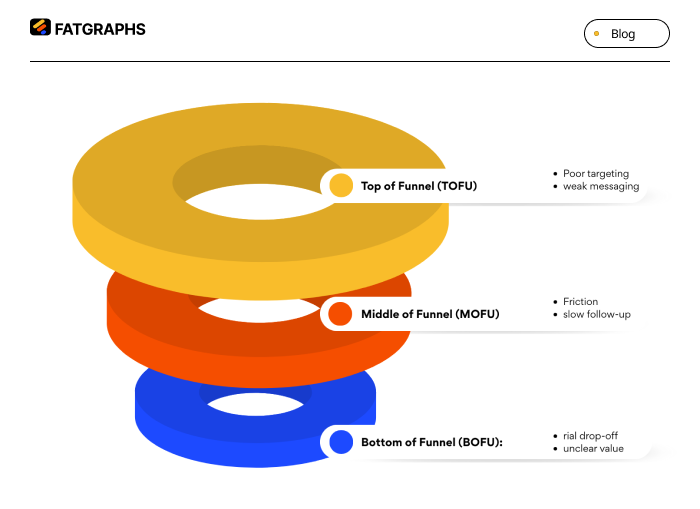
A deep dive into SaaS funnel leaks reveals opportunities to fix critical issues. Let’s get into where and why prospects drop out of your funnel.
Top of Funnel (TOFU): Poor targeting and weak messaging
TOFU sits at the widest part of your funnel, where most users enter—yet this stage sees the highest drop-off rates. Wrong audience targeting stands out as a major issue, since visitors won’t convert unless they need your product. Even SaaS companies focused on enterprise clients waste resources by attracting individual users and small businesses.
Message relevance makes a huge difference in TOFU results. Content marketer Dale Cudmore points out that relevance is “the most commonly underrated factor of conversion”. Visitors quickly disappear when your message lacks clarity or confuses them about your value proposition.
Middle of Funnel (MOFU): Friction and slow follow-up
MOFU leaks happen after prospects show interest but haven’t decided to buy. Complex signup processes create friction, long forms, and confusing flows push away qualified leads.
Follow-up failures cause significant losses. Research shows 6-13 touches work best to convert prospects. Lack of lead nurturing is a common cause of this poor performance”.
Bottom of Funnel (BOFU): Trial drop-off and unclear value
BOFU leaks occur when qualified leads ready to convert hit roadblocks. Users often abandon trials if they don’t see value quickly. New users struggle with key features due to poor in-app guidance, which leads to frustration and abandonment.
Knowledge gaps and coordination problems surface as prospects move between departments (marketing to sales to customer success). Poor arrangement between sales and marketing costs B2B companies approximately 10% of revenue annually. More than that, complex pricing structures and confusing upgrade paths create friction at the exact moment customers want to pay.
How to Identify SaaS Funnel Leaks?
Businesses need proactive monitoring to identify funnel leaks in SaaS. Your ideal scenario would convert 100% of prospects, but customer losses between funnel stages happen in every business. A systematic analysis with proper tools helps find these leaks.
Use funnel metrics to track conversion rates
The first step requires understanding what motivates customers to progress through your sales process. Analytics platforms with conversion goals measure prospect progression through funnel stages. These key metrics need monitoring:
- Stage-by-stage conversion rates: Calculate what percentage of users advance from one stage to the next
- Time-to-convert: Measure how long users spend at each stage (median and 90th percentile)
- Absolute vs. relative drop-offs: Track both raw numbers and percentages to prioritize the largest leaks
Conversion funnels make it easy to spot user disengagement by visualizing the flow from first contact to final conversion. An IDG study shows that 61% of marketers report problems generating high-quality leads. These systemic funnel problems need metrics for identification.
Spot drop-off points with analytics
Path analysis reveals unexpected routes prospects choose instead of your designed funnel. Users often encounter friction points or confusing navigation that pulls them away from conversion paths. Tools like Amplitude, Mixpanel, or GA4 help visualize customer experiences and find significant drop-off points.
You can see alternate actions taken by users who abandoned each funnel step – data that proves vital for issue diagnosis. Heatmaps create visual representations of user engagement and show exact click, hover, and scroll patterns. This data reveals areas where users ignore calls to action.
Monitor lead behavior across stages
User segmentation by different properties reveals varied group behaviors throughout the funnel. Comparing cohorts based on traffic source, device type, or other characteristics helps identify segment-specific leaks. Session replays provide detailed views of real user interactions with your product.
These recordings reveal subtle friction points like confusing button labels or commonly skipped onboarding steps. Quantitative drop-off data works best when combined with qualitative research. User surveys that ask about incomplete actions provide context beyond raw numbers.
How to Fix SaaS Funnel Leaks at Each Stage
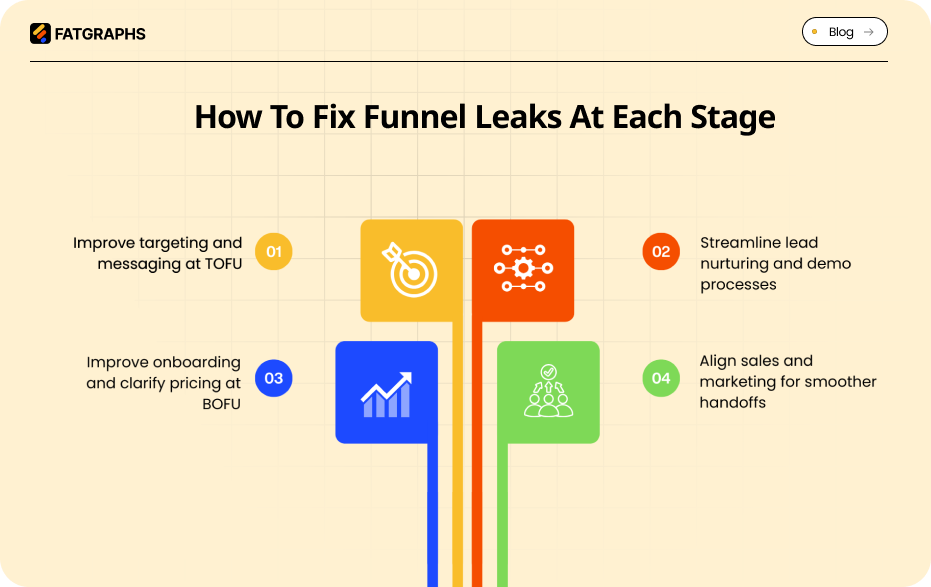
Targeted strategies help fix SaaS funnel leaks at each stage. You need specific solutions to patch those leaks after spotting where prospects drop off.
Improve targeting and messaging at TOFU
Your buyer personas and the “job to be done” need a thorough review to attract customers to your product. Your content should match user expectations based on their source. A clean, uncluttered design with your strongest value proposition will affect conversion rates the most. Companies have seen up to 81% increases just by optimizing their CTAs.
Streamline lead nurturing and demo processes
Prospects typically convert after 6-13 touchpoints. Automated lead scoring helps identify quality leads through engagement and demographic data. Your sign-up forms should ask for basic information upfront. Complex products need a preview of the onboarding trip before prospects commit.
Improve onboarding and clarify pricing at BOFU
Each pricing plan needs its own onboarding trip. Premium customers get frustrated with generic approaches that treat everyone the same. Premium features should appear right away instead of later. ROI calculators built into onboarding help customers spot upgrade benefits quickly. Simple pricing structures make it clear what customers pay for.
Align sales and marketing for smoother handoffs
Of course, B2B companies lose about 10% of their yearly revenue due to poor alignment. These steps create smooth coordination:
- MQL and SQL criteria should reflect real buyer behavior
- Clear follow-up SLAs affect conversion chances directly
- Sales teams need content ready to handle common objections
Conclusion
Fixing funnel leaks is a vital step to achieving sustainable SaaS growth. In this piece, we explored how these leaks quietly drain revenue potential at every stage of your customer experience. The cost of ignoring these problems multiplies over time and affects your customer acquisition costs and overall profitability.
Your SaaS funnel needs constant monitoring and optimization. Start by setting up proper metrics to track conversion rates at each stage. Analytics tools will help you pinpoint where prospects drop off. You can then apply targeted fixes based on each leak’s specific nature, from messaging issues at the top to onboarding challenges at the bottom.
Natural drop-off differs a lot from SaaS funnel leaks. Some attrition will always exist, but excessive abandonment points to fixable problems in your process. Companies that systematically fix these issues see dramatic improvements in conversion rates and revenue growth.
Sales and marketing teams working together prevent leaks during handoffs effectively. Teams should share definitions of qualified leads, follow clear protocols, and maintain consistent messaging to keep prospects from falling through the cracks.
SaaS businesses deal with extended sales cycles, complex buying committees, and multi-stage conversion paths. Notwithstanding that, these challenges become manageable with a methodical approach. The strategies in this piece will help you turn your leaky funnel into a powerful revenue-generating engine that maximizes value from every prospect in your ecosystem.
FAQs
Q1. What exactly is a SaaS funnel leak?
A SaaS funnel leak occurs when potential customers drop out of the sales process prematurely at points where they could have been retained. Unlike natural drop-offs, these leaks represent fixable conversion opportunities where qualified prospects exit before completing desired actions.
Q2. How can I identify leaks in my SaaS funnel?
You can identify funnel leaks by tracking conversion rates between stages, analyzing drop-off points using analytics tools, and monitoring lead behavior across different funnel stages. Utilize funnel metrics, path analysis, heatmaps, and session replays to spot where and why users are disengaging.
Q3. What are the common causes of leaks at different funnel stages?
Top-of-funnel leaks often result from poor targeting and weak messaging. Middle of funnel leaks typically occur due to friction in processes and slow follow-ups. Bottom of funnel leaks are commonly caused by trial drop-offs and unclear value propositions or pricing structures.
Q4. How can I fix leaks in my SaaS funnel?
To fix funnel leaks, improve targeting and messaging at the top of the funnel, streamline lead nurturing and demo processes in the middle, and enhance onboarding while clarifying pricing at the bottom. Additionally, ensure better alignment between sales and marketing teams for smoother handoffs.
Q5. Why are SaaS funnels more vulnerable to leaks?
SaaS funnels are particularly vulnerable due to extended sales cycles, complex buying committees involved in decision-making, and the freemium-to-paid conversion paths. These factors create more touchpoints where prospects might disengage, making it crucial to optimize each stage of the funnel.