
 Book Call with Haroon
B2B SaaS messaging frameworks are the operational backbone of customer acquisition, pipeline conversion, and long-term revenue growth. Yet most SaaS companies, from seed-stage startups to mid-market players, still ship messaging that barely moves the needle.
The disconnect is predictable: companies write about what their product does instead of what their customer gets. A well-defined Ideal Customer Profile (ICP) is what makes any B2B SaaS messaging strategy work. Without it, your messages fall flat, your brand narrative fragments across channels, and you bleed budget on campaigns that generate impressions but no pipeline.
This guide shows you exactly how to fix that, with real framework examples, a build process, and a scaling system that keeps messaging sharp as your product evolves.
Why Most SaaS Messaging Frameworks Fail
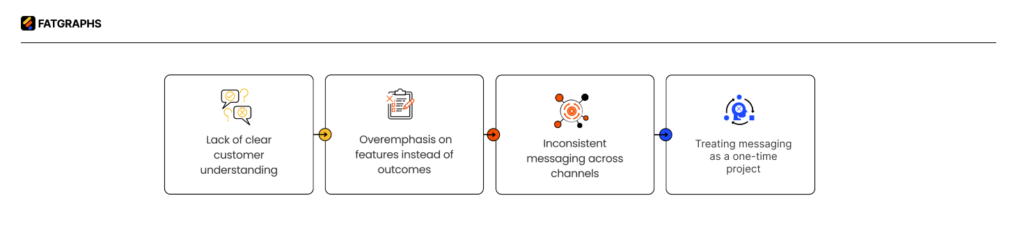
1. Lack of Clear Customer Understanding
SaaS companies often create messages that are internally focused; they describe the product from the inside out, not from the buyer’s perspective. This one-sided approach pushes potential customers away instead of pulling them in.
Messages must speak directly to your target audience’s environment, priorities, and daily frustrations. When companies skip customer research and rely on internal assumptions, they miss the language, urgency, and context that would actually convert. The gap between what a company believes and what a customer needs creates a trust deficit that no ad budget can close.
2. Overemphasis on Features Instead of Outcomes
The biggest conversion killer in SaaS messaging is leading with features instead of outcomes. Research consistently shows that a technical-first approach turns off prospects who care far more about solving a problem than understanding an architecture.
Companies try to explain every capability and end up overwhelming their audience with details that bury the actual value. Compare these two:
- Feature-first: “Automated task assignment with rule-based routing logic.”
- Outcome-first: “Cut planning time by 40%, tasks route themselves.”
The second version is what converts. Features describe what a product does. Benefits explain why it matters to the buyer’s world. Most SaaS funnel leaks start here, at the top, before a prospect even enters the funnel.
3. Inconsistent Messaging Across Channels
Mixed messaging across your website, sales decks, email sequences, and paid ads destroys brand credibility. Marketing promotes one angle. Sales pitches another. The product page says something else entirely.
This breakdown usually starts internally, with different departments following different playbooks. As companies scale, messaging becomes siloed. The result is a fragmented buyer experience where your product’s unique value gets lost in contradictions. Prospects notice this inconsistency, and it reads as a sign of organizational chaos, not a company they want to trust with a 12-month contract.
4. Treating Messaging as a One-Time Project
Effective messaging is a system, not a document. Treating it as a one-time deliverable guarantees declining returns. As your product grows from a point solution to a platform, the original messaging structure fails to reflect new capabilities, new buyer segments, and a more competitive market.
Without a system to refresh messaging based on win/loss data, customer interviews, and market shifts, your positioning stays frozen while everything around it, product, market, competition, and buyers, keeps evolving.
How to Build a SaaS Messaging Framework That Works

1. Create a Clear Value Proposition
Your value proposition answers one question every prospect is silently asking: “Why should I choose you over doing nothing, or choosing someone else?”
The structure that converts into B2B SaaS:
[Product name] helps [ICP] achieve [specific outcome] by [key mechanism], without [common objection or trade-off].
Example:
“Ramp helps finance teams close their books 5 days faster by automating expense categorization, without replacing their existing ERP.”
Lead with the outcome. Back it with a number. Remove the objection. That’s a value proposition.
2. Develop a Positioning Statement
A positioning statement is an internal alignment tool; it’s not marketing copy, but it governs all marketing copy. It keeps your entire go-to-market team speaking with one voice.
A full B2B SaaS positioning statement includes:
- For: [Target segment]
- Who: [Has this specific problem or need]
- Our product is: [Category]
- That: [Primary benefit or outcome]
- Unlike: [Key competitor or alternative]
- We: [Primary differentiator]
This becomes the reference document that sales, marketing, and product all pull from. If your team can’t agree on the positioning statement, your external messaging will never be consistent. This directly impacts your B2B SaaS marketing KPIs, especially pipeline quality and conversion rates.
3. Create Messaging Pillars for Consistency
Messaging pillars are the 3 to 5 core themes that sit between your value proposition (the summary) and your individual marketing assets (the execution). Each pillar addresses a specific pain point your ICP faces and is supported by a proof point, data, case study, or customer quote.
Example pillar structure for a B2B SaaS project management tool:
| “Hard to justify software spend to CFO.” | Pain Point Addressed | Proof Point |
|---|---|---|
| Speed to Deploy | “Takes months to onboard new tools” | “Live in 4 days, not 4 months” |
| Cross-team Visibility | “Silos between engineering and ops” | “87% of customers report fewer status meetings” |
| Predictable ROI | “Hard to justify software spend to CFO” | “Average 3.2x ROI in 6 months” |
Every blog post, ad, landing page, and sales email should ladder back to one or more of these pillars. Consistency is what builds category authority over time.
4. Use Storytelling to Build Emotional Connection
In B2B SaaS, buyers are humans making decisions under career risk. They’re not just evaluating your product; they’re evaluating what happens to them professionally if the implementation fails.
The most effective SaaS narratives follow a simple arc:
- Situation: Here’s the world your buyer lives in (the pain)
- Complication: Here’s what happens if nothing changes (the stakes)
- Resolution: Here’s how life looks after your product (the outcome)
Your customer is the hero of this story. Your product is the tool that makes the hero’s win possible. Keep yourself in the supporting role.
5 SaaS Messaging Framework Examples That Actually Work
Most messaging guides stop at theory. Here are five real-world B2B SaaS messaging frameworks, with what makes them effective and where to apply them.
Framework 1: The Jobs-to-Be-Done (JTBD) Framework
What it is: Messaging built around the specific “job” a customer is trying to get done, not who they are demographically, but what outcome they’re hiring your product to produce.
How it works: Identify the functional job (“I need to close the books faster”), the emotional job (“I need to stop looking incompetent to the CFO”), and the social job (“I want to be the person who brought in the tool that fixed this”). Then write messaging that speaks to all three layers.
Example in practice:
- Weak: “Advanced financial reporting software.”
- JTBD messaging: “Give your CFO the numbers before they ask for them.”
Best used for: Homepage hero copy, positioning statements, and sales email sequences for mid-market buyers with complex buying committees.
Why it outperforms: Because it aligns with how buyers actually make decisions, based on the outcome they need, not the feature they’ll use.
Framework 2: The Problem-Agitate-Solution (PAS) Framework
What it is: A direct-response copywriting structure adapted for SaaS that identifies a pain point, amplifies its consequences, then positions your product as the fix.
How it works:
- Problem: State the specific, quantified pain (“Your sales reps spend 3 hours a day on manual data entry”)
- Agitate: Escalate the downstream consequences (“That’s 60 hours a month per rep not spent selling, and your pipeline shows it”)
- Solution: Introduce your product as the direct answer (“Automate data entry in one click. Your reps focus on closing.”)
Best used for: Paid ad copy, email nurture sequences, and landing pages targeting cold or warm audiences who haven’t heard of you yet.
Why it outperforms: PAS creates urgency without manufactured hype. It works because it mirrors the buyer’s internal monologue before they even reach your website.
Framework 3: The StoryBrand (SB7) Framework
What it is: A 7-part narrative framework by Donald Miller that casts your customer as the hero and your brand as the guide. Widely used by B2B SaaS companies to restructure their entire website and content strategy.
The 7 elements:
- A character (your ICP)
- Has a problem (external, internal, philosophical)
- Meets a guide (your brand)
- Who gives them a plan (your framework/process)
- And calls them to action (your CTA)
- That ends in success (the outcome)
- And helps them avoid failure (what happens if they don’t act)
Best used for: Full website messaging architecture, explainer videos, and ABM campaign narratives targeting VP and C-suite decision-makers.
Why it outperforms: Most SaaS websites make the brand the hero, which alienates buyers. StoryBrand flips this, the customer is the hero, and the brand becomes the trusted advisor. This structural shift alone typically increases homepage conversion rates.
Framework 4: The Value Wedge Framework
What it is: A competitive positioning tool that maps the overlap between what customers value, what competitors offer, and what you uniquely deliver. The “wedge” is the space that is valuable to buyers but unaddressed by competitors, your real differentiation zone.
How it works: Draw three overlapping circles:
- Circle 1: What your ICP explicitly says they need
- Circle 2: What your top competitors claim to deliver
- Circle 3: What your product genuinely does better than anyone else
The intersection between Circle 1 and Circle 3, excluding Circle 2, is your value wedge. Build your primary messaging around that intersection.
Best used for: Competitive displacement campaigns, sales battlecards, and positioning in markets where you’re the challenger brand.
Why it outperforms: Most SaaS companies either ignore competitive context entirely or directly attack competitors. The value wedge creates a third path, owning a differentiated space that’s genuinely valuable and unclaimed.
Framework 5: The Outcome-Evidence-Action (OEA) Framework
What it is: A simple three-layer messaging structure designed specifically for B2B SaaS companies at the growth stage, where you have enough customer data to prove claims but need to convert faster.
How it works:
- Outcome: Lead with the specific, measurable result your product delivers (“Cut customer onboarding time by 60%”)
- Evidence: Immediately back the outcome claim with proof (customer quote, case study stat, aggregate data from your customer base)
- Action: Give the buyer a low-friction next step aligned to their stage in the journey (not “Buy now” for cold traffic, “See how [Company similar to theirs] did it”)
Best used for: Mid-funnel content (case study pages, ROI calculators, comparison pages), and retargeting ad sequences for buyers who’ve already visited your site.
Why it outperforms: It collapses the trust-building cycle. Instead of making a claim and hoping buyers believe you, you anchor every message in evidence immediately, which is what B2B buyers, particularly SaaS demand generation programs, need to move buyers efficiently through mid-funnel.
How to Optimize and Scale Your Messaging Framework
Building the framework is the start. The companies that rank, convert, and retain best treat messaging as a continuously improving system.
1. Align Messaging with the Customer Journey
Your message should match where a buyer is in their decision process, not where you want them to be.
- Top of funnel (awareness): Speak to the problem, not the product. “Why your sales reps are losing deals before the first call” converts better than “CRM software.”
- Middle of funnel (consideration): Speak to outcomes and differentiation. ROI data, comparison content, and use-case specificity win here.
- Bottom of funnel (decision): Speak to risk reduction. Implementation support, security docs, customer references, and pricing transparency close deals.
Mapping your messaging to SaaS pipeline metrics at each stage tells you where the copy is working and where prospects are dropping off.
2. Test and Refine with A/B Testing
A/B testing removes opinion from the equation. Companies running systematic message testing have reported trial signup increases of 450%, doubled activation rates, and paid conversion lifts of 175%.
Test one element at a time: headline, CTA text, value prop phrasing, or hero image. Run tests until you have statistical significance before changing anything else. Small wins compound quickly across a full funnel.
3. Train Internal Teams for Consistency
Only 24% of SaaS sales teams feel confident adapting messaging to different buyer contexts. This is a training failure, not a talent failure. Your messaging framework should include role-specific guides: a version for sales (with objection handling), a version for marketing (with channel-specific applications), and a version for customer success (with retention-focused language).
Embed this framework into onboarding for every customer-facing hire. Consistency in how your entire team talks about your product compounds into brand recognition over time.
4. Track the Metrics That Tell the Truth
Vanity metrics (impressions, traffic, MQL volume) can look healthy while your messaging is failing at the conversion layer. Track what actually matters:
- Trial-to-paid conversion rate (Is messaging setting the right expectations?)
- Time-to-first-value (is onboarding copy creating the right behavior?)
- Churn rate by segment (is messaging attracting the right ICP, or the wrong one?)
- Win rate on competitive deals (is your differentiation message landing?)
- NPS language analysis (how do happy customers describe your value, are you saying the same thing?)
Conclusion
SaaS messaging failure is almost always a strategy problem dressed up as a copywriting problem. The companies that win on messaging, and on search, and in sales cycles, aren’t necessarily better writers. They’re clearer thinkers about who their buyer is, what that buyer urgently needs, and how their product delivers it in a way no one else can.
The five frameworks in this guide (JTBD, PAS, StoryBrand, Value Wedge, OEA) aren’t academic exercises. Each one is a practical tool for a specific context, from homepage architecture to competitive displacement to mid-funnel conversion. Pick the one that matches your biggest current gap and build from there.
The process is straightforward: lock in your ICP, build your value proposition and pillars, choose a framework that fits the channel, and test continuously. Treat messaging as an evolving system that gets sharper as your customer data grows. That compound effect, better messaging informed by real customer language, tested against real conversion data, is what separates the SaaS brands that stay on page two from those that own page one.
Frequently Asked Questions
Q1. What is a SaaS messaging framework, and why does it matter?
A SaaS messaging framework is a structured system that defines how your company talks about its product, including your value proposition, ICP language, messaging pillars, and channel-specific copy guidelines. It matters because it creates consistency across every touchpoint a buyer encounters: ads, website, sales calls, and onboarding. Without a framework, every team member describes the product differently, which erodes buyer confidence and makes it harder to build category authority.
Q2. How many messaging pillars should a B2B SaaS company have?
Three to five messaging pillars is the right range for most B2B SaaS companies. Fewer than three, and your messaging lacks enough substance to address different buyer objections. More than five and you dilute focus, your content team can’t consistently execute against too many themes, and buyers can’t retain a complex narrative. Each pillar should address one core pain point your ICP faces, backed by at least one quantifiable proof point.
Q3. How is SaaS messaging different for early-stage vs. mid-market companies?
Early-stage companies typically lack proof points (case studies, ROI data), so messaging must rely more heavily on the problem narrative, explaining the pain so clearly that the solution becomes obvious. Mid-market SaaS companies have customer data but face the challenge of messaging to larger, more complex buying committees where multiple personas with different priorities must all be convinced. The framework structure is the same, but early-stage messaging sells the vision while mid-market messaging sells validated outcomes.
Q4. How often should we update our SaaS messaging framework?
Plan for a full messaging audit every 6 to 12 months, with tactical updates (headline tests, CTA language, pillar emphasis) happening continuously based on A/B testing and sales feedback. Triggers for an earlier full refresh include: entering a new market segment, launching a significantly expanded product, a major competitor shift in positioning, or a sustained decline in conversion rates that can’t be explained by traffic quality alone.
Q5. What is the biggest mistake SaaS companies make with their value proposition?
Writing the value proposition for themselves, not their buyer. The most common version of this: a value proposition that describes the product’s mechanism (“AI-powered workflow automation”) instead of the buyer’s outcome (“Cut operational overhead by 35% without hiring”). Your buyer doesn’t care how your product works; they care what changes in their world after they use it. Lead with that.
Q6. How do you create messaging that works for both the economic buyer (CEO/CFO) and the end user?
Build separate messaging layers within the same framework. Economic buyers (CEO, CFO, VP) respond to financial outcomes, risk reduction, and strategic positioning, “3.2x ROI in 6 months” and “reduce compliance risk” are their language. End users respond to usability, time savings, and reduced frustration, “no training required” and “find anything in 10 seconds” are their phrases. Your website should serve by structuring navigation and landing pages around personas, not just product features.
Related reading: