
 Book Call with Haroon
Your ICP isn’t who you think will buy, it’s who you can prove will pay for a specific outcome. Most pre-launch founders build personas around demographics and hope. The founders who succeed early define ICP with zero customers around situations where people are already spending money or time to solve the exact problem.
Mouad spent months building geospatial tools for “developers in GIS” before realizing whether his ICP was right or not. Developers don’t wake up needing GIS tools. Companies with mapping problems hire developers who then need GIS tools. His real ICP became companies running location-based operations that currently solve mapping challenges with expensive consultants or manual processes.
The difference between assumption-based ICPs and outcome-based ICPs determines whether your first 90 days generate revenue or excuses.
When Your Product Solves Everything for Everyone
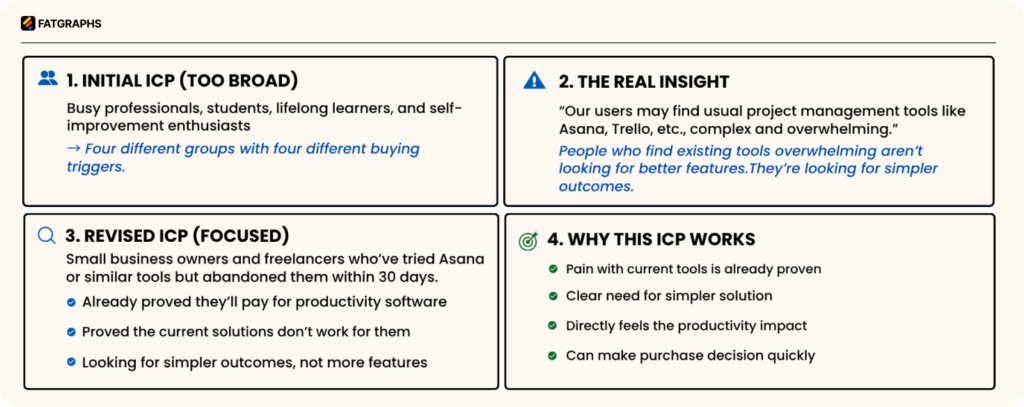
Yaser built Digital Cortex as “a digital extension of the brain to enhance individual productivity.” His ICP definition for early-stage SaaS covered busy professionals, students, lifelong learners, and self-improvement enthusiasts. Four different groups with four different buying triggers.
“Our users may find usual project management tools like Asana, Trello, etc., complex and overwhelming,” he explained. The real insight was in that constraint; people who find existing tools overwhelming aren’t looking for better features. They’re looking for simpler outcomes.
His revised B2B SaaS ICP became small business owners and freelancers who’ve tried Asana or similar tools but abandoned them within 30 days. These people already proved they’ll pay for productivity software and proved the current solutions don’t work for them.
Jakub made the same mistake with his AI debugging platform. “Freelance programmers, Software development companies, Internet Startups” have three completely different buying processes. Freelancers buy monthly subscriptions with their own credit cards. Development companies require IT approval and annual contracts. Startups need an integration proof of concept.
He narrowed it to development agencies with 5-20 employees who bill clients hourly. These agencies lose money every hour spent debugging, have the authority to purchase tools immediately, and can measure ROI in reduced project hours.
When You Know the Problem But Not the Buyer
Siyotekonen knew tax preparation was painful for gig workers. His product, Storatax, would save time and money for “individual rental property owners, Uber drivers, Lift drivers, taxi drivers, courier delivery drivers, real estate agents, self-employed working on the road.”
That’s not an ICP validation without customers; it’s a census category. Real ICPs answer: who’s currently paying to solve this problem and how much?
The insight came from segmenting by tax complexity, not job type. Uber drivers with simple 1099s use TurboTax. But gig workers juggling multiple income streams, vehicle depreciation, and quarterly payments pay $300-800 annually for tax professionals. Storatax’s ICP became multi-platform gig workers who filed Schedule C last year and paid someone else to do it.
Kevin built Playtrybe for “people currently open to play try or be something new, travelers, people searching for specific hobbies, people going on vacation.” The breadth killed focus. Travelers plan differently from hobby seekers. Vacation planners have a different urgency than skill learners.
He found his ICP by following the money. Travel bloggers and experience companies already monetize travel guides. His real ICP became content creators in travel and lifestyle niches who currently use multiple platforms (YouTube, blog, social) to share experiences and want to consolidate audiences into a subscription model.
The Pre-Launch ICP Framework – Define ICP with Zero Customers
The Pre-Launch ICP Framework is a qualification system that defines your ideal customer by their current spending behavior, not future intentions. It works by identifying people who are already paying to solve your problem with inferior solutions. Apply it by mapping three spending patterns: what they currently pay, why current solutions fail, and what outcome they’d pay more to guarantee.
Start with the outcome your product delivers, then trace backward to current spending. Don’t ask “who needs this?” Ask “who’s already paying for a worse version of this?”
Rudy built Naviflow for “SMEs in all economic sectors shipping more than 50 cross-border shipments per year.” That’s a demographic filter, not a buying signal. The framework shifted his focus: companies are currently spending on freight forwarders, customs brokers, or manual tracking systems that lose money when shipments are delayed or disappear.
His refined ICP became importers who’ve had at least one shipment problem in the past six months that cost them a client or required emergency air freight. These companies already budget for logistics software and have immediate pain.
When Your Market Seems Too Niche to Scale
Doug worried his Texas lottery scratcher analysis tool was too narrow. “Lotto scratcher players in Texas who play 40+$ a month” felt like limiting his market to hundreds of people instead of millions.
The niche was actually the strength. Players spending $40+ monthly on scratchers represent the top 5% of the market by volume. They’re already optimizing their purchases, tracking results, and seeking information edges. His tool replaced spreadsheets and gut feelings with data, a clear upgrade path.
The framework revealed his ICP: Texas scratcher players who track their wins and losses and have changed their buying patterns based on that tracking. These people proved they’ll modify behavior for better odds.
Golo feared his AI call agents were too technical: “Software companies, for example, creating booking systems for hotels.” But niche technical ICPs often convert faster than broad consumer ones. Software companies understand integration costs, measure API performance, and budget for development tools.
His framework-refined ICP became SaaS companies with customer service bottlenecks who currently use live chat or phone support and measure response times. These companies already pay for customer service tools and can calculate the cost per conversation.
When You’re Expanding to New Markets
Jacob knew cybersecurity but was expanding from IT services to certification consulting. He define ICP with zero customers as “small companies with IT presence who don’t have Cyber Essentials certification,” describing the entire UK SMB market.
The framework demanded spending behavior clarity. Which small companies currently invest in cybersecurity? Government contractors, financial services firms, and companies bidding on contracts that require certifications. These businesses already budget for compliance and understand the cost of losing contract opportunities.
His refined ICP became UK small businesses (10-50 employees) that bid on government or enterprise contracts and have lost at least one opportunity due to missing cybersecurity requirements.
Jeremy ran auctions but needed systematic seller acquisition. “Clearance sellers with stock to clear” could mean anyone from individuals cleaning garages to retailers liquidating inventory. The framework revealed different spending patterns: individuals want maximum price, retailers want speed and certainty.
His ICP became retail businesses with seasonal inventory that currently use discount liquidators and sacrifice 70-80% of retail value for quick clearance. These sellers already pay for liquidation services and can calculate the cost of holding dead stock.
When Technical Founders Build for Other Technical People
Melissa built BookBackr for “indie authors,” a massive, diverse group with different goals, budgets, and publishing strategies. Some authors want creative communities, others need marketing platforms, and others seek direct monetization.
The framework forced specificity around current spending. Which indie authors currently pay for reader relationships? Authors who’ve built email lists, use Patreon or similar platforms, or pay for reader engagement tools.
Her refined ICP became indie authors with existing readerships who currently use multiple platforms (social, email, Patreon) to engage readers and want to consolidate into a single subscription relationship.
Hoon knew sports bettors wanted better data, but “people who enjoy the grind and stay hustling” described motivation, not buying behavior. The framework revealed that arbitrage opportunity seekers already pay for odds comparison tools, data services, or betting software.
His ICP became sports bettors who currently subscribe to at least one paid betting tool or service and actively track their betting performance with spreadsheets or apps.
Bottom Line
At Pre-Launch, define ICP with zero customers, replacing demographic assumptions with spending behavior evidence. Your ICP is whoever currently pays money or time to solve your problem with inferior methods. Before you write a single marketing message, identify these current spenders, understand why existing solutions fail them, and map the specific outcome they’d pay more to guarantee. This approach turns pre-launch guessing into revenue-focused customer development that validates both your product and your go-to-market strategy from day one.
FAQs
Q1: How do I find customers who are already spending on my problem if my solution is completely new?
Your solution might be new, but the problem isn’t. Look for the current workarounds, manual processes, multiple tools, expensive consultants, or simply accepting the inefficiency. These represent hidden spending that your solution can replace.
Q2: What if my ICP analysis shows the market is too small to build a business?
A small market of active spenders beats a large market of people who might pay someday. Start with the proven spenders and expand from there. Most successful SaaS companies started by dominating tiny niches before expanding.
Q3: Should I survey potential customers to validate my ICP assumptions?
Surveys tell you what people think they want. Watch what they currently pay for instead. Interview people who’ve recently purchased competing solutions or alternatives to understand their actual buying process and criteria.
Q4: How do I know if I’m being too narrow with my ICP definition?
Too narrow means you can’t find 100 people who match your criteria and are actively spending on alternatives. Too broad means you define ICP with zero customer criteria, which could describe multiple different buyer types with different purchasing processes.
Q5: Can I have multiple ICPs as a pre-launch startup?
Only if they have identical buying processes and the same sales approach works for both. Otherwise, pick the group most likely to buy quickly and focus there until you have proven revenue and repeatable processes.