
 Book Call with Haroon
A B2B SaaS marketing funnel is like a roadmap for your customers. It’s not just about getting traffic; it’s about guiding the right people through each stage with the right content, channels, and coordination between marketing and sales. From the moment someone notices a problem, they decide to invest in your solution. This guide shows how to move prospects through awareness, consideration, and conversion, capture qualified leads, create effective entry points, nurture them smartly, and measure results to grow your business predictably.
Step 1: Identifying Your Ideal Customer
Before you can guide anyone through your funnel, you need to know who they are. Identify the companies, roles, and decision-makers most likely to benefit from your SaaS solution. Understand their challenges, goals, and what drives their decisions. This ensures that every piece of content, every campaign, and every touchpoint speaks directly to the people who matter most.
Step 2: Identifying Stages in B2B SaaS Marketing Funnel
Your next step after identifying your ideal customer is to map out the buyer’s trip through intent-focused funnel stages. A deep understanding of how prospects move through your B2B SaaS marketing funnel enables you to deliver the right content at the perfect moments.
1- Awareness stage in the B2B SaaS marketing funnel
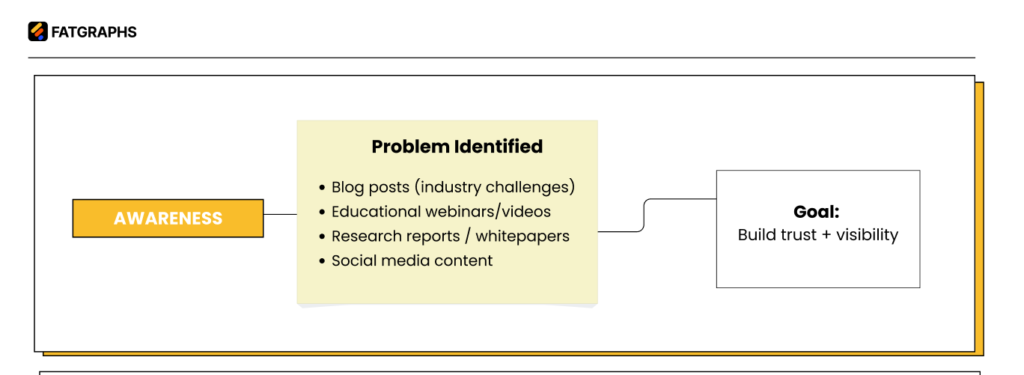
Prospects at the awareness stage know they face a problem but haven’t started looking for solutions. The original phase needs educational content that speaks to their pain points rather than direct product promotion. Brand visibility and trust building are the main goals here. These content types work well at this stage:
- Blog posts that tackle industry challenges
- Educational webinars and videos
- Research reports and white papers
- Social media content that gets people talking
Creating valuable resources helps position your company as a knowledgeable industry leader while subtly introducing your SaaS solution.
2- Consideration stage in the B2B SaaS marketing funnel
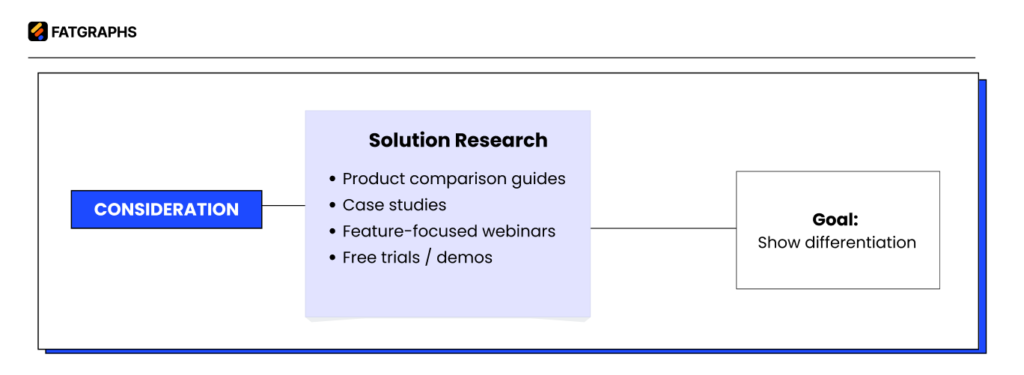
Prospects enter the consideration stage when they start researching solutions actively. They compare different options and evaluate which solution might best solve their problems. Your content should showcase why your solution stands above the rest during this middle-funnel phase. These content types work best:
- Product comparison guides
- Case studies showing real-life results
- Detailed webinars that highlight specific features
- Free trials or product demos
Highlight your unique value proposition and show how your solution tackles the specific challenges identified in the awareness stage.
3- Conversion stage in the B2B SaaS marketing funnel
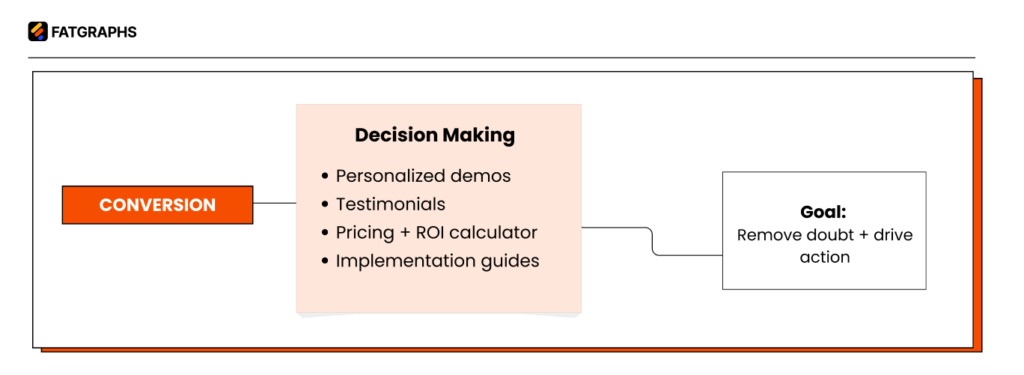
The bottom of your funnel represents the conversion stage, where prospects make their final decision. They evaluate whether your specific solution justifies their investment. Content at this stage should eliminate final doubts and build confidence. These assets work best:
- Customized product demonstrations
- Customer testimonials and success stories
- Detailed pricing information and ROI calculators
- Implementation guides and technical documentation
Offering implementation support or onboarding assistance helps ease transition concerns that might stop conversion. Each stage needs messaging that speaks to your ideal customer’s specific needs while guiding them naturally toward becoming a customer.
Step 3: Build demand at the top of the B2B SaaS marketing funnel
Your funnel stages are mapped out, and now you need to fill the top with high-quality prospects. Budget-friendly lead generation serves as the foundation of your entire B2B SaaS marketing strategy.
1- Using SaaS demand generation to attract qualified traffic
Your brand should be a solution to specific problems; this goes beyond product promotion. A content strategy that lines up with customer pain points identified in your research makes a great starting point. Content that builds awareness should educate your audience first and sell second. You might want to create:
- Articles showcasing expertise on industry challenges
- Practical guides and templates that deliver immediate value
- Industry research and original data to establish your brand authority
Quality matters more than quantity when it comes to attracting visitors who match your ideal customer profile. The right content speaks directly to your defined personas.
2- Channel selection for B2B SaaS lead generation
B2B SaaS companies get varying results from different marketing channels. The best approach targets platforms where your audience actively seeks information rather than spreading resources too thin. Effective B2B SaaS marketing funnel channels typically include:
- Search engine optimization focusing on high-intent keywords
- Paid search campaigns targeting problem-aware prospects
- Industry-specific communities and forums
- LinkedIn for both organic content and targeted advertising
- Strategic collaborations with complementary SaaS providers
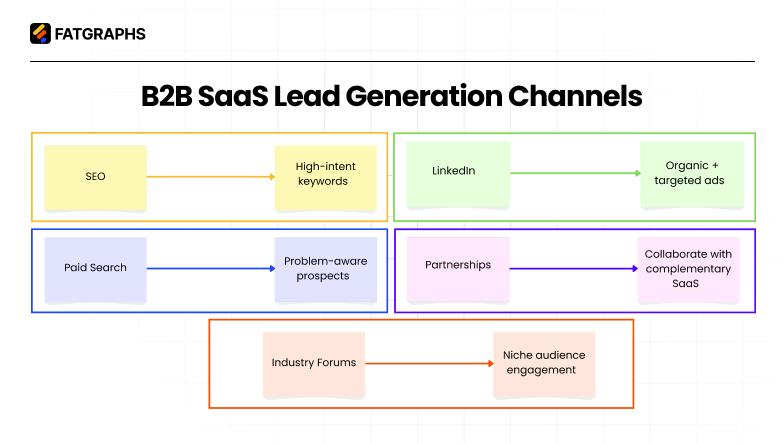
In the B2B SaaS Marketing Funnel, each channel needs clear metrics beyond simple traffic numbers. Engagement signals indicate genuine interest in your solution. The buyer’s mindset differs between platforms; Google searches show different intent than LinkedIn browsing.
Your channel selection should match your customer acquisition cost targets. While some channels provide higher-quality leads, they might cost more per acquisition. The sweet spot balances reach, relevance, and resource investment for your specific SaaS offering.
Step 4: Design a SaaS customer acquisition funnel that converts
Quality prospects in your funnel need a strong strategy to become customers. Your acquisition funnel must have strategic entry points and smart lead nurturing to optimize conversions.
1- Structuring entry points in the SaaS customer acquisition funnel
Great SaaS funnels give prospects multiple ways to enter based on their buying readiness. Each strategic entry point aligns with different awareness levels and purchase intentions.
These entry points work well:
- Ebooks, research reports, and templates that address specific pain points while capturing contact information
- Lightweight versions of your product that solve immediate problems
- Interactive evaluations that help prospects understand their needs while qualifying them
- Product demonstrations for bottom-funnel prospects already researching solutions
Each entry point needs matching follow-up actions. To name just one example, a prospect who downloads a high-level whitepaper needs different nurturing than someone asking for a product demo.
2- Lead qualification and nurturing in the SaaS growth funnel
Prospects entering your funnel need qualification to determine their fit and readiness. A solid qualification process includes:
- Assigning point values to specific actions, like visiting pricing pages or watching product videos
- Evaluating how closely prospects match your ideal customer profile
- Direct questions about budget, authority, needs, and timeline
Qualified leads need customized nurturing sequences that keep them involved throughout their decision experience. Your email sequences should deliver more product-focused content as prospects move deeper into the funnel.
True customization goes beyond using first names. Your content must align with prospect behaviors, role-specific challenges, and show interests. Segment your nurturing flows based on entry points, engagement levels, and specific pain points to work better.
Step 5: Align marketing and sales within the SaaS sales funnel
B2B SaaS marketing funnel growth works best when marketing and sales teams act as unified partners instead of separate entities. The best customer acquisition funnel fails when teams work in isolation.
1- Defining sales-ready leads in the B2B SaaS marketing funnel
Successful marketing-sales alignment needs clear lead qualification criteria as its foundation. Both teams must agree on what makes a prospect “sales-ready” to avoid premature handoffs and missed opportunities.
Teams should develop objective qualification frameworks based on:
- Specific actions suggesting genuine interest, such as pricing page visits or feature comparisons
- How closely do prospects match your ideal customer profile
- Behaviors that show active solution evaluation
- Confirmation of financial capacity to purchase
Marketing and sales teams should develop these criteria together rather than having marketing dictate them alone. Market conditions change, so regular reviews help refine these definitions.
2- Improving handoffs across the SaaS sales funnel stages
You need structured processes for smooth transitions between marketing and sales. Document clear handoff procedures that detail the information moving with each lead.
Sales teams should provide feedback about lead quality through two-way communication channels. Marketing teams need to share details about prospect engagement history and content consumption.
Service level agreements (SLAs) create mutual accountability by setting response times and follow-up expectations. These agreements help measure performance across the entire revenue operation.
Success depends on promoting collaboration through regular cross-team meetings, shared metrics, and unified technology systems. Both teams need visibility into the customer’s entire trip.
Step 6: Measure, optimize, and scale the SaaS growth funnel
Building a great funnel isn’t enough. You need to measure how well it works to keep improving it. The final step shows you how to turn your funnel into a data-driven growth engine.
1- Tracking performance using a SaaS funnel strategy
Successful SaaS companies watch metrics at each funnel stage to find bottlenecks. You should start by setting baseline performance metrics that include:
- Conversion rates between stages
- Customer acquisition cost (CAC)
- Customer lifetime value (LTV)
- Time-to-conversion by segment
The LTV: CAC ratio plays a crucial role. You want to achieve 3:1 or higher for sustainable growth. Looking at engagement metrics like feature adoption rates and NPS scores helps predict retention.
We used funnel visualization tools to see where prospects drop off. This visual approach shows exactly which stages need quick fixes.
2- Executing SaaS funnel optimization for scalable growth
After collecting performance data, you should focus on optimization efforts that give the best results. Start by fixing high-impact conversion points that boost revenue directly.
Run systematic A/B tests on key touchpoints, landing pages, email sequences, and pricing presentations. Document what works to create optimization playbooks.
As you grow, automation becomes more valuable. You can gradually automate lead qualification, personalized outreach, and performance reporting to work efficiently.
In the end, a mature SaaS funnel becomes a predictable revenue machine. You can confidently forecast results from specific inputs. This predictability changes your marketing from guesswork into a strategic growth driver.
Conclusion
Your funnel’s success substantially depends on attracting qualified prospects rather than just generating traffic. You should focus on creating valuable content that addresses specific pain points while you retain control of your brand. The right channels where your ideal customers actively seek information will maximize your marketing investment.
Entry points serve as gateways for prospects at different stages of readiness. Each entry point needs appropriate follow-up actions to nurture leads effectively. This approach keeps prospects involved throughout their decision experience.
Sales and marketing teams that line up create the most overlooked yet critical element of funnel success. Clear qualification criteria and smooth handoff processes ensure prospects get consistent experiences whatever team they work with. Your funnel will underperform without this alignment, even with the best design.
Information drives improvement in your entire funnel. Stage-by-stage metrics help identify bottlenecks, and systematic testing reveals ways to optimize. Your process matures as automation turns manual tasks into flexible systems.
Note that your B2B SaaS marketing funnel exists to create predictable revenue growth. A well-executed funnel transitions from a conceptual framework into a strategic asset. This lets you confidently forecast results based on specific inputs. The predictability separates thriving SaaS companies from those that don’t deal very well with inconsistent growth.
FAQs
Q1. What are the key stages of a B2B SaaS marketing funnel?
A typical B2B SaaS marketing funnel consists of three main stages: awareness, consideration, and conversion. Each stage requires different content and strategies to guide potential customers through their buying journey.
Q2. How can I attract qualified traffic to my SaaS funnel?
To attract qualified traffic, focus on creating valuable content that addresses your target audience’s pain points. Utilize channels like SEO, paid search, industry forums, and LinkedIn. Remember to prioritize quality over quantity by targeting prospects that match your ideal customer profile.
Q3. What are effective entry points for a SaaS customer acquisition funnel?
Effective entry points include high-value content downloads (like ebooks or research reports), free tool access, assessment quizzes, and product demonstrations. Each entry point should be matched with appropriate follow-up actions to nurture leads effectively.
Q4. How can I align marketing and sales teams within the SaaS sales funnel?
Align marketing and sales by establishing clear lead qualification criteria, implementing smooth handoff processes, and creating service level agreements (SLAs). Foster collaboration through regular cross-functional meetings, shared metrics, and unified technology systems that provide visibility into the entire customer journey.
Q5. What key metrics should I track to measure the performance of my SaaS funnel?
Important metrics to track include conversion rates between funnel stages, customer acquisition cost (CAC), customer lifetime value (LTV), and time-to-conversion by segment. Pay special attention to the LTV: CAC ratio, aiming for 3:1 or higher for sustainable growth. Also, monitor engagement metrics like feature adoption rates and NPS scores to predict retention.