
 Book Call with Haroon
You can validate ICP without spending money through direct conversations, selective outreach, and strategic beta testing before you touch an ad budget. Of the 12 pre-launch and early-stage founders I’ve worked with recently, none who validated first regretted the approach, but three who skipped validation burned through their initial marketing budget in 60 days.
Mouad’s experience shows that you can validate ICP without spending money by having structured conversations before investing in marketing.
Mouad from France built geospatial developer tools and thought his ICP was clear: “developers in geospatial and GIS.” Simple, right? When he started reaching out to validate, he discovered this wasn’t an ICP at all; it was a job title. Some GIS developers worked on enterprise mapping systems with six-month procurement cycles. Others built mobile apps needing real-time location data with completely different pain points and buying behaviors.
His validation method was direct outreach to developers in his network. No ads, no landing pages, just Slack messages and email conversations asking three questions: What’s your biggest challenge with current geospatial tools? How do you currently solve this? What would make you switch to something new?
Within two weeks of conversations, Mouad identified two distinct segments. Enterprise developers who needed robust data processing capabilities and indie developers who needed simple, fast integration tools. Same job title, completely different problems and buying processes.
When your ICP sounds like three different businesses
Kevin from the Netherlands built Playtrybe, a platform for collecting actionable experience guides. His stated ICP: “People currently open to play try or be something new to travelers, people searching for specific hobbies, people going on vacation who want to experience someone’s day on their own vacation.”
That’s not an ICP; that’s a demographic study. Kevin realized this when he tried to write copy that would resonate with all three groups simultaneously. You can’t write “Are you tired of generic travel guides?” to someone researching pottery techniques.
His validation approach was content first. He created three different guide collections, one for solo travel in Amsterdam, one for weekend photography projects, and one for beginner rock climbing. Then he shared each in relevant online communities and tracked which generated actual engagement and follow-up questions.
The photography guides got 10x more engagement than travel or climbing content. People weren’t just consuming; they were asking for specific techniques, sharing their own results, requesting more guides. That behavioral difference told Kevin more about his real ICP than any survey could.
When enterprise and SMB look the same on paper
Rudy launched Naviflow for cross-border shipment management. His ICP looked solid: “SMEs shipping more than 50 cross-border shipments per year by sea, air, and land, specifically cargo owners, not their 3rd party shipping providers.”
The 50 shipment threshold seemed logical. Anyone shipping less wouldn’t need software. Anyone shipping would value efficiency. But when Rudy started direct outbound conversations, he found that companies shipping 51 times per year operated completely differently than companies shipping 500 times per year.
The 51-shipment companies were still manual, still relationship-driven, still resistant to new software. They viewed each shipment as a custom project. The 500-shipment companies had dedicated operations staff, existing software they were frustrated with, and clear ROI expectations.
Rudy’s validation method was cold outbound with different value propositions. Half his outreach emphasized “simple implementation, barely requires training.” The other half emphasized, “unify operations, keep documents in sync.” The second message got 4x more responses from companies with high shipment volumes.
The Zero Budget Validation Framework
The Zero Budget ICP Validation Framework is a systematic approach to helping founders validate ICP without spending money before investing in advertising. It works by exposing your value proposition to real prospects and measuring engagement, not impressions. Apply to testing three distinct validation channels: direct outreach, content testing, and selective beta access.
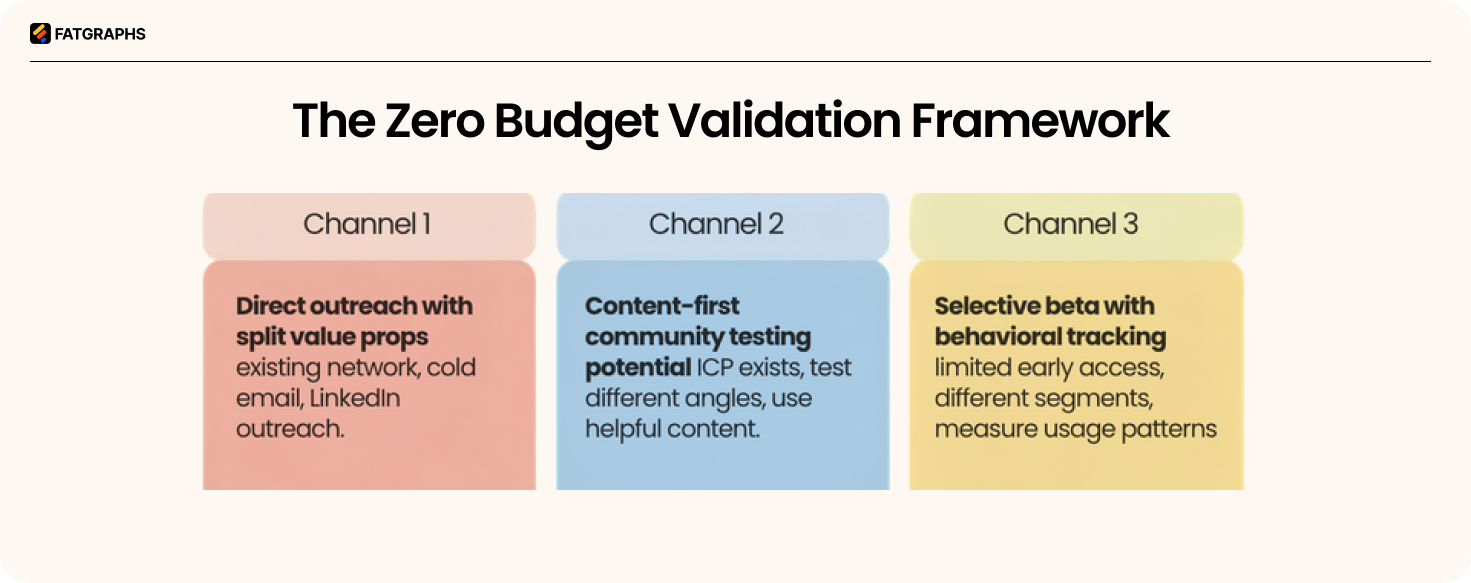
Channel 1: Direct outreach with split value props
Start with your existing network, cold email, or LinkedIn outreach. Don’t pitch your product; test your understanding of their problem.
Jakub built an AI debugging platform for developers. Instead of asking, “Would you use our AI bug detection tool?” he split-tested two problem statements:
Version A: “How much time do you spend reproducing bugs that users report?”
Version B: “How frustrating is it when you can’t reproduce a bug a user reported?”
Version A generated specific time estimates and workflow explanations. Version B generated emotional responses but no actionable data. The difference told him his ICP cared more about time savings than frustration reduction, crucial for positioning later.
Channel 2: Content-first community testing
Find where your potential ICP already gathers online and test different angles of your value proposition through helpful content.
Dialectical offers cybersecurity certifications to UK small businesses. Rather than guessing which pain points mattered, he posted different types of content in UK business forums:
“Why cyber insurance requires Cyber Essentials certification”
“How to avoid failing your first Cyber Essentials assessment”
“Cyber Essentials vs ISO 27001: which is right for small businesses”
The second post generated 3x more comments and direct messages. Small business owners weren’t worried about insurance requirements or comparing standards; they were terrified of failing an assessment and looking incompetent.
Channel 3: Selective beta with behavioral tracking
Offer limited early access to different segments and measure actual usage patterns, not signup rates.
Melissa built BookBackr for indie authors. Her stated ICP was “indie authors”, but she suspected romance authors might behave differently than sci-fi authors, self-published authors differently than traditionally published authors.
She offered beta access to 20 authors across four categories and tracked three metrics: profile completion rate, content upload frequency, and reader engagement with their content. Romance authors had 85% profile completion rates and uploaded 2x per week. Sci-Fi authors had 60% completion rates and uploaded monthly.
The behavioral data revealed that romance authors treated the platform like a business tool while sci-fi authors treated it like a hobby project. Same demographic label, completely different engagement patterns and willingness to pay.
If you’re trying to validate ICP without spending money, direct outreach and behavioral observation often produce better insights than surveys.
When you’re bootstrapping with zero marketing budget
Savvysc built a Texas lottery analysis tool with “minimal cash, bootstrapping.” His ICP was lottery players spending $40+ monthly on scratch tickets. The challenge: How do you reach people whose hobby involves gas station impulse purchases?
His zero-budget approach was location-based validation. He spent two weeks visiting high-traffic convenience stores during peak lottery times (Friday afternoons, Monday mornings after big drawings) and observed purchasing behavior.
He discovered that regular $40+ players fell into two distinct groups: systematic players who tracked their purchases and results, and intuitive players who bought based on “gut feelings” about which games looked lucky.
The systematic players were his real ICP. They already tracked data manually, understood concepts like odds and probability, and expressed frustration with not having better information. The intuitive players weren’t interested in data analysis; they played for the emotional experience.
This observation-based validation cost zero dollars and provided insights no online survey could capture.
When you’re expanding to a new market
Ali had an established AI call agent business in Germany but needed to validate their ICP for the US market. Their German success was with hotel booking software companies, but American hotel software might work completely differently.
This approach helped Ali validate ICP without spending money before committing resources to the US market.
Instead of assuming the same ICP would work, they used the LinkedIn learning approach. They spent 30 days commenting thoughtfully on posts from US hotel software founders, asking genuine questions about their integration challenges.
This wasn’t pitching; it was market research disguised as networking. They learned that US hotel software founders worried more about compliance and data privacy than German founders worried about efficiency and automation. Same product category, different primary concerns.
When your product solves multiple problems
Hoon built OddClover for sports betting analytics. He identified arbitrage opportunities and high-value bets two different value propositions for potentially different customer types.
Rather than surveying people about their betting preferences, he created two different Twitter accounts. One shared arbitrage opportunity with detailed explanations of guaranteed profit. Another shared high-value bet analysis with risk/reward breakdowns.
The arbitrage account attracted followers who engaged with every post, asked technical questions, and shared their own findings. The high-value bet account got more followers, but minimal engagement; people consumed but didn’t participate.
The behavioral difference revealed that arbitrage players were his real ICP. They were already analytically minded, understood the concepts, and actively sought more information. High-value bet players wanted entertainment, not tools.
Bottom Line
You can validate ICP without spending money through four zero-budget channels: direct outreach, content-first community testing, selective beta programs, and access to track actual usage behavior. Of 12 founders who validated before spending, the ones who discovered their initial ICP was wrong saved an average of $3,000 in mistargeted ad spend. The validation process takes 24 weeks but prevents months of marketing to the wrong audience. Start with your existing network, test different value propositions, and measure behavior rather than opinions.
Common Questions
How long should I spend validating my ICP before starting paid marketing?
Two to four weeks of active validation gives you enough data points to avoid major targeting mistakes. Mouad spent two weeks on direct outreach and discovered his ICP was actually two distinct segments. Kevin spent three weeks testing content in different communities and found photography guides generated 10x more engagement than travel content.
What if I can’t find my ICP in online communities or through cold outreach?
Use location-based observation or network-adjacent targeting. Savvysc couldn’t find lottery players in online communities, so he observed purchasing behavior at convenience stores. Ali couldn’t directly reach US hotel software founders, so he engaged with them on LinkedIn first to understand their concerns before pitching.
How do I know if my validation results are accurate or just lucky?
Test across multiple channels and look for consistent behavioral patterns, not just positive responses. Jakub tested two problem statements and got different types of responses. Hoon610 created two Twitter accounts and measured engagement patterns. Consistent behavior across different validation methods indicates real market fit.
Should I validate existing customers or new prospects?
New prospects for early-stage validation, existing customers for refinement. If you’re pre-launch, like most of these founders, you need to validate that prospects actually experience the problems you think they do. Retail ABC had existing auction clients but needed to validate marketing approaches for new seller acquisition.
What’s the minimum number of conversations needed to validate an ICP?
1520 direct conversations per segment you’re testing. Melissa tested with 20 authors across four categories and found clear behavioral differences between romance and sci-fi authors. Fewer than 15 conversations per segment gives you anecdotal data, not validation patterns.